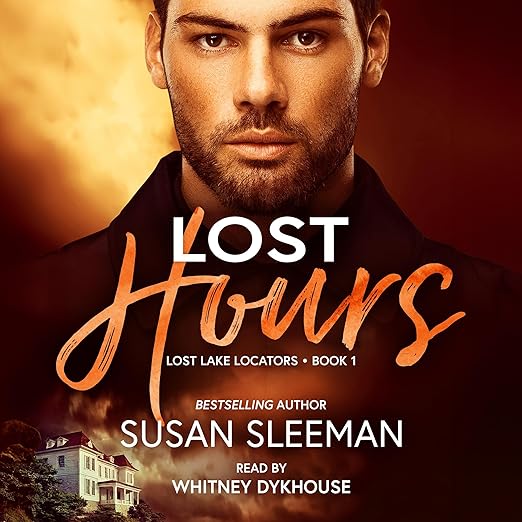
Quick Take
- Narration: Whitney Dykhouse brings consistent warmth to the Christian romantic suspense tone, handling both the investigative sequences and the romance threads with appropriate emotional calibration.
- Themes: forgiveness as the hardest form of justice, trust rebuilt between people who hurt each other, community under threat from inside
- Mood: Propulsive and intimate — the mystery and the romance pull in the same direction
- Verdict: A confident series launch that delivers tightly constructed mystery alongside its romance, particularly strong for readers who like their suspense grounded in forensic detail.
Susan Sleeman is one of those writers who has built a substantial and genuinely loyal readership while remaining largely invisible outside the Christian fiction ecosystem. Lost Hours, the first book in her Lost Lake Locators series, is a useful introduction to why that readership trusts her. She writes with a specific professional confidence — an understanding of how forensic investigation actually works, how people in tight-knit communities protect each other and simultaneously lie to each other, and how romantic tension survives and even deepens under the intrusion of real danger — that takes years to develop and is on full display here.
The setup is genuinely clever. Nolan Orr and his team, the Lost Lake Locators, receive what appears to be an invitation to a game night at a secluded mansion on Lost Island. The friends involved are described as more like family to Nolan than his actual family, and he accepts. When someone is murdered, the game-night framing transforms from charming into something considerably darker — every person in that room becomes a suspect, and the social bonds that defined this particular group of people start showing their fractures under the pressure of investigation.
The Murder Mystery Mechanism: Closed Room, Open Wounds
The closed-environment murder mystery is one of the oldest structures in crime fiction, and Sleeman uses it with clear awareness of the tradition she is working within. What she adds that distinguishes Lost Hours from a more conventional treatment is the forensic specificity that one reviewer accurately described as filling the book with investigative details about DNA evidence collection and many other techniques and procedures. Sleeman has clearly done substantial research, and the mystery’s solution depends on the reader following the procedural logic rather than on a convenient emotional confession or authorial sleight of hand. That is a harder trick to pull off than it sounds, and it is one of the things that makes the book’s climax feel genuinely earned.
Sheriff Mina Park’s arrival to take charge of the investigation is where the romance thread enters, and Sleeman handles the collision of professional and personal history with real efficiency. The summer fling that ended badly is a familiar setup in the genre, but the specific context here — Mina arriving in an official capacity to investigate a room full of people who constitute Nolan’s entire support network — creates friction that goes beyond the usual will-they-won’t-they dynamic. Nolan needs Mina to trust him enough to work with him as a civilian resource. Mina needs Nolan to stay inside his lane and not compromise her investigation. The mystery and the romance are genuinely pulling on each other rather than running in separate lanes.
The Found-Family Stakes That Drive the Resolution
What distinguishes Lost Hours from many entries in the Christian romantic suspense category is that the found-family stakes are not decorative. When the murder occurs within a group that represents Nolan’s actual emotional support network, the investigation cannot be conducted from professional distance. Every interview, every piece of evidence, every emerging suspect is someone who matters to him, which means the investigation is simultaneously a process of gathering facts and a process of confronting the possibility that someone he loves has done something unforgivable. Sleeman structures the book so that this personal cost is present throughout rather than arriving only at the climax, and that sustained pressure on Nolan’s emotional resources gives the book its particular weight.
The Theme Beneath the Plot and Dykhouse’s Narration
One reviewer observed that Sleeman’s thematic preoccupation in Lost Hours is unforgiveness — a wrong committed, held onto, nursed into a festering grudge that eventually produces the murder at the book’s center. That reading is accurate and worth noting because it elevates the mystery above a simple whodunit exercise. The theology is embedded in the plot structure rather than delivered as a sermon, which is the right way to handle faith themes in genre fiction. Whitney Dykhouse understands this balance and maintains it across the full nine hours and thirty-four minutes, keeping the emotional temperature consistent across both the forensic sequences and the personal scenes between Nolan and Mina. She has narrated previous Sleeman series, and the accumulated familiarity with the author’s style shows in a performance that feels settled and certain from the first chapter.
Frequently Asked Questions
Is Lost Hours the first book in the series, and where does it fall in Susan Sleeman’s broader catalog?
Lost Hours is book one of the Lost Lake Locators series. Sleeman has previously written several other series, and some familiar characters from those earlier works appear here. New readers can start without any prior Sleeman knowledge, but fans of her earlier series will recognize the returning characters and appreciate the continuity.
How strong is the Christian faith element — is it woven into the story or does it feel didactic?
The faith element is thematic rather than didactic. The book’s preoccupation with forgiveness and its absence runs through both the mystery and the romance without being delivered as a sermon. Characters reflect on faith naturally within the narrative rather than stopping the story to make spiritual arguments. This approach is consistent with Sleeman’s previous series.
Does the romance subplot resolve within this book, or is it a slow-burn across the series?
The romance between Nolan and Mina develops meaningfully within Lost Hours and reaches a satisfying emotional resolution appropriate to a first book in a series. The arc does not conclude completely — subsequent books will presumably continue these characters — but readers who need romantic closure within a single volume will not finish this book frustrated.
Whitney Dykhouse has narrated other Sleeman series — does familiarity with those books help with this one?
It helps in the sense that Dykhouse’s interpretive choices for Sleeman’s style are already calibrated, and listeners who have heard her previous Sleeman work will find the performance immediately comfortable. It is not required, however — Lost Hours introduces its world and characters clearly enough that new listeners can orient themselves without prior context.