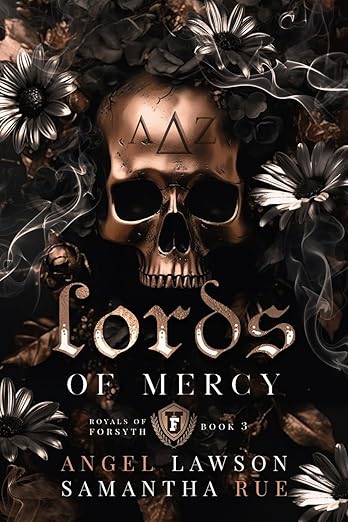
I came to Lords of Mercy knowing the broad contours of the bully romance subgenre and expecting something that leaned heavily on its darker elements as the primary draw. What I found was more interesting than that, a book that takes the premise seriously enough to work through what it would actually cost to build trust with people who have used cruelty as a form of control. Angel Lawson is doing something specific in the Forsyth University series, and that something is the structural work of demonstrating how loyalty and vulnerability can emerge from an adversarial beginning without minimizing the adversarial part.
Bridget Bordeaux narrates a nearly eighteen-hour audiobook, and the cast she has to carry is complex: the heroine returning to Forsyth on her own terms, three Lords who have moved from tormentors to reluctant allies, and a web of external threats that makes the internal drama of trust-building more urgent than it would be in a purely domestic story. Bordeaux gives the heroine a voice that is defiant without being uniformly hard, the emotional shifts as the relationships change are legible in the narration rather than requiring the listener to infer them from context alone.
How Lords of Mercy Holds Up
The synopsis locates this as the second major act in the heroine's story at Forsyth. She has taken her revenge, the terms make this clear, and now lives under the Lords' roof under her own conditions: no rules, no punishments, no surveillance, no uninvited intrusions. What she is offering in return is a chance. That negotiated starting point is what makes this installment more interesting than a simpler enemies-to-lovers progression. The relationship is not softening from cruelty because the heroine has decided to forgive. It is being rebuilt from a position of her choosing, on terms she set, which makes her agency structural rather than rhetorical.
The plot introduces a murder investigation, a stalker, and a traitor within the inner circle, which serves to accelerate the timeline on trust-building in a way that feels organically motivated rather than contrived. When the external threat is real, the question of whether Killian, Dimitri, and Tristian can actually be trusted, not just tolerated, becomes an immediate practical matter rather than an abstract relational one. Lawson uses the thriller scaffolding to force the relationship questions into the foreground.
Why Lords of Mercy Works as an Audiobook
Because the book is genuinely interested in the mechanics of the thing it is describing. Dark romance as a genre has attracted legitimate criticism for presenting the behaviors of its heroes without sufficient examination of the power structures that make those behaviors possible and harmful. Lawson does not sanitize what the Lords did in the first installment, and she does not let the heroine's return function as forgiveness or redemption without work. The conditions she negotiates at the start of Lords of Mercy are specific precisely because vague goodwill is not enough and both the characters and the reader know it.
The length, over eighteen hours, gives the relationship arc room to develop without the abrupt emotional pivots that shorter dark romance can be prone to. The slow accumulation of trust is the point, and the runtime allows Lawson to place small moments of genuine care and loyalty within a larger context of wariness that makes them meaningful rather than simply reassuring.
Weak Spots in Lords of Mercy
This is the second entry in a series, and readers who have not read the first Forsyth University novel will miss substantial context for who these characters are and what happened between them previously. The synopsis assumes knowledge of the prior events, and the emotional weight of the trust-building arc is significantly lighter without understanding the history it is trying to repair. Starting here without the first book is possible but not recommended.
The dark romance content is present throughout and includes the power dynamics and difficult interpersonal history that define the subgenre. Readers who are sensitive to those elements even when handled with relative care should know they are engaging with material that takes the darkness in dark romance seriously rather than treating it as a mere aesthetic flavor.
The Right Listener for Lords of Mercy
Readers already in the Forsyth University series who are ready for the second major act of this central relationship. Dark romance listeners who want a longer, more structurally ambitious entry in the subgenre rather than a shorter, simpler version of the formula will find Lords of Mercy a satisfying commitment. Bridget Bordeaux's narration makes the eighteen hours move well for listeners who enjoy audio romance. Those new to the series should start with the first Forsyth novel before picking this up.