Quick Take
- Narration: Maxwell Glick handles Haruka’s chaotic internal monologue and the large supporting cast with genuine comic timing, his performance is a significant part of why the humor lands.
- Themes: Neurodivergent thinking as hidden superpower, dungeon politics and royal intrigue, the isekai loner archetype taken to its logical extreme
- Mood: Comedic and fast-moving, with occasional genuine tension in the dungeon sequences
- Verdict: Essential for fans of the series; volume 4 expands the stakes with a royal antagonist and an invincible dungeon king while keeping Haruka’s rambling genius intact.
I’ll be direct: Loner Life in Another World is not the series you come to if you want tight, purposeful plotting. You come to it because Shoji Goji has done something genuinely unusual with a premise, isekai hero transported to a fantasy world, that the light novel market has used to the point of parody. He’s made the protagonist interesting through specificity rather than through raw power levels, and by the fourth volume that specificity has accumulated into something with real texture.
Haruka is, as one reviewer accurately notes, on the ADHD spectrum. In Japan, his associative, non-linear thinking made him invisible and misread. In the fantasy world, his ability to link apparently unrelated facts and synthesize approaches that normative thinkers would never reach is what makes him formidable. His classmates can’t follow his reasoning. They also can’t argue with his results.
Our Take on Loner Life in Another World, Vol. 4
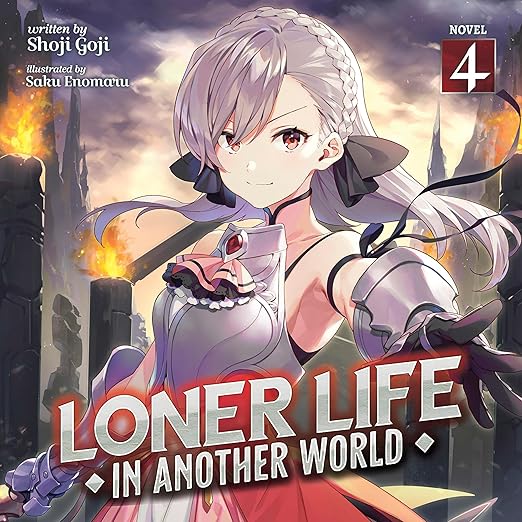
This volume opens with the frontier saved from Nallogi’s advances but immediately raises the stakes in two directions. Haruka and his classmates go deeper into the dungeons around Omui and encounter a dungeon king powerful enough to challenge Angelica, the strongest fighter in their orbit, which is saying something. Simultaneously, the kingdom itself moves against the frontier, sending a mysterious royal agent whose motives are unclear. The dual-threat structure gives volume 4 more formal narrative tension than previous entries while still leaving plenty of room for Haruka’s trademark internal tangents and comedic misdirection.
The dungeon sequences are where Goji’s plotting is most efficient. The dungeon king confrontation has genuine escalation and creative resolution, Haruka’s solution to an invincible opponent is, predictably, lateral rather than direct, and satisfying for exactly that reason. The royal intrigue thread is slower and more setup-heavy, clearly positioning pieces for future volumes rather than resolving in a standalone way.
Why Listen to Loner Life in Another World, Vol. 4
Maxwell Glick’s narration is a real asset to this series. Haruka’s voice is the challenge, he thinks in digressive bursts that could easily become exhausting or irritating under an inexperienced narrator. Glick makes the ramblings entertaining because he commits to the comic rhythm fully without pushing the humor so broadly that it becomes grating. His handling of the female supporting cast is carefully differentiated without caricature.
At nearly ten hours, this is also the longest volume yet, and Goji uses the additional space to flesh out secondary characters who had been relatively thin in earlier installments. The classmates begin to feel like an actual ensemble rather than a collection of reaction functions to Haruka’s chaos. That development makes the group dynamics more interesting and gives the dungeon sequences a clearer sense of stakes.
What to Watch For in Loner Life in Another World, Vol. 4
The female cast’s treatment of Haruka continues to be the element of the series that divides readers most sharply. The pattern of the female classmates imposing on Haruka financially and otherwise continues without resolution. Whether this reads as humorous or frustrating depends entirely on your tolerance for that particular genre convention, the isekai male lead as target of constant imposition. It’s a tension Goji hasn’t resolved in four volumes, and some readers feel it getting worse rather than better.
New listeners cannot start here. Volume 4 assumes familiarity with the established world, the classmates, Angelica, and Haruka’s accumulated abilities. Jumping in at book four would mean entering a story mid-stream with no footing.
Who Should Listen to Loner Life in Another World, Vol. 4
Existing fans of the series who have followed Haruka through three previous volumes. This entry expands the scope and delivers the escalating dungeon confrontation the setup has been building toward. Newcomers to isekai light novels who enjoy comedy-forward series with a genuinely atypical protagonist would do well to start at volume one and work forward. Listeners who find the male-as-hapless-target-of-female-demands dynamic irritating in other isekai should know it’s present and unresolved here.
Frequently Asked Questions
Can I start the series at volume 4, or do I need to begin at book 1?
You need to start at book 1. Volume 4 builds on three books of established relationships, world details, and Haruka’s accumulated skills. Starting here would mean missing the context that makes the current conflicts meaningful and the character dynamics comprehensible.
How does Maxwell Glick handle Haruka’s distinctive internal monologue style?
Well. Haruka thinks in digressive, associative bursts that could easily become tiresome, but Glick commits to the comic rhythm fully without pushing the humor into caricature. His timing is what makes the rambling feel entertaining rather than exhausting.
Is this volume suitable for readers new to isekai as a genre?
It’s accessible as a genre introduction in terms of premise, but the series-specific context makes this specific volume a poor entry point. Those drawn to comedy-forward isekai with an unusual protagonist should start at volume 1.
How does the female cast’s dynamic with Haruka evolve in this volume?
Some reviewers find it worsening, the pattern of the female classmates imposing on Haruka financially and otherwise continues without resolution. Others accept it as genre convention. Goji has not addressed this tension structurally in four volumes, and it remains the most divisive ongoing element of the series.