Quick Take
- Narration: Jennifer Lim brings measured precision to Ng’s ensemble cast, distinguishing voices cleanly across a large set of characters.
- Themes: the myth of controlled perfection, the ethics of motherhood and identity, race and belonging in suburban America
- Mood: Slow-burning and layered, with a quality of dread beneath the surface calm
- Verdict: One of the stronger literary fiction audiobooks of recent years, Ng’s character construction and structural control reward attentive listening.
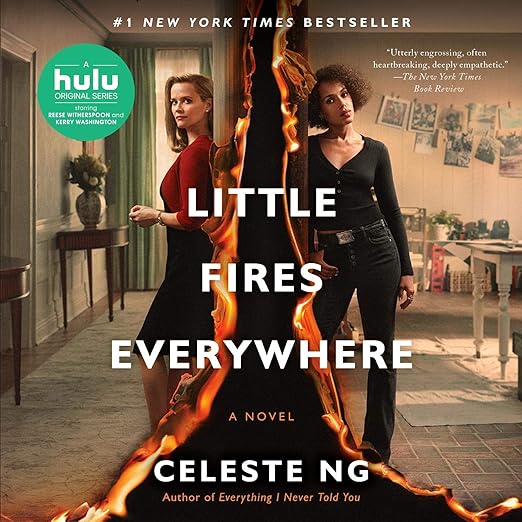
I first read Little Fires Everywhere in print and came back to it in audio form during a long drive through the kind of planned suburban landscape that could almost be Shaker Heights, wide roads, color-coordinated houses, the faint sense that someone, somewhere, has decided exactly how everything should look. Celeste Ng’s Shaker Heights is real, by the way. It exists in Ohio with its actual rules about house colors and trash placement. That specificity is part of what makes the novel work so well as a study of the gap between a community’s self-image and its lived reality.
The setup is deceptively simple. Elena Richardson, organized, principled, absolutely certain she is one of the good people, rents a house to Mia Warren, an artist and single mother who has spent years moving from place to place with her daughter Pearl. Pearl falls into orbit with the Richardson children. Secrets accumulate. When a Chinese-American baby at the center of a custody battle divides the town, Mia and Elena end up on opposite sides, and Elena begins investigating Mia’s past with the kind of obsessive certainty that believes it is righteousness.
Our Take on How Ng Constructs Character
What Ng does exceptionally well, and what Jennifer Lim’s narration helps to surface, is the interiority of characters who are all, to varying degrees, both right and wrong about each other. Elena is easy to read as a villain, controlling, class-conscious, racially oblivious in the specific way of people who believe themselves progressive. But Ng keeps disrupting that easy reading. Elena’s certainties come from somewhere comprehensible. Mia’s freedom and her willingness to upend lives also comes at real cost. The novel refuses the simple moral alignment its surface plot seems to promise, and that refusal is where Ng’s literary sensibility lives.
Lim’s narration is technically accomplished. She keeps the Richardson children, four of them, all distinct in personality, differentiated without resorting to caricature, and her handling of Mia is particularly effective: a contained, slightly opaque quality that mirrors how the character is perceived by the people around her. One reviewer described the novel’s characters as intricate, rich and wholly vivid, and the narration does justice to that construction.
Why Listen to Little Fires Everywhere in Audio Specifically
The novel is built on dramatic irony, we know the house burned at the very beginning, and the story works backward and forward from that knowledge. Audio works particularly well with this structure because the pacing is controlled for you. In print, a reader can rush ahead toward the explanation. In audio, you sit inside each scene as Ng intended, and the slow accumulation of detail in what reads like a domestic realist novel gradually reveals itself as a psychological pressure cooker. The Shaker Heights setting, its actual ordinances, its self-conscious progressivism, its 1990s Clinton-era context, becomes more atmospheric when you cannot skip ahead.
At eleven hours and twenty-seven minutes, the runtime is appropriate for a novel with this many characters and this much subterranean movement. Listeners who prefer fast plot mechanics may chafe at the deliberate pace in the middle sections. Those who read for character and theme will find the time well spent.
What to Watch For in the Custody Battle Narrative
The subplot involving the Chinese-American baby and the custody battle that divides Shaker Heights is the book’s most politically charged element, and it is also the most carefully constructed. Ng, herself a Chinese-American author writing about Chinese-American identity in a white suburban context, does not stack the deck in one direction. The family seeking to adopt the baby are not villains. The birth mother’s situation is not simple. The town’s response, including which side Elena and Mia take, and why, reveals more about each character than any direct confrontation could. It is genuinely sophisticated social fiction.
Who Should Listen to Little Fires Everywhere
Readers who enjoy literary fiction with social stakes and character complexity will get the most from this audiobook. It rewards listeners who are content to let a story breathe and who do not need a thriller’s pace to stay engaged. Those who have already watched the Hulu series adaptation with Reese Witherspoon and Kerry Washington should know that the show diverges meaningfully from the novel, the book is worth experiencing on its own terms. Listeners who prefer linear plots with resolved conclusions should know that Ng’s ending is deliberately ambiguous in certain respects.
Frequently Asked Questions
Is Little Fires Everywhere significantly different from the Hulu TV series?
Yes, in meaningful ways. The show expands the racial identities of some characters and adds storylines not in the novel. The book is set entirely in the 1990s and has a different tonal register. Both versions have merit, but they are distinct experiences.
Does Jennifer Lim differentiate the large cast of characters effectively in her narration?
Yes. With four Richardson children plus Mia and Pearl and supporting adults, the character management is demanding, and Lim handles it with clean vocal differentiation without resorting to exaggerated character voices.
Is the custody battle subplot easy to follow in audio form, given how many perspectives Ng presents?
Yes. Ng structures each perspective clearly, and the audio pacing actually helps listeners sit with each point of view before moving to the next. The subplot is one of the stronger elements of the audiobook experience.
At 11 hours and 27 minutes, does Little Fires Everywhere sustain its pace throughout?
Mostly. The early and late sections are the strongest. Some listeners find the middle third slightly slower as Ng builds the pressure that the later chapters release. Those comfortable with literary pacing will not find it a problem.