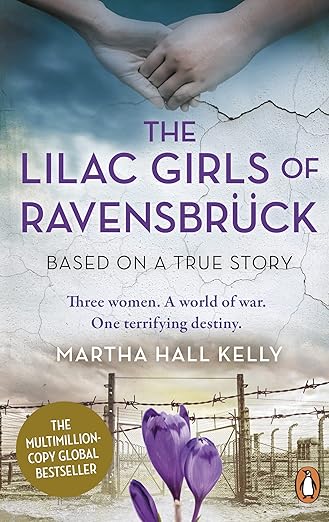
Quick Take
- Narration: Cassandra Campbell handles the three-strand structure with care, giving each woman a distinct vocal register and sustaining the emotional weight across seventeen-plus hours.
- Themes: Women’s survival under war, moral complicity, justice and memory
- Mood: Harrowing and intimate, with moments of unexpected tenderness
- Verdict: A meticulously researched historical novel that earns its emotional impact through specificity rather than sentiment, best appreciated by readers willing to sit with moral discomfort.
I picked this one up on a recommendation from a colleague who had been researching Ravensbrück for an unrelated project. She said it was the book that had moved her most in a year of reading primary sources, which was the kind of endorsement that makes you stop whatever you are doing. I started it on a Sunday evening and did not want to stop when I finally had to.
Martha Hall Kelly’s Lilac Girls is structured around three women whose lives collide in and around the Nazi concentration camp for women at Ravensbrück. The premise is not new to the genre, but what distinguishes this novel is the ambition of its moral architecture and the sheer density of historical research woven through the narrative.
Our Take on Lilac Girls
Kelly divides her narrative among Caroline Ferriday, a New York socialite working at the French consulate whose real-world model was instrumental in bringing justice to Nazi perpetrators; Kasia Kuzmerick, a young Polish teenager who becomes a resistance courier before being sent to Ravensbrück; and Herta Oberheuser, the German doctor who joins the camp’s medical program and participates in the notorious surgical experiments on prisoners known as the Rabbits. Each woman gets her own voice, her own chapters, and her own moral universe.
The Caroline sections have drawn criticism for pacing, and that critique has some validity. Her chapters spend considerable time on New York social life and a romantic entanglement before the war reshapes everything. A reviewer called it a “long, winding story” that takes too long to reach critical points. I think that misreads Kelly’s intention. Caroline’s pre-war life is the world the war destroys, and the comfort of those scenes makes what follows land harder. But I understand why some listeners find it slow.
Why Listen to Lilac Girls
Cassandra Campbell’s narration is one of the strongest arguments for choosing the audio version. Across seventeen and a half hours, she manages to keep the three narrative strands sonically distinct. Caroline sounds measured and privileged, Kasia sounds young and increasingly hollowed out, and Herta sounds, disturbingly, like a woman who has rationalized herself into someone unrecognizable. Campbell does not overplay the horror. She lets the text do the work, which requires a considerable amount of trust in the material and in the listener.
The Ravensbrück sections are brutal in the way that good historical fiction about this period has to be. Kelly does not soften the surgical experiments, the starvation, the casual violence. She also does not wallow. The balance is careful, and Campbell’s narration holds that balance in the audio version particularly well. You are never allowed to feel like you are watching spectacle. It remains human throughout.
What to Watch For in Lilac Girls
The Herta Oberheuser character is the most interesting and the most unsettling aspect of the novel. Kelly gives her interiority, ambition, even a kind of pathos, and then shows that interiority committing atrocities. It is not a redemption story. Herta does not redeem herself, and Kelly does not ask us to feel sympathy. But she does ask us to understand, which is harder and more valuable. For readers who prefer clear moral categories in their historical fiction, this is worth knowing going in.
The book is long at nearly five hundred pages, and the audio runs seventeen and a half hours. Some stretches in the middle section feel like they could have been compressed. The romantic subplot involving Caroline is the weakest element, and listeners who are primarily interested in the Ravensbrück narrative may find those sections testing their patience. The last third moves with considerably more urgency and pays off the structural work of everything that precedes it.
Who Should Listen to Lilac Girls
Readers who responded to The Tattooist of Auschwitz or The Nightingale will find Kelly’s book at least as accomplished, and in some respects more morally rigorous. The research is exhaustive, rooted in real people and documented events, and the author’s note at the end is worth staying through. Listeners who want WWII historical fiction that does not flinch from complicity will get more from this book than those seeking straightforward heroism and villainy. If you are approaching this as background listening for commutes, give it more attention than that. The three-strand structure rewards active engagement.
Frequently Asked Questions
Is this based on real people and events, or is it purely fictional?
It is grounded in real people and events. Caroline Ferriday was a real New York socialite who campaigned for justice for the Ravensbrück survivors known as the Rabbits. Herta Oberheuser was a real Nazi doctor. The Kasia character is fictional, though her experiences are based on documented survivor accounts.
How does Cassandra Campbell handle the three-narrator structure across such a long audiobook?
Very well. She differentiates the three women vocally in ways that help listeners track which story thread they are in, and she maintains consistent characterization across the full seventeen-plus hours. Her restraint in the horror sequences is particularly effective.
Is the pacing really as slow as some reviewers suggest?
The first third, particularly the Caroline sections set in pre-war New York, moves deliberately. Kelly is establishing the world that the war will dismantle. Listeners who want to get to the camp narrative quickly may feel some impatience. The second half moves with considerably more momentum.
Does the novel include both American and European settings?
Yes. The narrative crosses New York, Paris, Germany, and Poland. Caroline’s story is largely American and French, Kasia’s is Polish and eventually German, and Herta’s is primarily within the Nazi medical establishment. The structural geography mirrors the moral distances between the characters.