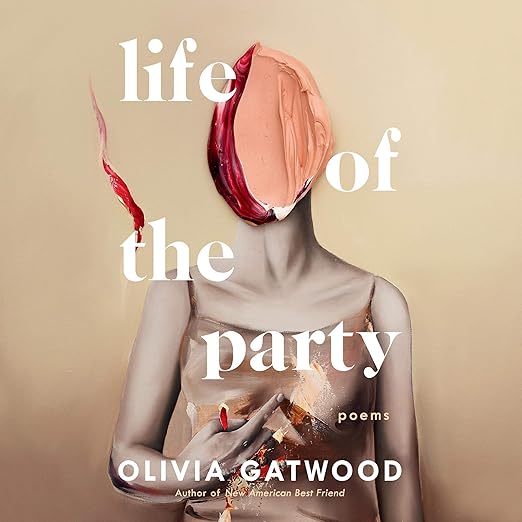
Quick Take
- Narration: Olivia Gatwood reading her own poems is the only version of this collection that makes full sense; her spoken-word background gives the audio a quality the text alone cannot replicate.
- Themes: Growing up female in a culture saturated with violence against women, the blurred line between real fear and imagined threat, the body as both subject and object
- Mood: Blistering and tender in alternation, the experience of reading someone who is furious about the right things and precise about why
- Verdict: For a poetry collection narrated by the poet, this is the format it was built for; Gatwood’s spoken-word origins mean the audio is not simply a supplement to the text but the primary experience.
I was familiar with Olivia Gatwood’s work before I listened to Life of the Party, having encountered her video performances through the usual channels, a late-night internet rabbit hole, a friend’s recommendation, the way writers find each other online. I thought I knew what I was getting. I was wrong about the scale of it. At two and a half hours, this is a short audiobook, but I sat with it for an entire afternoon because I kept stopping to stay with individual poems after they ended.
Gatwood’s debut collection, published in 2019 through Random House, arrives with a specific cultural argument: that girlhood in contemporary American culture is inseparable from a consciousness of violence. Not the experience of violence, necessarily, though some of these poems document that too, but the ambient awareness of it as a constant possibility that shapes every decision a young woman makes. The poem Girl, quoted in the synopsis, puts it directly: I wanna be all the girls I’ve ever loved. That desire to be multiple things simultaneously, to inhabit all the versions of femininity the culture demands, is the collection’s emotional engine.
Our Take on Life of the Party
The collection investigates what Gatwood calls our culture’s romanticization of violence against women, and she pursues that investigation in two registers. There are poems that are blistering, direct, riotous with controlled anger. And there are poems that are tender, almost elegiac, about friendship and the specific texture of female adolescence before the violence intrudes. Both registers are necessary to each other: the tenderness gives the anger its stakes, and the anger gives the tenderness its weight.
What keeps Life of the Party from becoming polemic is Gatwood’s precision with the physical and psychological specific. She doesn’t write about women in general suffering under patriarchy in general. She writes about particular rooms, particular towns, particular nights, particular bodies. The details are so accurate that reviewers have consistently described the collection as feeling like a real depiction of girlhood, not an artistic construction of one. That concreteness is harder to achieve than it looks, and it’s what makes the poems last beyond the reading.
Actress Madeline Brewer, in the collection’s promotional material, described spending so much time with the book that its spine was already breaking before she shared it, and finding the content enlightening, inspiring, igniting, and frightening in the same breath. That combination is exactly right. These are poems that don’t let you settle into one response. Just when you find a comfortable position, Gatwood shifts register and asks you to hold something harder.
Why Listen to Life of the Party
Gatwood’s spoken-word background makes this one of the clearest cases I’ve encountered for the audio format as the primary rather than supplementary way to experience a poetry collection. She has millions of followers for her video performances specifically because the way she reads is integral to how the poems mean what they mean. Her timing, the pauses before a line that lands differently than you expected, the moments where she accelerates and the moments where she slows down: these are not decorative. They are the poem completing itself in performance.
Random House Audio’s production captures this well. The recording is clean and close, with a presence that puts Gatwood in the room rather than at a podium. For a collection this intimate, that proximity is exactly right. Some poetry collections suffer in audio because the visual arrangement of words on the page is part of the meaning; Gatwood’s poems are relatively free of that dependency, built for the ear rather than the eye.
At two and a half hours, the collection is short in absolute terms but demands more of a listener than its runtime suggests. These are not casual listening poems. Gatwood is precise about difficult material, and the effect accumulates across the collection in ways that require real attention to register. Listeners who give it that attention will find themselves at the end with the sensation, as one reviewer described it, of having sat with it long after closing, which in audio means long after the final poem ends.
What to Watch For in Life of the Party
The collection’s engagement with true crime and the media’s treatment of female victims is among its most politically charged threads. Gatwood is interested in how a culture that romanticizes violence against women trains women to navigate their own potential victimhood, to model scenarios, to read environments, to calculate risk in ways that men in the same environments generally don’t have to. These poems are not comfortable, and they’re not intended to be.
The friendship poems are the collection’s quietest achievement. The way Gatwood writes about female friendship as both refuge and mirror, about the specific intimacy of teenage girls who understand each other’s fear without having to articulate it, is where the collection’s emotional intelligence is most concentrated. Listen to the transition between the more politically charged poems and these quieter ones; the shift tells you something important about how the collection is structured as an argument.
Listeners who are not poetry readers by habit should know that Life of the Party is accessible by the standards of contemporary poetry. Gatwood writes in spoken language, not in the compressed, allusion-heavy style that puts many casual readers off. The poems are rhythmically alive and immediately comprehensible on first hearing, while earning re-listening for the details you missed. One reviewer noted that you don’t have to be a poetry fan to devour this book, and that’s accurate, with the caveat that active, attentive listening is required.
Who Should Listen to Life of the Party
Listeners who have encountered Gatwood’s spoken-word videos and want the full collection in the format it was built for will find this everything they hoped. The audio is not a pale copy of what’s in print; it’s closer to the definitive version of the work.
Readers who want to encounter contemporary feminist poetry and don’t know where to start will find Life of the Party both accessible and substantive. Gatwood doesn’t sacrifice rigor for accessibility; the collection earns its political positions through the quality of its imagery and argument, not through volume. Those who find politically charged art uncomfortable regardless of its craft should be prepared for a collection that is explicitly interested in making discomfort productive. The poems are worth the discomfort. Gatwood is, as Jamie Loftus put it in the collection’s advance praise, writing about the women who were forgotten and the men who got off too easy with an effortlessness and empathy and anger that is genuinely rare.
Frequently Asked Questions
Is the audio version of Life of the Party significantly different from reading the poems on the page?
Yes, in ways that matter. Gatwood has a spoken-word background and her video performances have millions of followers specifically because of how she reads. Her timing, pacing, and the way she inhabits the lines are constitutive of the poems rather than supplementary to them. The audio version is closer to the primary experience of this collection than the text alone.
At two and a half hours, does the collection feel complete or does it leave you wanting significantly more?
It leaves you wanting more, but as a feature of the collection’s quality rather than a deficiency in its length. Poetry collections are not judged by runtime. Two and a half hours is substantial for a debut poetry collection, and the density of what Gatwood packs into it means the experience runs longer than the clock suggests.
How graphic or explicit is the content in Life of the Party? What should listeners prepare for?
The collection deals directly with violence against women, sexual threat, and the ambient fear of female existence in contemporary culture. It is not gratuitously graphic, but it is specific and unflinching. The tone ranges from riotous anger to quiet grief. Listeners who are sensitive to content about assault or who find explicit engagement with gendered violence difficult should approach with that awareness.
Does Gatwood’s spoken-word background make the poems feel performative rather than literary in audio?
The opposite. Her spoken-word training gives her an instinct for where a poem’s meaning lives in performance, which makes the audio feel like the poems completing themselves rather than being performed at you. The literary quality is fully present; the performance doesn’t overwhelm it. This is one of the cleaner integrations of spoken-word roots and literary ambition in contemporary American poetry.