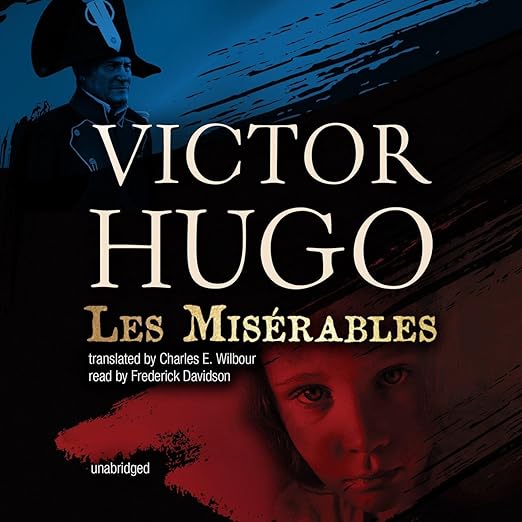
Quick Take
- Narration: Frederick Davidson brings measured gravitas to Hugo’s epic, sustaining authority across nearly 58 hours without ever sounding weary, a genuinely impressive feat of endurance narration.
- Themes: redemption and moral transformation, law versus conscience, the weight of class and poverty in 19th-century France
- Mood: Grand and emotionally immersive, with long stretches of digression that reward patient listeners
- Verdict: If you have the patience for Hugo’s famous digressions, Davidson’s performance makes this the definitive way to experience the novel in English.
I set myself an ambitious goal last winter: finish the unabridged Les Miserables before spring. I had read an abridged version in university, written a paper on it, felt I knew it. The unabridged audiobook disabused me of that notion within the first three hours. Hugo’s novel is not a story you can summarize. It is a civilization in prose, and Frederick Davidson’s narration made me understand that in a way no print edition had.
The famous opening chapters on Bishop Myriel alone run to a length that would constitute a short novella. At 57 hours and 48 minutes, this Blackstone Audio production is not a casual listen. But I kept coming back to it, early mornings before anyone else was awake, sometimes just twenty minutes at a time, occasionally a long Sunday afternoon stretch. By the end, I felt I had lived inside the early 19th century in a way I had not expected to feel through an audiobook.
Our Take on Les Miserables
This is among the greatest novels ever written, and I say that without hedging. The story of Jean Valjean, imprisoned for 19 years for stealing bread to feed his sister’s starving family, and then relentlessly pursued by Inspector Javert after his release and attempted reformation, remains one of literature’s most precise examinations of the tension between legal justice and moral conscience. Hugo understood something that many of his contemporaries did not: that law and ethics are not synonymous, and that the machinery of the state can be both rigorous and profoundly cruel simultaneously.
What the synopsis correctly identifies as the novel’s sweeping power is not merely rhetorical. The chapter on the Battle of Waterloo, which halts the main narrative entirely for what feels like several hours, is one of the most startling structural choices in canonical literature. Hugo is not merely providing historical context. He is arguing that large human forces, history, poverty, chance, military catastrophe, shape individual fates in ways that render simple moral judgment inadequate. Valjean’s story cannot be understood without Waterloo any more than the sewers of Paris are simply a backdrop. They are, in Hugo’s treatment, the physical substratum of a society’s hidden suffering.
Why Listen to Les Miserables
Davidson’s narration is the right choice for this material precisely because he does not attempt to perform the novel in the theatrical sense. His voice is steady, clear, and deeply literate. He moves through Hugo’s digressions, the pages on Parisian street argot, the history of French convents, the taxonomy of Parisian street children, with a patience that becomes its own form of respect for the source. Some listeners find those digressions exasperating. One reviewer, Paul Frandano, puts it bluntly: Victor Hugo will simply not shut up. He is right, and he is also right that this is part of what makes the novel extraordinary. Davidson makes those sections bearable, sometimes genuinely fascinating, by maintaining an even, engaged tone throughout.
The novel’s emotional peaks, Fantine’s degradation, Cosette’s childhood under the Thenardiers, Valjean’s decision to reveal himself at Champmathieu’s trial, land hard in audio. There is something about hearing the prose rather than reading it that strips away the intellectual distance you might maintain on the page. Several listeners have described being moved to tears, and I was not immune to that, listening in the early-morning dark somewhere around hour forty.
What to Watch For in Les Miserables
Be prepared for the digressions to arrive without warning and last longer than you expect. Hugo’s account of Waterloo begins mid-novel and does not feel like an interlude, it feels like a second book has started. Similarly, his chapters on Parisian sewers are not a metaphor. He actually explains how the sewer system was engineered and expanded over decades. These passages are either the most fascinating or most frustrating elements of the listening experience depending entirely on your tolerance for encyclopedic curiosity dressed as fiction.
The novel also asks something of listeners in terms of its moral framework. Hugo’s sympathies are never hidden, but the complexity of Javert, a man who believes in law the way others believe in God, and who cannot survive the discovery that law and mercy can exist simultaneously, is sophisticated enough to demand real engagement. He is not a villain. He is a tragedy. Understanding that distinction requires active listening across many hours.
Who Should Listen to Les Miserables
This audiobook rewards listeners who have time and patience. If you are the kind of reader who annotates margins and pauses to think, you will find Davidson’s measured pace inviting rather than slow. Literary fiction readers who have been meaning to finally read Hugo in full will find this the easiest version to actually complete, the audio format makes the length feel less daunting than holding a thousand-page physical volume.
Skip it if you need narrative momentum above all else. If you listened to the musical cast recording and thought you knew the story, be aware that the novel is unrecognizable in scope and philosophical ambition by comparison. Also be aware that significant stretches of the recording have almost no plot movement at all. Those stretches are, arguably, where Hugo is doing his most important work.
Frequently Asked Questions
Is this the complete unabridged text of Les Miserables?
Yes. At 57 hours and 48 minutes, this Blackstone Audio edition includes all of Hugo’s original text, including the extended Waterloo sequence, the chapters on Parisian sewers, and the full digressions on convent life and street argot that are often cut from abridged versions.
How does Frederick Davidson handle the novel’s many different voices and registers?
Davidson maintains a consistent, authoritative tone rather than performing distinct character voices. This works well for the novel’s narrative-heavy structure, though listeners seeking highly differentiated character voices may find his approach restrained. His strength is in sustaining coherence across nearly 58 hours.
Do I need to know French history to follow the Waterloo chapters?
Not deeply, though a basic sense of Napoleon’s fall helps. Hugo provides substantial context within the text itself. Davidson’s even narration makes the historical sections accessible to non-specialists, though they remain demanding listening regardless.
How does this audiobook compare to experiencing Les Miserables through the musical?
They share character names and a rough plot skeleton, but the novel operates at an entirely different scale of moral and philosophical complexity. The musical condenses and romanticizes material that Hugo treats with considerable darkness and ambiguity. Familiarity with the musical is neither a help nor a hindrance, treat them as separate works.