Quick Take
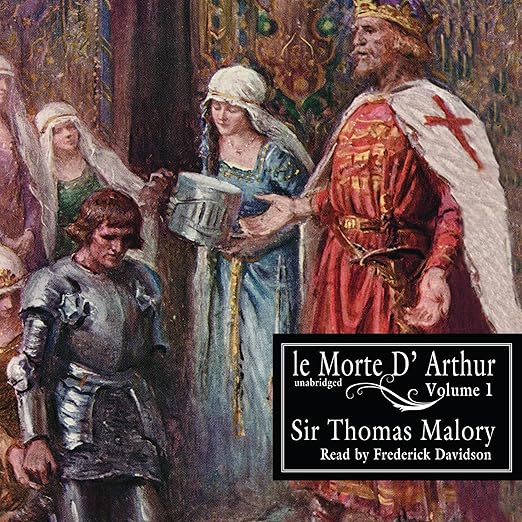
- Narration: Frederick Davidson brings an authoritative, measured cadence to Malory’s Middle English prose, the language becomes navigable rather than forbidding with his pacing.
- Themes: Chivalric honor and its corruption, the fall of an ideal community, loyalty torn between love and duty
- Mood: Stately and elegiac, with sudden eruptions of violence and wonder
- Verdict: The foundational Arthurian text deserves patience, and Frederick Davidson’s narration is the reason to experience it in audio, 32 hours of medieval grandeur that earns every minute.
I first read Le Morte d’Arthur in university, struggling through an annotated edition with footnotes every three lines. I was twenty-one, impatient, and more interested in the quest structure as a narrative theory problem than as a story. Listening to Frederick Davidson narrate Malory at the pace Malory intended, unhurried, ceremonial, the sentences unspooling with their strange double negatives and archaic spellings, I understood something I had missed: this text is meant to be heard.
Thomas Malory completed his compilation of Arthurian legend sometime around 1470, drawing from French prose romances, Celtic oral traditions, and English chronicles to produce what became the primary source for nearly everything that followed in the Arthurian tradition. Tennyson read it. T.H. White read it. Every film version of Arthur’s court, every modern fantasy novel featuring Merlin or Guinevere, owes a structural debt to what Malory arranged. At thirty-two hours and fifty-three minutes, this audiobook is not a casual commitment. It is something closer to an education.
Our Take on Le Morte d’Arthur
The challenge one reviewer identified is exactly right: this text does not have the pacing or narrative logic of a modern novel. Events occur seemingly at random. Knights appear, perform extraordinary deeds, and vanish. The Holy Grail quest occupies a long central section that many readers find simultaneously the most spiritually ambitious and the most tedious part of the book, Galahad’s perfection is as narratively inert as it is morally exemplary. But Malory’s version of Arthur’s tragedy, the slow collapse of Camelot through the double betrayal of Guinevere and Lancelot on one side and Mordred’s ambition on the other, builds to an ending of genuine sorrow.
The romance of Tristram and Isolde runs parallel to the main narrative and gives the book a second great love story to set against the Guinevere and Lancelot arc. Malory is uninterested in clean moral resolution, he presents characters doing contradictory, self-defeating things for human reasons, and the fact that Camelot falls not through external conquest but through the internal betrayals of the people who loved it most is the text’s darkest and most enduring insight.
Why Listen to Le Morte d’Arthur
Frederick Davidson’s narration is the decisive argument for the audiobook format. Several readers who reviewed the print edition mentioned the language as a barrier that requires sustained effort to cross. Davidson makes that crossing almost imperceptible, his pacing treats the Middle English spellings not as obstacles but as music, and after twenty or thirty minutes your ear adjusts and the strangeness of the language becomes part of the listening experience rather than an impediment. One reviewer described it as a genuine transportation to an earlier time, and Davidson’s voice is central to that effect.
The Blackstone Audio production from 2007 is clean, without the distracting restoration artifacts that sometimes plague older recordings. Davidson’s voice has the quality of someone who has spent a career with difficult texts, patient, confident, never condescending about the material he is navigating.
What to Watch For in Le Morte d’Arthur
The episodic structure will frustrate listeners accustomed to forward momentum. The book is organized as a collection of interlaced narratives rather than a single through-line, and individual characters can drop out for hours at a time before reappearing. The section covering Sir Gareth in Book VII is among the most accessible, it has a clear quest arc and a satisfying resolution, and can serve as a test for whether the format is working for you before you commit to the full thirty-two hours.
The violence, by contemporary standards, is graphic and matter-of-fact. Battles and tournaments are described in clinical detail. The treatment of women ranges from reverent to functionally absent, and contemporary listeners will find medieval gender dynamics difficult in places.
Who Should Listen to Le Morte d’Arthur
This belongs to readers who love the Arthurian tradition and want to understand where it comes from, fans of Bernard Cornwell’s Warlord Chronicles, Mary Stewart’s Merlin Trilogy, or T.H. White’s The Once and Future King will find their source material here. Students of medieval literature, listeners who enjoy long audio commitments on par with the complete works of Dickens or Tolstoy, and anyone who has wondered what Tennyson was actually working from will get significant value from this. Casual listeners who want a clean narrative arc should know this is not that, it is a monument, and monuments reward the right kind of attention.
Frequently Asked Questions
Is the Middle English in Le Morte d’Arthur difficult to follow as an audiobook listener?
Less difficult than reading it on the page. Frederick Davidson’s narration helps your ear acclimatize to the archaic spellings and sentence structures within the first half hour. Most listeners report that the language stops feeling like a barrier relatively quickly once you surrender to the rhythm.
At 32 hours, where would you suggest starting if you want to test whether this is for you?
Book VII, covering the tale of Sir Gareth of Orkney, is the most accessible section, it has a clear quest structure, a satisfying arc, and vivid characters. It gives you a good sense of Malory’s storytelling at its most engaging without requiring you to have read everything before it.
How does this recording compare to a modern prose retelling of the Arthurian legends?
They are different experiences. A modern retelling will give you accessibility and psychological depth. Malory will give you the actual texture and structure that all subsequent versions derive from, the specific names, episodes, and moral framing that define the tradition. For understanding where the legend comes from, there is no substitute for Malory directly.
Is the full text included, or is this an abridged version?
This is the complete, unabridged text published by Blackstone Audio, all eight books of Malory’s compilation, which accounts for the thirty-two hour and fifty-three minute runtime. An abridged version of Le Morte d’Arthur loses too much of the structural logic to be worth considering.