Quick Take
- Narration: Pegah Ferydoni brings warmth and authority to Morgan’s voice, a performance that carries the emotional complexity of a protagonist caught between duty, power, and love.
- Themes: female power and political constraint, Arthurian revisionism, loyalty versus ambition
- Mood: Rich and immersive, with the weight of legend and the intimacy of a personal drama
- Verdict: A strong second entry in Sophie Keetch’s Morgan le Fay trilogy that deepens the world and pushes the character into genuinely difficult territory.
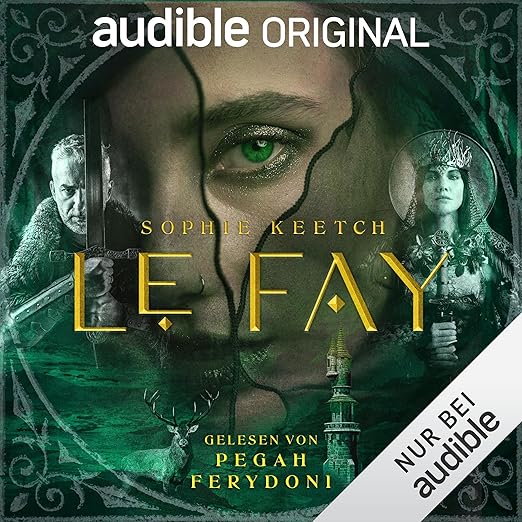
I came to Le Fay having spent the previous week finishing the first book in Sophie Keetch’s Morgan le Fay trilogy, and the transition between them felt seamless in the way good serial fiction should: the world was already alive in my head, and Le Fay simply expanded it. This is Book 2 in the Morgan Le Fay Trilogy, a German Audible Original published in April 2025, running at just under sixteen hours. Narrator Pegah Ferydoni delivers the whole thing with an assurance that makes you forget you’re listening to a performance rather than a voice inside a story.
The setup, briefly: Morgan has escaped an unhappy marriage and arrived in Camelot, where her brother Arthur has installed her as a trusted advisor. This is the good version of her story, the one where she is recognized as intelligent and capable rather than dismissed or feared. But Keetch’s Morgan is not allowed to rest in that recognition for long. A vengeful ex-husband wants their son. Guinevere is suspicious and cold. Merlin is angling for something. And a face from Morgan’s past arrives in Camelot carrying the kind of unfinished feeling that derails carefully constructed futures. What follows is fifteen hours of watching a brilliant woman navigate a world that is theoretically open to her but persistently, structurally resistant to her flourishing.
Camelot as a Political Trap
The Morgan le Fay that most English-language readers grew up with is defined by her opposition to Arthur, the villain of the Arthurian cycle, or at best its most troubling figure. Keetch’s reframing inverts this entirely. Arthur and Morgan, here, are genuinely close. He values her. She advises him. The tragedy of the Arthurian world isn’t that Morgan is wicked, it’s that even in the most favorable possible reading of her circumstances, she cannot move freely. Her estranged husband has legal claim to their son. Guinevere resents her position. Merlin is dangling a deal that is clearly not what it appears to be.
Reviewer joycesmysteryandfictionbookreviews noted that Arthur and Morgan share a deep bond as the story opens, and that this version of Morgan gets along poorly with Guinevere out of what reads as jealousy rather than any fault of Morgan’s. That dynamic is central: Le Fay is interested in how a brilliant woman navigates a system that theoretically includes her but constantly reminds her of its limits. The Merlin subplot, which escalates toward the end of the book, takes that constraint to its extreme, Morgan is offered power, but at a cost that blurs the line between life and death, and you feel the weight of her choice because Keetch has spent fifteen hours making you understand what she is risking and why she values what she values.
Ferydoni’s Morgan as Living Contradiction
Pegah Ferydoni is the engine of this listening experience. Morgan is a character who must hold warmth and cunning simultaneously, who must be sympathetic in her vulnerability and formidable in her intelligence, and Ferydoni navigates that tonal range with precision. The scenes between Morgan and Arthur carry genuine sibling warmth. The scenes involving Guinevere have a controlled tension. The moments where Morgan is most alone with her own calculations feel interior in the right way, you hear a woman thinking, not a narrator explaining her thoughts.
Reviewer H0neyb@dger, who grew up loving the Arthurian world through The Once and Future King and The Mists of Avalon, described this series as reigniting a love for Morgan le Fay that hadn’t been touched in decades. That response, from a reader already steeped in the tradition, is the measure of what Keetch and Ferydoni are accomplishing together. Reviewer VonWitt noted that sequels usually disappoint them, and that this one had already prompted a pre-order of Book 3. Reviewer highdesertgradgirl called it outstanding retelling with a clever, strong heroine and complex characters. Across multiple reviewers coming from different orientations, Arthurian lovers, fantasy readers, people who simply stumbled into the series, the response is remarkably consistent.
The Twist and What It Costs the Story
Reviewer Em Matthies mentioned a serious twist in this book and said little more, which is the right approach. I’ll follow suit, except to note that the twist is earned, it’s built from choices Morgan has made and circumstances Keetch has been layering throughout both books, not a shock parachuted in from outside the story’s logic. What makes it work is that it forces Morgan to choose between competing versions of herself: the woman who protects those she loves, and the woman who maintains the kind of moral clarity she has insisted on throughout the narrative. Keetch doesn’t let her off the hook, and Ferydoni’s reading of the aftermath is among the best performance moments in the entire audiobook.
At fifteen hours and fifty-two minutes, Le Fay is a substantial listen. It rewards patience and investment in Morgan as a character rather than plot momentum as an end in itself. The pacing is deliberate rather than propulsive, which is appropriate for a story about a woman navigating a world that moves slowly against her while she must appear to move slowly back. The political maneuvering of Camelot’s court, which might frustrate readers looking for action, is precisely the environment that makes Morgan’s situation meaningful.
Who This Is Right For
If you finished the first book in this series and are wondering whether Le Fay lives up to it: yes, and in some respects surpasses it. If you love Arthurian retellings from female perspectives, particularly the tradition established by Marion Zimmer Bradley’s Mists of Avalon or Mary Stewart’s Arthurian Saga, this trilogy is working in that lineage and doing it well. Note that this is a German Audible Original produced with German narration; English-language listeners interested in Morgan le Fay retellings should confirm language preference before purchasing. For those who can access the German edition, this is one of the most compelling Arthurian revisionist projects currently in production, with a narrator who is fully equal to its ambitions.
Frequently Asked Questions
Is Le Fay accessible without having listened to the first book in the trilogy?
Le Fay picks up directly from the events of I Am Morgan, and while Keetch provides enough context to follow the plot, the emotional weight of Morgan’s relationships with Arthur, Guinevere, and Merlin is significantly richer if you have read the first book. Starting from the beginning is strongly recommended.
Is Le Fay a German-language audiobook, and is there an English edition available?
Le Fay is a German Audible Original narrated in German by Pegah Ferydoni. As of this writing, the series began with a German-language edition. English-language listeners should verify current availability of any English translation or edition before purchasing.
How does Sophie Keetch’s version of Morgan le Fay compare to Marion Zimmer Bradley’s Mists of Avalon?
Both center Morgan as a complex protagonist unjustly marginalized by history’s retelling of the Arthurian legend. Keetch’s version is more focused on the political constraints Morgan faces within Camelot itself, while Bradley’s is broader in its spiritual and matriarchal themes. Readers who love one are likely to appreciate the other.
Is Le Fay available as a free audiobook on Audible?
Yes, this free audiobook is available to Audible members through their subscription as an Audible Original. Check the current listing for availability and language options, as catalog access can vary by region.