Quick Take
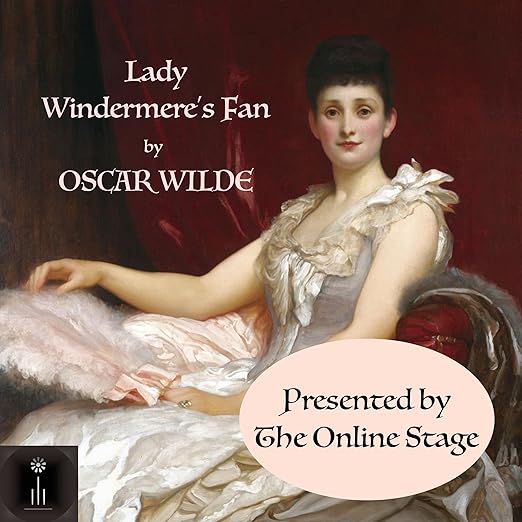
- Narration: A full-cast production from The Online Stage, with Elizabeth Klett leading as Mrs. Erlynne and a roster of voice actors handling the sharply differentiated characters with period-appropriate formality and genuine wit.
- Themes: Moral judgment versus moral complexity, the social machinery of Victorian reputation, sacrifice concealed as propriety
- Mood: Elegant and pointed, with an undercurrent of genuine pathos that Wilde’s wit keeps in careful suspension
- Verdict: The full-cast format is exactly right for a play of this kind, and the production honors Wilde’s dialogue without over-performing it.
I was partway through a gray Tuesday afternoon when I put on Lady Windermere’s Fan, expecting something brisk and theatrical to carry me through the rest of the day. What I did not expect was to find myself sitting quietly at my desk for several minutes after it ended, thinking about Mrs. Erlynne. That is, I think, the correct response to this play. Wilde wants you to leave with more questions than you arrived with, and this production has the intelligence to let him do that.
Lady Windermere’s Fan is Wilde’s first successful play, premiered in 1892, and it displays something that the more famous Importance of Being Earnest sometimes obscures: Wilde was not only a wit. He was a moralist, of a complicated kind. The play’s surface is comedy, drawing-room maneuvering and social gossip among the London elite gathering for Lady Windermere’s twenty-first birthday. Beneath that surface is a story about judgment, about the distance between how we see ourselves and what we actually do under pressure, and about sacrifice performed in secret for reasons that resist easy explanation.
The Production That Fits the Material
This version comes from The Online Stage, a collective of narrators and actors dedicated to audio productions of classic dramatic works. The full-cast approach is simply the right choice for a play. Wilde’s dialogue is built on rapid-fire exchange, on wit striking against wit, and on the very precise social calibration of who says what to whom and in what register. A single narrator performing all parts would flatten those distinctions. Here, the cast handles the ensemble with enough differentiation to keep the social topology of the evening clear.
Elizabeth Klett leads as Mrs. Erlynne, the mysterious and scandalous woman whose presence at the birthday party unleashes the evening’s crisis. Her Mrs. Erlynne is controlled, watchful, and carries the weight of the play’s central moral pivot without telegraphing the reveal. The other principals, including Amanda Friday as Lady Windermere and Ben Lindsey-Clark as Lord Darlington, find the right notes for their respective positions in the comedy. Lord Darlington’s elegant libertinism, which in a lesser production tips into caricature, is handled here with enough genuine charm to make Lady Windermere’s temptation plausible rather than merely convenient to the plot.
Wilde’s Second Play and What It Shares with His Best
One reviewer, chasing the high of The Importance of Being Earnest, found Lady Windermere’s Fan not quite that. I think that is the wrong comparison but an understandable one. Earnest is more consistent in its anarchic wit. Lady Windermere’s Fan is less purely comic, more willing to let genuine feeling intrude. The reviewer who described Lady Windermere’s life as almost a thriller is onto something. The question of who Mrs. Erlynne really is, and what she actually wants, has a suspense dimension that Earnest does not.
This is a play about something darker than misidentity and cucumber sandwiches, and its comedy is in service of that darkness, not an escape from it. At under two hours, the production clips along at the appropriate pace for material that was designed to be performed in an evening. There is no padding, no over-explained stage business. The direction is clean and serves the dialogue rather than competing with it. Listeners who are accustomed to longer audio productions should know that the brevity here is the point: Wilde built his plays tight, and the production honors that construction.
A Century-Old Play That Has Not Aged Out
The morality of Lady Windermere’s Fan is Victorian in its specific social mechanics but not in its underlying questions. The things Wilde is actually examining, the way we make judgments about people based on categories rather than knowledge, the way reputation functions as social currency, the way sacrifice can be performed without acknowledgment and still matter enormously, are not period pieces. The reviewer who described the play’s themes as holding true today was right, and the production does not work against that contemporary relevance by overstressing its Victorian setting.
The Wilde wit is present throughout, and the cast handles the epigrams with the appropriate precision: delivered quickly, not labored over, landing with the dry click that this kind of line requires. The famous remark about the gutter and the stars is there, as are the surrounding structures of dialogue that give it context. In audio, without the visual production, the writing has to do more work, and it holds up with the ease of material that was always, at root, a literary achievement as much as a theatrical one.
Who Should Listen and Who Should Skip
This is essential listening for anyone who loves Wilde and wants to hear the plays in a format that respects the material. It is also a reasonable introduction to Wilde’s dramatic work for listeners who know his prose but not his theater. The under-two-hour runtime makes it genuinely accessible even for listeners who are hesitant about full play productions.
Skip it if you have no patience for Victorian drawing-room dynamics or if you need a story structure built on action rather than conversation. The play is almost entirely talk, and gloriously so, but that quality is not for everyone in audio form. For those who are open to it, the combination of Wilde’s writing and this cast’s restraint produces something close to the theatrical experience in audio, which is a harder achievement than it looks and worth the under-two-hour investment to find out.
Frequently Asked Questions
Is the Online Stage production performed with period accents, and does that affect accessibility for international listeners?
The cast performs with broadly British accents appropriate to the late Victorian setting, which suits both the material and the social world Wilde is satirizing. The accents are clear enough not to impede comprehension for American or international listeners, and the formality of the period dialogue is consistent rather than jarring. Accessibility should not be a concern for listeners familiar with British theatrical style.
How does this play compare to The Importance of Being Earnest for listeners who want to explore Wilde’s theater?
Lady Windermere’s Fan is less purely comic and more willing to engage genuine feeling. Earnest is Wilde at his most anarchic and stylistically concentrated. Lady Windermere’s Fan has a more conventional dramatic structure and a moral seriousness that the later play largely sets aside. Both are excellent. If you want sustained wit above all, start with Earnest. If you want wit in service of genuine moral complexity, Lady Windermere’s Fan may be the more interesting choice.
The cast list is large. Is it easy to keep track of who is speaking in audio format without visual staging?
The Online Stage production differentiates its cast clearly enough that the major characters are trackable without difficulty. The secondary characters who appear primarily for comic effect are distinguishable as a group even if individual identification is not always immediate. The play’s social hierarchy is established quickly, which gives listeners a framework for following the ensemble even without visual cues.
One reviewer mentions the film A Good Woman starring Scarlett Johansson and Helen Hunt. Is it worth watching alongside the play?
A Good Woman is a 2004 film adaptation that transposes Wilde’s play to 1930s Italy. Several reviewers mention it favorably, and one noted that it adds some characteristic Wilde wit of its own. Watching the film after listening to the play can be a rewarding pairing: the film makes choices that reveal different possibilities in the source text. But neither requires the other, and both stand alone.