Quick Take
- Narration: Erin Bennett delivers a technically accomplished performance that has earned the trust of a fanbase initially skeptical of the narrator transition, her work here consolidates that goodwill.
- Themes: power dynamics among adventuring parties, the acceleration of change in a world-at-scale, identity and consequence across an epic cast
- Mood: Dense and sprawling, with flashes of unexpected lightness, the football subplot is not a typo
- Verdict: Book 17 is exactly what series veterans want and exactly what newcomers should not start with, Penny’s arrival for the non-initiated first, then seventeen volumes of context to make this one pay off.
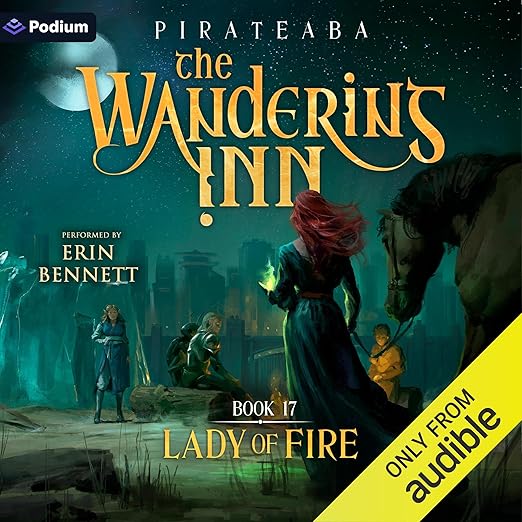
I want to be direct about something before I say anything else about Lady of Fire: this is Book 17 of The Wandering Inn, and at 46 hours, it is not a point of entry. It is a reward. If you have not read the sixteen preceding installments, nothing I write here will give you the context to appreciate what pirateaba is doing, and starting here would be like walking into a theatrical production midway through the third act of a seventeen-act play. That said, for listeners who have made that investment, this installment delivers the kind of intricate, simultaneously-threaded storytelling that has made The Wandering Inn one of the more remarkable long-form fantasy projects of recent years.
Released in late 2025 and narrated by Erin Bennett for Podium Audio, Lady of Fire picks up the threads from multiple ongoing storylines across the continent of Chandrar and beyond, the aftermath of the King of Duels’ battle with the King of Destruction, the Horns’ arrival in Invrisil where Gold-rank status does not guarantee the deference they’ve earned, and a magic door at The Wandering Inn that pulls everything back toward pirateaba’s peculiar, beloved central location. The synopsis also mentions, without elaboration, football. Or soccer. The distinction is left delightfully unresolved.
Our Take on Lady of Fire
The Wandering Inn has always defied easy genre categorization. It draws on LitRPG conventions, stat systems, class progressions, leveling logic, but reviewer after reviewer in this series notes that the books work precisely because the genre mechanics are background infrastructure rather than the story itself. Reviewer from December 2025 puts it directly: “The best thing about these books is that they are great books that happen to have some litrpg.” That’s the right framing. Lady of Fire has assassins, raiders, Gold-rank political maneuvering, magical flames, and a hat subplot that apparently warrants specific mention in the official synopsis. What it also has is a genuine investment in what its enormous cast of characters actually want from the world they’re navigating.
The Perrin Aybara parallel is irresistible for WoT veterans: at this depth in any long-running epic fantasy, the ability to hold dozens of character threads simultaneously without flattening any of them is the primary craft challenge, and pirateaba is unusually good at it. The Horns sequence in Invrisil, where Gold-rank status meets the social reality of established adventuring hierarchies, is one of the more grounded political dynamics the series has explored, the tension between earned competence and institutional legitimacy is handled with more nuance than the genre usually manages.
Why Listen to Lady of Fire
The narrator transition from Andrea Parsneau to Erin Bennett, which generated real anxiety among long-term listeners, has settled into something that reviewer symcoxkd describes as flowing “seamlessly.” Bennett does not attempt to replicate Parsneau’s approach. She has built her own performance vocabulary for the series, and by Book 17 that vocabulary has fully cohered. Reviewer Mike, who has listened to all 17 installments and compares the series favorably to Wheel of Time, describes Lady of Fire as “a great buy given the book length and quality”, and at 46 hours, length is very much part of what you’re buying into.
The sheer scope is both the attraction and the challenge. This is a 46-hour audiobook that assumes you have already spent somewhere in the vicinity of 400+ cumulative hours with these characters. The emotional payoffs in Lady of Fire are built on that accumulated investment, and they are real payoffs, moments where choices made ten books ago create consequences here that feel both surprising and inevitable. That architecture is genuinely impressive, even if it means the book is completely inaccessible without the prerequisite reading.
What to Watch For in Lady of Fire
The review from “Prodigious Reader” places this installment “somewhere in the middle” of the series, not the best, not the worst, but solid. That’s an honest assessment. Lady of Fire doesn’t have the concentrated emotional impact of the series’ peak installments, and some of the new character threads introduced feel like setup for Book 18 rather than payoffs for the arc being told here. That’s a structural cost of writing at this scale: not every volume can be the one where everything converges. This one does convergence work for the threads it picks up and setup work for what follows, which is useful but not uniformly satisfying on a book-by-book basis.
The football subplot, and yes, it is football, or soccer, and the ambiguity is intentional, is one of pirateaba’s characteristic tonal shifts. The Wandering Inn has always moved between high tragedy and absurdist comedy without much warning, and if you’ve made it to Book 17, you either embrace that quality or you stopped reading around Book 4. Lady of Fire has both modes, sometimes within the same chapter.
Who Should Listen to Lady of Fire
Established Wandering Inn listeners who are current through Book 16 will find this a worthy continuation and should start it without hesitation. Everyone else should start at Book 1, accept the time commitment involved, and understand that Lady of Fire represents the payoff for that commitment rather than a shortcut to it. The series has been compared favorably to both Wheel of Time and the better long-form webserial tradition, and those comparisons hold, in their scale, their character depth, and in the patience they require from readers willing to meet them on their own terms.
Frequently Asked Questions
Can someone start The Wandering Inn with Lady of Fire, Book 17?
Absolutely not. This installment assumes comprehensive knowledge of sixteen preceding books and hundreds of hours of accumulated narrative. It functions as a continuation for established readers, not as an entry point. Start with The Wandering Inn Book 1 if you want to experience this series.
How did listeners respond to Erin Bennett replacing Andrea Parsneau as narrator?
Initial skepticism has largely converted to acceptance. By Book 17, multiple reviewers describe Bennett’s performance as seamless and note that she has developed her own distinct approach to the series rather than imitating her predecessor. One reviewer specifically calls out Lady of Fire as the book that solidified Bennett as “a fantastic choice.”
How much of Lady of Fire is genuinely LitRPG versus conventional epic fantasy?
The stat and class systems exist but function as background infrastructure. Reviewer sentiment across the series consistently notes that the books work as character-driven epic fantasy that happens to use LitRPG conventions, not as LitRPG fiction that happens to have good characters. If you enjoy the genre but find pure LitRPG mechanics tedious, this series handles the balance more gracefully than most.
Is there actually a football subplot in Lady of Fire, and how seriously does it take itself?
Yes, and pirateaba takes it exactly as seriously as the rest of the book, which is to say with total commitment and a kind of cheerful absurdism. The series has always moved between high fantasy stakes and low comedy without transition warnings. The football element is characteristic of the author’s tonal range and has been reported by reviewers as one of the more entertaining threads in this installment.