Quick Take
- Narration: Justine Eyre brings the Victorian setting to life with a warm, expressive delivery that serves the novel’s layered mystery and slow-burn romance with equal skill.
- Themes: Hidden identity and authorship, family secrets and inheritance, faith as a stabilizing force in uncertainty
- Mood: Atmospheric and slowly unfolding, with Gothic undertones and genuine warmth beneath them
- Verdict: A debut that earns its comparisons to Victorian literary fiction; the hidden-author premise is genuinely original and gives the mystery dimension real texture across the full runtime.
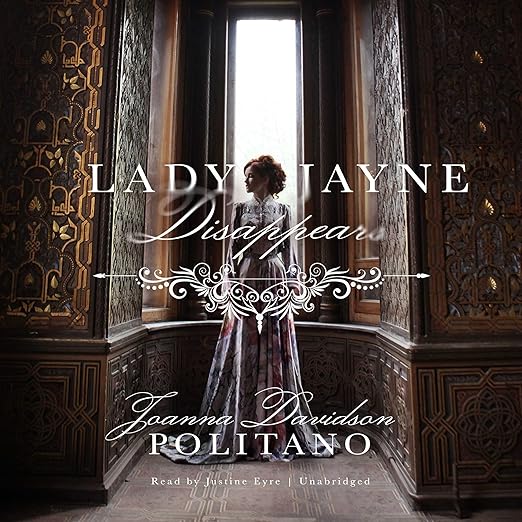
I came to Lady Jayne Disappears on a recommendation from a colleague who rarely reads Christian fiction but had been caught off guard by how much she enjoyed it. That framing stuck with me as I listened, because Joanna Davidson Politano’s debut is that particular kind of genre book that works on its own terms regardless of whether the reader shares its theological commitments. It is a Victorian mystery with genuine atmospheric craft, a romance built on reluctance and good sense rather than manufactured chemistry, and a central premise that is original enough to carry the whole structure through its nearly eleven-hour runtime.
Aurelie Harcourt is the daughter of a man who died in debtor’s prison. He left her two things: access to his wealthy family, whom she has never met, and his famous pen name, Nathaniel Droll. The family, it turns out, has no particular interest in welcoming her. Only one houseguest, Silas Rotherham, offers genuine warmth. And Aurelie decides that since she is unwanted and essentially invisible to the household’s social dynamics, she might as well use that invisibility productively. She continues writing the serial novel her father left unfinished, and she writes the family into it, unflattering and recognizable, while simultaneously searching for the truth about what happened to her mother.
The Hidden Author and Why That Conceit Works
The narrative mechanism of a hidden author writing real people into fiction while living among them is not new in literary history, but Politano uses it with more sophistication than the premise might suggest. The chapters from the unfinished serial are woven into the main narrative in a way that gives Aurelie’s inner life additional texture and analytical depth. She sees the family through a writer’s eye, which means the reader sees them that way too. Characters who would otherwise appear as standard Gothic supporting cast, the resentful cousin, the apathetic aunt, the unsettling uncle, accumulate genuine complexity because Aurelie’s fictional versions of them are not caricatures. They are observations, and the gap between her fictional rendering and the actual people reveals something about both.
Justine Eyre’s narration is one of the better historical fiction performances I have come across in recent listening. She does not iron the Victorian syntax into something more familiar and contemporary. She lets the period rhythms run at their natural pace, which requires the listener to adjust slightly at the outset, but pays off in genuine immersion once the accommodation is made. The fiction-within-fiction passages are handled with a subtle but consistent vocal shift that makes the nesting clear without becoming distracting across repeated transitions.
The Mystery and Whether It Delivers
The synopsis promises both the truth about Aurelie’s mother’s disappearance and potentially the truth about her father’s death. The book delivers on both counts, though with different degrees of satisfaction. The mother’s storyline is the more fully developed arc, and it gives the Victorian setting genuine weight rather than using it purely as aesthetic backdrop. Reviewers praised the character development as having humanity revealed layer by layer, and Eyre’s performance supports that experience: she gives each character room to change within their scenes rather than locking them into static emotional registers.
The father’s story is resolved, but listeners who enter expecting a tightly plotted mystery with puzzle mechanics will find Politano’s approach more interested in character revelation than in clockwork plot engineering. This is a mystery that cares more about what happened to a family’s humanity than about who did what to whom. One reviewer who initially avoided the book under the impression it would be unrelentingly dark came away delighted by the genuine warmth at its center. That reversal is worth flagging as useful information for prospective listeners.
Faith in the Background, Not the Foreground
The Christian element in the narrative deserves specific discussion because it functions quite differently from how readers familiar with the genre label might expect. Aurelie’s relationship to belief is woven through her resilience and her interpretation of events rather than deployed as comfort when the plot requires it or as instruction when the themes seem to demand reinforcement. Reviewers who were not particularly interested in Christian fiction found the religious dimension atmospheric rather than prescriptive, which speaks to Politano’s genuinely light touch with material that many authors in the genre push harder. The faith is present, but it earns its place through character rather than through the narrative’s insistence that the reader adopt it.
A Debut That Earned Its Reputation
Listeners who enjoy Victorian literary fiction and do not require a hard-edged mystery plot will find this exactly as satisfying as its enthusiastic reviews suggest. Fans of serialized Victorian novels will recognize the fiction-within-fiction structure as a tradition Politano is consciously working within and doing justice to. Those who specifically want tight plotting and fast pacing will find the deliberate unfolding rhythm frustrating. But those who are willing to spend eleven hours in Aurelie’s company as she slowly assembles the truth about her family will find Justine Eyre’s narration a consistently rewarding guide through what is, for a debut, a genuinely accomplished piece of fiction.
One reviewer called Lady Jayne Disappears a future classic, and while that prediction is impossible to verify, the conditions are right: an original premise, characters who develop across the narrative rather than being fixed from the first chapter, a setting that is fully inhabited rather than merely decorated, and a narrator in Justine Eyre who serves all of those elements without overshadowing any of them. The book was Politano’s first novel, and the confidence it demonstrates in its structural choices and its emotional restraint suggests a writer who knew what she was building before she started building it. For a debut, that is notable, and Eyre’s performance honors it.
Frequently Asked Questions
Is Lady Jayne Disappears appropriate for listeners who do not usually read Christian fiction?
Multiple reviewers without a particular interest in Christian fiction found it accessible and engaging. The faith element is woven into character rather than delivered as instruction, which means it functions as part of the atmosphere rather than as a discrete theological argument.
How does Justine Eyre handle the fictional serial novel passages embedded within the main narrative?
Eyre uses a subtle but consistent vocal distinction for the fiction-within-fiction sections, making it clear to listeners when they are in Aurelie’s secret manuscript without the shift being so pronounced that it breaks the immersion of the main story.
Is the mystery element satisfying, or does the romance overshadow it?
The mystery and the romance develop in parallel without either overtaking the other. The resolution of the mother’s disappearance storyline is the more substantive mystery payoff, while the romance between Aurelie and Silas is built deliberately and earns its conclusion.
Is this book part of a series, and if so, is it necessary to listen to them in order?
Lady Jayne Disappears is a standalone novel and functions completely independently. Politano has written other books in similar Victorian settings, but this one requires no prior or subsequent reading to be fully satisfying.