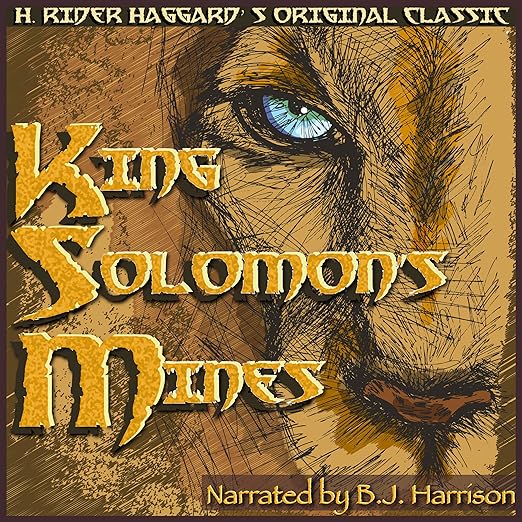
Quick Take
- Narration: B.J. Harrison brings the Victorian adventure register to Quatermain’s first-person voice with the confidence and period-appropriate authority the material demands.
- Themes: the Victorian quest narrative, loyalty and sacrifice among unlikely companions, the romance and violence of imperial adventure fiction
- Mood: Brisk, sweeping, and unmistakably of its era, with occasional discomfort for modern readers
- Verdict: The novel that invented the template for almost every adventure story that followed deserves to be heard in its own right, and Harrison’s narration does justice to its considerable energy.
I picked up King Solomon’s Mines on a week when I had been reading too much contemporary fiction that was in dialogue with itself, and I wanted something that had no idea it was supposed to be a precursor to anything. H. Rider Haggard published this in 1885 with no particular sense that he was inventing the adventure novel as a genre, and that unselfconsciousness is one of the things that makes it still work. There is no ironic distance, no awareness of archetype, no meta-fictional anxiety. There is just Allan Quatermain, three Englishmen, a secret map, and a journey into the interior of Africa that gets progressively more dangerous in the most direct possible way.
The plot is essentially the template that Indiana Jones, the Tarzan series, and a hundred other adventure franchises have been running on ever since: a scholar-hunter is recruited to find a missing man in a territory no outsider has returned from, joins forces with improbable companions, encounters a civilization with its own politics and violence, and has to navigate between external danger and internal betrayal. It sounds familiar because everything written since has borrowed from it. Reading the original is the experience of discovering where all those borrowed elements came from.
Our Take on King Solomon’s Mines
What strikes me most about the novel, and what even its enthusiastic 19th-century readers probably could not have articulated, is how economical Haggard is. The prose is clean and moves fast. Quatermain does not editorialize much; he describes what he sees and what he does, and lets the reader draw conclusions. One reviewer called it a tightly written, enthralling proto-Indiana Jones, which is exactly right in terms of narrative efficiency. The battle sequences in the second half are extended, and at least one reader found them slow, but they are nothing like the elaborate tactical set pieces of modern military fiction. Haggard is interested in the human cost of violence, and the battle chapters have a grimness that cuts through the adventure register.
B.J. Harrison is a practiced narrator of Victorian and Edwardian fiction, and he handles Quatermain’s voice with appropriate restraint. Quatermain narrates in first person and is not a boastful man, despite his reputation as a renowned safari hunter. Harrison captures that quality of understatement, which is crucial to the novel’s tonal balance. The supporting characters, particularly the regal guide Umbopa, are rendered with enough vocal distinction that the ensemble stays clear across nine hours.
Why Listen to King Solomon’s Mines
The case for listening rather than reading is partly that Haggard’s prose has a quality that rewards the spoken voice: it was written for an audience that read aloud, and the rhythms respond to articulation. The other case is that B.J. Harrison, as a narrator with deep experience in this period of literature, understands how to navigate the racial assumptions of the text without either performing them enthusiastically or apologizing for them with editorial distance. He reads it as the document it is, and that is the right call.
The novel’s influence is a genuine reason to engage with it. Understanding where Rider Haggard’s Africa stands in relation to Conrad’s, Kipling’s, or later Hemingway’s illuminates what each writer was doing with the adventure tradition they inherited. King Solomon’s Mines is the least self-conscious of these, which makes it in some ways the most instructive. It has not yet learned to be complicated about its own premises.
What to Watch For in King Solomon’s Mines
The racial attitudes of an 1885 novel are embedded in the text and unavoidable. Most reviewers note they are less severe than expected for the period, and that is largely true, but they are present. Haggard’s African characters are given dignity that the imperial adventure genre rarely afforded, particularly Umbopa, who is presented as genuinely heroic and politically complex. But the framing is still colonial, and Quatermain’s perspective is that of a Victorian Englishman who does not question the assumptions of his world. Readers looking for a critique of imperialism will not find it here; readers willing to engage with a period document on its own terms will find considerably more than expected.
The extended war sequences in the second half test patience for some readers. Haggard describes the battle in considerable detail, and one reviewer found this section slow enough to encourage skimming. The novel tightens again after the battle resolves, but the middle section does require some commitment.
Who Should Listen to King Solomon’s Mines
Readers interested in the origins of the adventure genre, in Victorian popular fiction, or in the literary ancestors of Indiana Jones and the pulp adventure tradition will find this genuinely rewarding. It is also a good choice for anyone who wants to understand what the narrative imagination of the 1880s looked like at its most energetic. Skip it if you cannot engage with colonial-era racial attitudes even in a historical context, or if extended battle sequences are something you find tedious rather than atmospheric. At nine hours with B.J. Harrison narrating, it is one of the more accessible entry points into Victorian adventure fiction available in audio.
Frequently Asked Questions
How should modern listeners approach the racial attitudes in a novel written in 1885?
Most reviewers find the racial attitudes less severe than expected for the period; Haggard gives his African characters, particularly Umbopa, unusual dignity and complexity for an 1885 adventure novel. But the colonial framing is unavoidable. B.J. Harrison reads the text as a period document rather than editorializing, which is the appropriate approach.
Is this the best audio version of King Solomon’s Mines available?
B.J. Harrison is a narrator with deep experience in Victorian and Edwardian fiction, and his narration has been specifically praised by reviewers of this edition. His understanding of the period register makes this a strong choice compared to versions recorded by less experienced narrators.
Do you need to know anything about H. Rider Haggard’s other work, particularly the Allan Quatermain novels, to enjoy this?
No. King Solomon’s Mines is Quatermain’s first appearance and works entirely as a standalone novel. Knowing his subsequent history might add a layer of interest, but the book was written before Haggard had developed Quatermain into a series character, and it stands on its own terms.
Is the battle sequence in the second half as slow as some reviewers suggest?
It is extended, and at least one reader found it the weakest section of the novel. Haggard describes the battle in considerable detail, which for some listeners reads as atmospheric and for others as pace-killing. It is probably the most dated section of the novel in terms of how contemporary adventure fiction handles action sequences.