Quick Take
- Narration: Ethan Reid handles the single-POV structure well, maintaining the mystery around secondary characters that the first-person format requires.
- Themes: Enemies-to-lovers, bargain-as-trap, dark fae court intrigue
- Mood: Lush and suffocating, with sparks of sardonic humor underneath
- Verdict: A strong romantasy debut for a new series that delivers on its dark fae promise, though the cliffhanger ending will frustrate listeners who prefer complete story arcs.
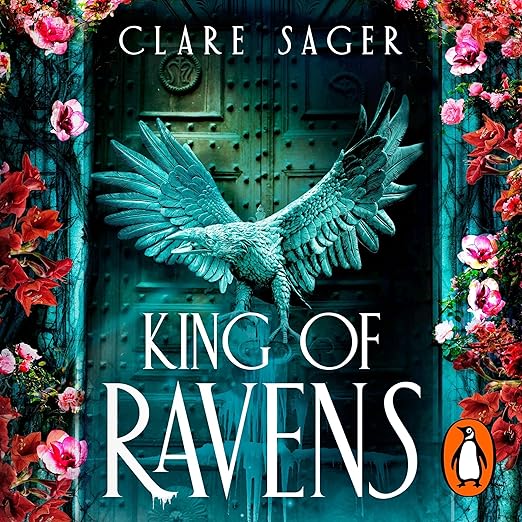
I picked up King of Ravens on a Sunday afternoon when I wanted something atmospheric and knew I’d be doing chores for the next few hours. By the time I’d finished the dishes, tidied the study, and made dinner, I was three-quarters through and had essentially stopped being useful to myself as a functioning adult. Clare Sager has written something that operates at the intersection of dark myth and slow-burn romance, and it pulls hard.
The setup draws from Persephone mythology without being slavishly faithful to it: Rhiannon is dying of an unknown illness, kept sheltered by her family in a clifftop home. When an unseelie King of the Dead arrives and offers her a choice, become his bride or watch him take her family instead, she descends into an underworld of withered gods, scheming courtiers, and ancient magic. She intends to hate her husband. The narrative, of course, has other plans.
Our Take on King of Ravens
What Sager does smartly here is refuse to let the marriage-of-convenience framework become comfortable. Rhiannon, whose name in the underworld is Annon, is not a passive figure waiting to be thawed by love. She is actively working against her situation, looking for exits, cataloguing weaknesses, trying to understand the rules of a world designed to deceive her. The cold and infuriating husband, Drystann, earns the slow-burn label because his thawing feels genuinely earned rather than mechanically scheduled.
The worldbuilding is dense without being confusing. The underworld has its own geography and logic: a labyrinth Annon can move between and the underworld proper, court factions with competing agendas, and an overarching sense that beauty in this setting is specifically designed to conceal cruelty. Sager is good at the texture of a threatening place, not the theatrical Gothic darkness of lesser romantasy, but something more subtly wrong, where every promise has teeth and every gesture of kindness comes with an unstated price.
Why Listen to King of Ravens
Ethan Reid’s narration serves the single-POV structure in ways that matter. Because we spend the entire novel inside Annon’s perspective, the listener is as dependent on her observations and interpretations as she is on her own perceptions. Reid maintains that interiority consistently, keeping the voices of secondary characters, Drystann especially, slightly opaque in a way that mirrors Annon’s own uncertainty about their motives. That’s a specific craft choice, and it’s the right one for this book.
The Penguin duet production label is worth noting for audio fans: the quality of the production reflects investment in the audio format as a primary medium rather than an afterthought. The fifteen-plus hour runtime doesn’t feel padded; Sager uses the space to develop relationships and world rather than filling it with action set-pieces.
What to Watch For in King of Ravens
The cliffhanger. Multiple reviewers flagged it, and one reader described being left physically unwell by the ending. Sager has constructed something that ends at a point of genuine crisis rather than resolution, which is a legitimate creative choice for the first book in a planned series but a punishing one for listeners who picked this up without knowing the sequel wasn’t yet available. The stomach-pit reaction described in the reviews is real: the emotional investment the novel generates makes the abrupt stopping point feel like a betrayal rather than a hook.
A minority of readers also found the pacing uneven, particularly in the first act, and one reader who loved Sager’s previous Shadows of the Tenebris Court series felt the writing style here was different enough to be disorienting. It’s worth knowing that King of Ravens is the start of a new series in a new setting, not a continuation of the Sabreverse, even though Sager uses the term Sabreverse for promotional purposes. Different world, different register, different storytelling rhythms.
Who Should Listen to King of Ravens
Fans of Carissa Broadbent’s The Serpent and the Wings of Night, Phantasma, and Kingdom of the Wicked will be in familiar territory here, same appetite for morally grey antiheroes, dark fae settings, and the enemies-to-lovers tension that unfolds through proximity and shared danger rather than sudden epiphany. Listeners who prefer resolved story arcs within a single audiobook should either wait for the full series to release or prepare themselves for the ending ahead of time. Romantasy readers who enjoy the journey more than the destination will have no complaints whatsoever.
Frequently Asked Questions
Is King of Ravens related to Clare Sager’s Shadows of the Tenebris Court or Beneath Black Sails series?
It’s set in a different world, not the Sabreverse of those previous series. Some readers who loved her earlier work found the tonal shift surprising. King of Ravens is a fresh start rather than an expansion of existing mythology.
Does the audiobook end on a cliffhanger, and is the sequel out yet?
Yes, the ending is a significant cliffhanger that multiple reviewers described as genuinely distressing. The book was released in January 2026 as the first in the Upon a Broken Throne series; check current release schedules for the sequel’s availability before starting if unresolved endings frustrate you.
Is this told from a single POV or multiple perspectives?
Single POV throughout, from Rhiannon’s first-person perspective. This is a deliberate structural choice that creates mystery around other characters’ motives, you know only what Annon knows, which heightens both the romance tension and the court intrigue.
How explicit is the romance in King of Ravens?
The romantic tension is built primarily through slow burn and enemies-to-lovers dynamics rather than explicit scenes. Multiple reviews describe it as having significant heat and passion without being graphic, landing closer to spicy fantasy than outright erotica.