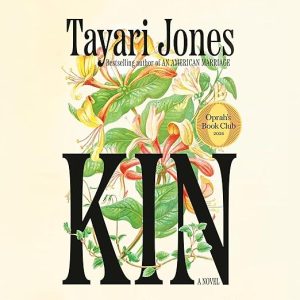
Two motherless girls from Honeysuckle, Louisiana grow into two entirely different women in this audiobook, and the distance between them is the whole engine of Tayari Jones's novel. I got through the back half of Kin: Oprah's Book Club on a long drive, the kind where you keep finding excuses to stay behind the wheel just to hear one more chapter, and what struck me most was how patiently Jones lets Vernice and Annie's lives pull apart before she ever tries to braid them back together. Vernice and Annie start as neighbors and best friends, raised without mothers in the same small Southern town. By the novel's midpoint they occupy almost different universes, and the audiobook format, with its unbroken forward motion, makes that widening gap impossible to ignore.
Vernice and Annie Drift Apart by Class
Vernice leaves Honeysuckle at eighteen for Spelman College, where she's absorbed into what the synopsis calls a sisterhood of powerfully connected Black women, a world of manners, aspiration, and money that her aunt's stable but modest household never prepared her for. Annie stays fixed on the mother who abandoned her, chasing that absence into a life of real peril and, eventually, a fight for her own survival. Jones isn't interested in which path is more virtuous. She's interested in how two people who started as mirror images of each other end up speaking almost different languages, a divergence that has as much to do with class and access as it does with individual choice.
Readers of An American Marriage will recognize Jones's patience with ordinary people making understandable, sometimes damaging decisions under pressure they didn't create. Kin extends a structural interest she explored even earlier in Silver Sparrow, another novel built around two young women whose lives run parallel without quite touching. Here the device serves a different purpose: not a shared father kept secret, but a shared childhood that money, education, and geography slowly pull apart.
Kin Means Both a Home and a Haunting
The title itself carries two competing definitions running underneath the plot. Kin as the family you build on purpose, the fierce aunt who raises Vernice into a stable home against real odds. And kin as the family that haunts you by its absence, the mother Annie can't stop reaching for even when reaching for her leads somewhere dangerous. Jones never resolves the tension between those two meanings, and the novel is stronger for refusing to.
Folding the Oprah's Book Club accolade directly into the title, rather than treating it as a separate sticker on the cover, is an unusual publishing choice worth noting. Since 1996, an Oprah selection has reliably meant a huge jump in readership and a specific kind of cultural conversation around a book, book clubs, morning shows, wide crossover appeal beyond the usual literary fiction audience, and putting that expectation right into the title signals how much confidence the publisher has in this novel finding that same broad readership.
Pean Balances Sympathy for Two Diverging Women
Angel Pean has to hold two distinct registers in one performance: Vernice's increasingly polished, Spelman-shaped voice and Annie's harder, more guarded one, without letting either character curdle into a type. One reviewer's description of the structure, that each girl narrates herself as she's going up in the world, at different speeds and toward different outcomes, is a fair test of what this narration has to accomplish, and it's a genuinely demanding assignment for thirteen hours of solo narration.
That runtime matters here. A story built on two lives drifting apart needs room to let the drift feel earned rather than schematic, and thirteen hours and ten minutes gives Jones space she wouldn't have in a shorter book. One listener described crying and laughing in close succession, which tracks with a novel that refuses to stay in one emotional register for long, alternating hard scenes with real warmth between the two women whenever their paths do cross again.
The harder task for Angel Pean isn't just keeping two voices distinct, it's keeping listener sympathy alive for both women even as their choices start to frustrate. Annie's fixation on the woman who left her leads her into genuinely reckless territory, and a narrator who tips too far into judgment or pity risks flattening a character Jones clearly wants read with compassion. Holding that balance across thirteen hours of close, intimate narration is a quieter skill than accent work, and it's the one that determines whether the back half of this audiobook still lands.
Class Stratification Gets an Unflinching, Ambivalent Look
At least one reader found the ending short of what she'd hoped for, even while crediting Jones with a beautifully told story overall. I won't spoil which sister's arc prompts that reaction, but it's worth knowing going in that Kin resists the tidy, redemptive close that a friendship narrative like this might promise on the surface. Jones is working in a realist register, and realism here means an ending that reflects the actual, unequal costs of the paths these two women chose.
This is also, quietly, a novel about class stratification inside one Black Southern community, and it doesn't flinch from the uncomfortable parts of that subject. Vernice's world of affluence and aspiration is presented with real ambivalence, not simple admiration, and listeners expecting a straightforward story of sisterhood and uplift should know the book is more interested in inequality than in easy solidarity.
Thirteen hours is real length, and once Vernice and Annie's lives fully diverge, the book spends long stretches keeping them apart, alternating chapters rather than shared scenes. Listeners drawn in by the childhood-friendship framing of the premise should know the middle section is mostly solo work for each woman, with reunion withheld until Jones has fully earned it. That's a deliberate structural choice, but it does ask for patience from anyone expecting the two friends to share the page more often.
Patient Realism Fans Get Southern Class Tension
This one is for readers who loved the patient, unglamorous realism of An American Marriage and want Jones working at similar length on a different kind of relationship. It also suits anyone drawn to Southern coming-of-age stories that take class and colorism inside Black communities seriously rather than glossing over them, and Oprah Book Club listeners who trust that particular seal more than most.
Readers who admire Jacqueline Woodson's work on Black girlhood and long-running friendship under pressure will likely find a similar sensibility here, patient, unsentimental, willing to let affection and resentment coexist inside the same relationship. Vernice's fierce aunt is worth watching for specifically too, a chosen-family figure built as a direct counterweight to Annie's absent mother, and one of the novel's clearest arguments that stability has to be actively built rather than simply inherited.
Skip it if you want a fast plot engine or a wrapped-with-a-bow ending. Kin moves at the pace of two lives actually being lived, not a thriller's pace, and the payoff is emotional accumulation rather than a twist. If patient character work isn't what you're after this month, this may test your attention more than reward it.
A Few Questions About Kin: Oprah's Book Club
Does Angel Pean narrate both Vernice and Annie in distinct voices in this audiobook, or is the narration more uniform?
Distinct voices are the whole point of the assignment. Pean shapes Vernice's register to sound increasingly shaped by Spelman and affluence while keeping Annie's voice grounded in a harder, more guarded reality, so the two never blur together even as the book moves quickly between them.
Is Kin a sequel to An American Marriage, or can this audiobook be enjoyed without reading Tayari Jones's earlier novel?
Kin is a fully separate story with new characters, not a sequel. Nothing about An American Marriage is required background, though listeners who loved that book's patient, realist tone will recognize the same sensibility here.
How long is the Kin audiobook, and does the pacing hold up across two intertwined life stories?
It runs thirteen hours and ten minutes. The length is used deliberately to let Vernice's and Annie's diverging paths breathe rather than feel rushed, though listeners wanting a brisk plot should know this is a character-paced novel, not a fast one.
Does the ending of Kin resolve both Vernice's and Annie's stories, or does the audiobook leave threads open?
Both arcs reach a conclusion, but at least one reader has been vocal that it isn't the resolution she hoped for. Jones favors an emotionally honest ending over a fully redemptive one, which is worth knowing before you start.