Quick Take
- Narration: Pete Cross brings warmth and pacing that suits the episodic chapter-per-artist structure, reading with the kind of enthusiasm a teacher would bring to a classroom biography unit.
- Themes: childhood perseverance, artistic identity, ordinary beginnings
- Mood: Encouraging and lively, ideal for short listening sessions
- Verdict: A genuinely entertaining introduction to art history for kids who need proof that great artists were once regular, struggling children.
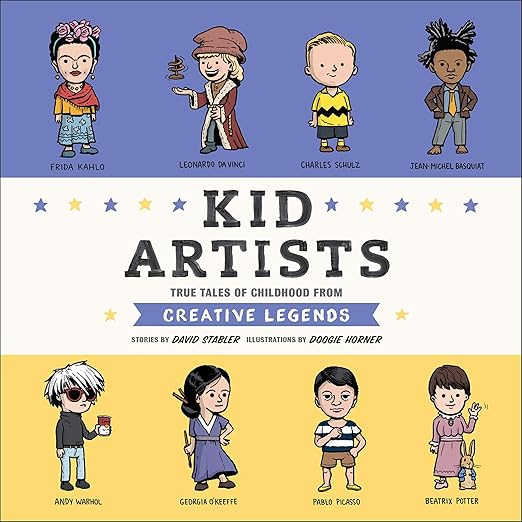
I was tidying up on a Saturday afternoon when I put this one on through the living room speaker, mostly as background. Within about ten minutes I had stopped folding laundry and was just standing there listening. David Stabler has a genuine gift for distilling a famous life down to its most relatable moments, and Kid Artists does something deceptively simple: it strips the mythology away from names like Picasso and Van Gogh and puts their childhood struggles front and center.
The book belongs to the Kid Legends series, which follows a proven format of presenting celebrated figures through the lens of their formative years. This installment covers fifteen artists, including Jackson Pollock, Georgia O’Keeffe, Jean-Michel Basquiat, Claude Monet, Leonardo da Vinci, Frida Kahlo, Beatrix Potter, Yoko Ono, Dr. Seuss, Keith Haring, and Charles Schulz, among others. The range is excellent. It is not merely a parade of European masters.
The Stories Stabler Chose to Tell
What distinguishes Stabler’s approach is his editorial instinct for the telling detail. We learn that Jackson Pollock moved eight times before he turned sixteen, which reframes his famous restlessness as something he learned early. Georgia O’Keeffe was overshadowed by a brother considered more gifted, which gives real texture to her later insistence on her own singular artistic vision. And Jean-Michel Basquiat’s story, rooted in poverty and eventual triumph, is handled with a directness that respects young listeners without softening the difficulty of his circumstances.
These are not sanitized hagiographies. The subjects struggle. They face rejection, self-doubt, family pressure, and financial hardship. A reviewer noted that her nine-year-old daughter learned facts she had never encountered before, and that the stories were genuinely fun rather than textbook-dry. That rings true. Stabler writes with real narrative momentum.
Pete Cross in the Narrating Chair
Pete Cross handles the episodic structure well. Each artist gets their own chapter, which means the narration has to reset and recalibrate repeatedly, and Cross manages the tonal variety without becoming monotonous. He is clear and well-paced, which matters for young listeners who may be following along without a physical book in hand. He does not overdo the enthusiasm, which is a genuine risk with children’s nonfiction narration. The result is something that works for a seven-year-old and does not irritate an adult listening alongside them, which is a harder balance to strike than it sounds.
What Art History Looks Like at This Age
One reviewer mentioned buying the book for an art room and having a child immediately claim it. That trajectory feels right. This is a book that serves as an entry point into conversations about creative identity, and it earns that role through specificity rather than vague inspiration. The Basquiat chapter alone, which addresses poverty without sensationalizing it, is worth the listen for any parent or teacher who wants to introduce that artist to a young audience in a grounded way. The inclusion of Yoko Ono, Dr. Seuss, and Louise Nevelson alongside the canonical European figures is also worth noting. The book’s definition of artist is broad.
Who Should Listen and Who Should Skip
This audiobook is pitched clearly at the six-to-twelve age range, and within that span it works best for kids around eight to eleven who can follow longer biographical narratives and absorb the historical context. Younger listeners will enjoy the anecdotes; older listeners may find the treatment too brief. Adults listening solo will find it pleasant but thin. As a co-listening experience for a parent and child on a road trip, it is close to ideal. Anyone hoping for deep art history or critical analysis of the works themselves will need to look elsewhere. This is about the people, not the paintings.
Frequently Asked Questions
Does the audiobook include all fifteen artists listed in the print edition?
Yes, Pete Cross narrates chapters on all fifteen subjects named in the synopsis, including Basquiat, Pollock, O’Keeffe, Monet, da Vinci, Kahlo, Potter, Ono, Seuss, Haring, Schulz, Nevelson, Lawrence, Carr, and Van Gogh.
Is this appropriate for a six-year-old listening independently, or does it need parental co-listening?
Most of the content is accessible for ages six and up, but younger listeners may miss context around subjects like Basquiat’s poverty or O’Keeffe’s family dynamics. Co-listening adds depth. An eight- or nine-year-old can follow it independently.
Is Kid Artists part of a series, and do the books in the Kid Legends series need to be listened to in order?
Kid Artists is a standalone title in the Kid Legends series. Each installment covers a different category of famous figures and can be listened to in any order without missing prior context.
Does the audiobook work without the print edition’s illustrations?
The narration is written to be understood without visual support, so the audio stands on its own. However, listeners interested in the cartoonish illustrations reviewers praise will want to pair the audio with the print book for the full experience.