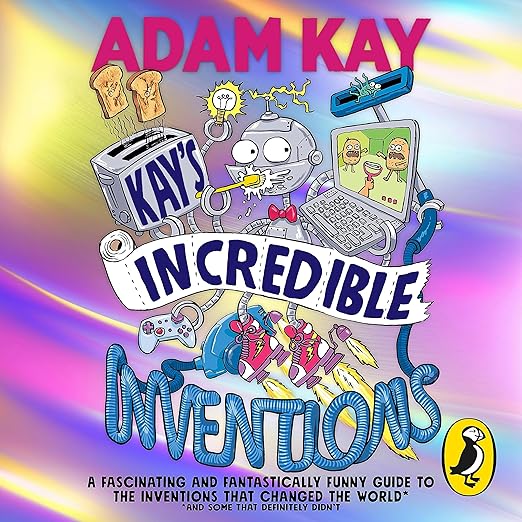
Quick Take
- Narration: Adam Kay self-narrates with the timing of a practiced comedian, his voice is the delivery mechanism for the humor, and a professional narrator could not replicate it.
- Themes: History of invention, gross science, accidental discovery
- Mood: Boisterous and irreverent with genuine educational substance
- Verdict: The third entry in Kay’s trilogy of gross-out nonfiction is as strong as its predecessors, best suited for children who learn best when they are laughing.
I came to Kay’s Incredible Inventions already familiar with Kay’s Anatomy and Kay’s Marvellous Medicine, both of which have become reliable gifts for the eight-to-twelve set in my orbit. I started this one on a Thursday afternoon commute, planning to sample a chapter or two, and finished well into the evening. The book follows the same formula as its predecessors: take genuinely interesting history, weaponize it with precisely calibrated disgust, and deliver the whole thing in the voice of a person who is both genuinely knowledgeable and deeply committed to making you laugh.
Kay, a former physician turned writer and performer, self-narrates, and that choice is load-bearing. The comedy in this book lives in the timing, in the pause before a punchline, in the way he drops his voice slightly before a particularly absurd factual aside. A professional narrator could read the text competently. Only Kay can deliver it the way it was written to land. His performance on Kay’s Anatomy set the standard, and Kay’s Incredible Inventions matches it.
The A-to-Kay-to-Z Structure
The book organizes itself alphabetically through inventions, which gives it a satisfying navigational logic. Electricity gets serious treatment alongside entries for smell-o-vision and, memorably, trampolines, which Kay describes as a creation that absolutely did not change the world but is still a lot of fun. That tonal balance, rigorous where rigor matters, gloriously silly where silliness is earned, is the thing that separates Kay’s nonfiction from lesser imitations in the genre.
The entries on household objects are where the book is most genuinely revelatory. Kay’s question about what was used before toilet paper is answered in enough specific detail to generate the kind of visible horror on a child’s face that becomes a dinner table story. But the maggots-in-margarine passage, addressing pre-refrigeration food storage, is the moment that most converts casual listeners into fans. The information is real, the history is accurate, and the framing is built specifically to make it impossible to forget.
Gross-Out as Pedagogy
There is a pedagogical argument buried inside Kay’s entire series, and it is worth stating plainly: disgust is a powerful memory anchor. Children who hear the toilet paper entry will remember the relevant history of sanitation. Children who hear the maggot-margarine section will retain something about the history of refrigeration. The entertainment mechanism and the educational mechanism are the same mechanism. One parent reviewer described a seven-year-old becoming obsessed with all things science after working through the Medicine and Inventions books in sequence, which tracks with how this kind of material works on curious kids.
At nearly six hours, this is a substantially longer listen than a picture book audio edition, and it earns that runtime. Individual chapters are short enough that a child can stop and start without losing momentum. But unlike a collection of disconnected facts, Kay maintains a conversational thread that makes the full experience feel coherent rather than encyclopedic.
What the Third Book Adds
Series fatigue is a real risk in children’s nonfiction, and it does not appear here. Kay’s Incredible Inventions feels like the work of someone who has found a format that fits him and committed to it fully rather than coasting on an established brand. The Puffin production is clean and well-mastered. The humor is consistent without becoming repetitive. And the final chapter, a trivia section designed to be played with family, adds a participatory dimension that neither of the earlier volumes offered.
Who Should Listen / Who Should Skip
Ideal for children between seven and twelve, particularly reluctant readers and curious science-minded kids. Strong family road trip listen. Works as an introduction to the series or as a continuation after Kay’s Anatomy and Kay’s Marvellous Medicine. Not suited for parents who object to mild gross-out content, though the disgust factor is firmly child-appropriate throughout.
Frequently Asked Questions
Do you need to have listened to Kay’s Anatomy or Kay’s Marvellous Medicine before Kay’s Incredible Inventions?
No. Each book in the series is fully standalone and covers completely different subject matter. Kay’s Incredible Inventions focuses on the history of invention and can be enjoyed without any prior exposure to the series.
Is Adam Kay’s narration available in US editions or is this a UK-only production?
The audiobook is a Puffin/Penguin Audio production and is available internationally through Audible and similar platforms, though Kay’s accent and some cultural references are distinctly British.
What is the recommended age range for Kay’s Incredible Inventions?
Publisher guidance points to ages seven through twelve. The gross-out content is calibrated for that range, specific enough to be funny, never gratuitous or age-inappropriate.
Does the audiobook include the trivia chapter mentioned in the synopsis?
Yes. The final chapter is a trivia section designed to be played interactively with family, which is an addition not present in the earlier books in the series.