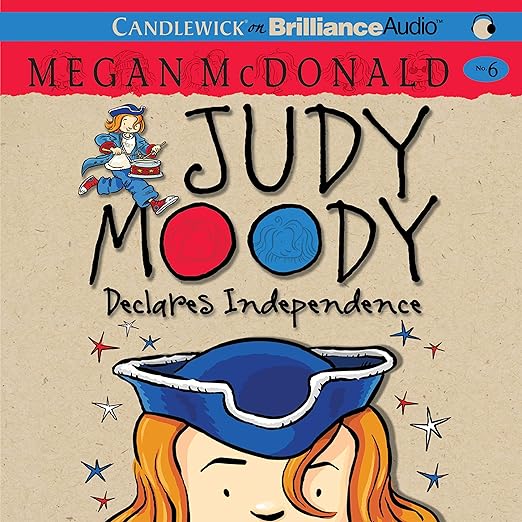
Quick Take
- Narration: Barbara Rosenblat is perfectly cast as Judy, she captures the character’s headstrong energy and comic self-seriousness without making her grating.
- Themes: Independence vs. responsibility, American history through a child’s lens, the limits of third-grade authority
- Mood: Comic and lively, with an undercurrent of genuine heart
- Verdict: One of the series’ most thematically playful entries, Rosenblat’s narration elevates the material, and the history hook gives it more substance than a typical Judy Moody episode.
The Judy Moody series has always operated on a specific comedic frequency: the gap between how seriously Judy Moody takes herself and how seriously the world is willing to take a third-grader. Judy Moody Declares Independence takes that premise and gives it an irresistible historical anchor, Judy visits Boston, absorbs the revolutionary spirit, and decides that the Founding Fathers were basically doing what she wants to do, which is be free from parental oversight and her brother Stink. The parallel is absurd, and Megan McDonald plays it straight, which is exactly right.
What surprised me about this entry, revisiting it with a critical eye, is how much actual American history is folded into the narrative. The Boston trip provides context for Paul Revere, the Declaration of Independence, and the general revolutionary temperament of 1776 in a way that registers with young listeners because Judy’s frame of reference makes it personal. She is not learning history; she is recruiting history to support her current argument. That’s a much more effective pedagogical mechanism than it has any right to be.
Barbara Rosenblat as Judy Moody
Rosenblat is the definitive Judy Moody narrator for a generation of listeners, and her work in Declares Independence demonstrates why. The technical challenge of performing Judy is managing the character’s intensity without tipping into irritation, Judy is loud, impulsive, and convinced of her own rightness in ways that could easily become exhausting over ninety minutes. Rosenblat threads this by finding genuine affection for the character beneath the bluster. Her Judy is funny rather than shrill, and when the character’s independence plans begin to backfire, the shift from triumphant to chastened is handled with real comic timing. Young reviewers who’ve written their first-ever reader reviews about Judy Moody, citing the characters’ feelings and the hints of history as what they love, are responding directly to how Rosenblat makes both elements accessible.
The Revolutionary Parallel and What It Teaches
Judy’s declaration of independence is structured as a formal document, which gives the book a running gag with genuine educational bite: Judy has to understand enough about the original Declaration to parody it effectively. The result is that young listeners absorb Jefferson’s basic arguments, unalienable rights, grievances against authority, the right to self-governance, filtered through the lens of what a third-grader considers tyrannical. Stink stealing the TV remote becomes a grievance against liberty. Parents enforcing bedtime becomes an arbitrary imposition of power. It’s silly and it’s also, surprisingly, accurate to the rhetorical structure of the Declaration. McDonald gives Judy just enough self-awareness to make the parallel work without making it didactic.
The Judy Moody Series and Where This Entry Sits
At book six in the main series, Declares Independence assumes a reader relationship with Judy that newcomers won’t fully have, particularly with Stink, whose presence in Judy’s grievances only lands as comedy if you’ve experienced the full sibling dynamic across earlier books. The audiobook works for new listeners, but returning fans will get more from the payoff when Judy inevitably reconciles with the limits of third-grade autonomy. At eighty-nine minutes, this is a full-length entry that earns its runtime. One reviewer, who identified herself as eight years old and cited the book as inspiration to become an author, probably said everything that needs to be said about what Megan McDonald and Barbara Rosenblat built here.
Frequently Asked Questions
Is Judy Moody Declares Independence a good introduction to the series for new listeners?
It works as a standalone but is richer for listeners who know Judy’s world, particularly her relationship with Stink. The series is designed for any-order reading, but the sibling comedy lands harder with accumulated familiarity. Starting with book one is rewarded but not required.
How much actual American history does the book cover?
More than you might expect. The Boston setting allows McDonald to work in Paul Revere, the Sons of Liberty, the Declaration of Independence, and the general spirit of the American Revolution, all filtered through Judy’s self-serving interpretation. Reviewers note it teaches history through humor, which is accurate.
Is Barbara Rosenblat the narrator across the full Judy Moody series?
Rosenblat has narrated the Judy Moody series consistently, making her the definitive voice for the character. Listeners who’ve heard earlier entries will find her performance in Declares Independence entirely consistent, which matters for a character whose vocal personality is so central to the experience.
What age range is this best suited for?
The Judy Moody series is typically recommended for ages 6-10, roughly grades 1-4. This particular entry skews slightly older within that range due to the American history content, children who’ve had some exposure to the Revolution in school will get extra enjoyment from the parallels.