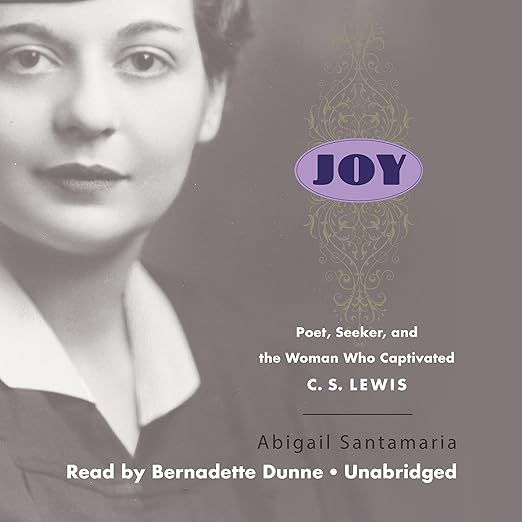
Quick Take
- Narration: Bernadette Dunne gives a literary, measured performance well-matched to the biographical subject, attentive to the intellectual and emotional registers the material demands.
- Themes: literary identity, religious conversion, women erased by proximity to famous men
- Mood: Richly researched and quietly urgent, with the texture of serious biography
- Verdict: A meticulous reclamation of a complicated woman, essential listening for anyone invested in C.S. Lewis, but fully justifying its runtime on Joy Davidman’s own terms.
There is a particular kind of erasure that happens to remarkable women who happen to fall in love with more famous men. Joy Davidman has been subject to it comprehensively: she appears in C.S. Lewis biographies as a plot point, in the film Shadowlands as a softened romantic protagonist, and in Lewis’s own A Grief Observed as the beloved whose death produced that extraordinary grief. Abigail Santamaria’s biography is a corrective act, over fourteen hours, it restores Davidman to her own story.
I sat with this one over several evenings, and I found myself returning to it with the kind of anticipation I usually reserve for fiction. The research is exhaustive, the argument is clear, and Davidman herself is a genuinely astonishing figure once you understand her full biography.
Our Take on Joy
Santamaria begins with Davidman’s Bronx origins, born to Jewish immigrant parents, a child prodigy who became a poet and novelist, and works forward through her years as a communist intellectual and contributor to New Masses, her unlikely conversion to Christianity, her difficult first marriage, her arrival in England, and eventually her marriage to C.S. Lewis. That trajectory, from atheist to Dianetics to Christianity, from communist literary circles to Oxford, would be remarkable in fiction. As biography it is almost unbelievable, and Santamaria treats it with the seriousness it deserves.
The section covering Davidman’s literary friendships in New York in the 1930s and 40s is particularly vivid. She was working in the same circles as some of the most significant writers of the period, and Santamaria places her there credibly rather than gesturing vaguely at the cultural context. Reviewer James McGrath Morris, himself a biographer, praised the portrait as the honest, engaging one Davidman has long deserved, which is high-caliber professional praise and warranted.
Why Listen to a Biography Whose Subject Is Better Known as Someone Else’s Wife
Fourteen hours is a substantial commitment, and some listeners may find the pacing in the earlier sections deliberate to the point of patience-testing. Santamaria is thorough with sources and the biography proceeds chronologically without many shortcuts. But that thoroughness is the argument: the case for Davidman’s significance depends on the accumulation of detail. You cannot understand how much she brought to Lewis intellectually and spiritually without first understanding the person she was before she ever wrote to him. Reviewer Cosenza, who gave the book four stars, noted feeling unsatisfied at the end, not because the biography fails, but because Davidman’s life was so compressed at its richest that even a thorough account leaves you wanting more.
What to Watch For in Bernadette Dunne’s Narration
Dunne brings a literary sensibility to the narration that serves the material well. She moves between the American settings of Davidman’s early life and the English world she ultimately inhabited without awkwardness, and she handles the shifting tonal registers, the political passion, the intellectual energy, the later spiritual depth, with consistent authority. A biography this densely researched could easily become a recitation in lesser hands; Dunne makes it feel like the telling of a life. The Blackstone Audio production is clean and well-paced for the length.
Who Should Listen to Joy
If you have ever read C.S. Lewis and wondered who Joy Davidman actually was beyond her role in his grief, this biography will be revelatory. It is also essential for anyone interested in the radical literary culture of 1930s and 40s New York, in mid-century religious conversion narratives, or in the history of women writers who were systematically overlooked by the literary establishment of their time. It is not a quick or casual listen, Santamaria demands your attention across fourteen hours of documented detail. If you are willing to give it, this is an exceptional piece of biographical writing. It is also a necessary corrective to a literary history that has consistently undervalued the women who shaped, and in many cases significantly influenced, the men it celebrates.
Frequently Asked Questions
Do I need to be a C.S. Lewis fan to appreciate this biography?
No, though Lewis fans will gain considerable context about the later period of his life. Santamaria makes a deliberate case that Davidman deserves to be understood as a significant figure in her own right, as a poet, a political intellectual, a convert, and a mother, independent of her relationship with Lewis. The biography works for readers with no prior Lewis investment.
How does the biography handle the tension between Davidman’s communist past and her Christian conversion?
Santamaria treats both phases of Davidman’s intellectual life with equal seriousness, neither sensationalizing the communist period nor diminishing it in light of her later faith. The conversion is presented as a genuine spiritual event, and the biography examines the continuities and discontinuities between Davidman’s political radicalism and her subsequent religious commitments with real nuance.
Is Bernadette Dunne’s narration suited to a 14-hour biography of this scope?
Dunne is a strong choice for long-form biography. Her pacing is measured and she brings appropriate gravitas to serious material without making it feel funereal. Listeners who struggle with dense biographical narration may find the total runtime demanding, but Dunne keeps the voice alive across the full length.
How much of the biography covers the Lewis marriage versus Davidman’s life before England?
Santamaria gives significant attention to Davidman’s full American life, the New York literary years, the communist intellectual circles, the first marriage, the conversion, before the England chapters. The Lewis relationship is the culmination rather than the whole story. Readers expecting primarily a behind-the-scenes account of the Lewis marriage will find the earlier sections more substantial than they might anticipate.