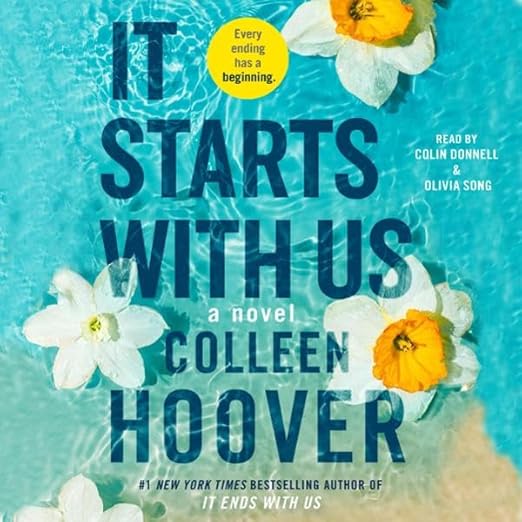
Quick Take
- Narration: Colin Donnell handles the dual Lily and Atlas perspectives with warmth, though listeners should note the audiobook uses a single narrator for what is a two-POV novel.
- Themes: Healing after domestic abuse, second chances and earned trust, co-parenting under shadow of an ex-partner
- Mood: Emotionally warm and quietly hopeful, a breath taken after a long difficult exhale
- Verdict: A necessary continuation that answers what the first book left unresolved, particularly for Atlas’s inner life, and does so with genuine emotional craft.
I read It Ends with Us three years ago and felt the way you sometimes feel after finishing a book that has done something real to you: slightly wrung out and very reluctant to return to anything lightweight. I came to It Starts with Us with that emotional residue still present and with the particular wariness that sequels earn when the original was as affecting as Colleen Hoover’s first Lily and Atlas novel. The sequel had everything to prove and a difficult emotional register to maintain.
It earns its place. That is not a small thing to say about a sequel to a book about surviving an abusive relationship. Hoover makes choices here that feel considered rather than commercial. She doesn’t manufacture new trauma to sustain momentum. Instead, she gives Lily a version of peace that is complicated rather than simple, and she gives Atlas an interior life that the first book only gestured at.
Our Take on It Starts with Us
The setup picks up directly from the epilogue of It Ends with Us. Lily and Ryle have settled into a civil co-parenting rhythm when Atlas reappears. The structure of the novel alternates between Lily’s and Atlas’s perspectives, which is the book’s most significant structural addition relative to the first volume. Getting Atlas’s point of view is not just a fan-service gesture. It adds genuine information to the story, particularly about how he has processed his own history and what his feelings for Lily have meant across years of absence.
Reviewers who had read both books back-to-back described the experience as seamless, and that continuity is real. Hoover maintains the tonal consistency between the two books while shifting the emotional center. Where It Ends with Us was largely about recognizing harm and leaving, It Starts with Us is about what comes next, the slower and less cinematically dramatic work of building something that actually holds. One reviewer described it as a warm, healing exhale after the first book, which captures the shift in emotional register accurately.
Why Listen to It Starts with Us
Colin Donnell’s narration gives the emotional passages room to breathe. The dual POV requires him to distinguish between Lily’s voice and Atlas’s, which he does with consistent differentiation across the eight-plus hour runtime. The material rewards a narrator with genuine sensitivity to pacing, and Donnell provides it. Several reviewers praised the flow between the two books as a listening experience specifically, suggesting that the audio format serves Hoover’s prose particularly well.
The romantic arc between Lily and Atlas is handled with restraint. Hoover does not rush them, and that discipline is part of why the book works. The reader knows these characters, knows their histories, knows the obstacles, and so every step forward carries weight. The jealousy and interference from Ryle, who remains a significant presence despite being out of the marriage, is handled with enough nuance to avoid reducing him to a simple obstacle. He is still the father of Lily’s daughter, and the book doesn’t let either character, or the reader, forget that.
What to Watch For in It Starts with Us
This is not a standalone novel. Readers who have not read It Ends with Us first will find themselves without the emotional context that gives this book its meaning. The events Lily references, her marriage, the abuse, the decision to leave, all happened in the first book, and It Starts with Us assumes you have processed that experience alongside her. A reviewer was explicit about this: read the first book before moving to this one.
Some readers who came to this novel expecting the same level of narrative tension as the first book found it quieter than expected. That quietness is not a failure. It is appropriate to the story Hoover is telling, which is about healing rather than crisis. But listeners calibrated for the first book’s sustained tension should know they are entering different emotional territory.
Who Should Listen to It Starts with Us
Readers who finished It Ends with Us and needed to know what happened next will find this book answers those questions with care. Listeners interested in contemporary fiction that handles themes of domestic abuse recovery without sentimentalizing the process will find Hoover’s approach more rigorous than the genre sometimes manages. Anyone approaching this as a first Hoover novel should start with the first book without exception.
Frequently Asked Questions
Is It Starts with Us a direct sequel and do I need to read It Ends with Us first?
Yes, absolutely. The book begins immediately after the epilogue of It Ends with Us and assumes full familiarity with Lily’s marriage, the abuse she experienced, and the circumstances of her separation. Reading the first book is not optional.
Does Atlas get his own POV chapters in this audiobook?
Yes, and this is one of the sequel’s most significant additions. The novel alternates between Lily’s and Atlas’s perspectives, giving readers access to his inner life for the first time across the series. Reviewers found this addition genuinely meaningful rather than a structural gimmick.
How does Colin Donnell handle the transition between Lily’s and Atlas’s perspectives?
Donnell maintains distinct vocal registers for each character, making the alternating POV easy to track without requiring chapter headers as orientation. The narration has been praised for its emotional sensitivity, particularly in the quieter relationship-building sequences.
Is this a lighter or darker read than It Ends with Us?
Lighter in terms of crisis and tension, though not light in an escapist sense. The book is concerned with healing, second chances, and the slow rebuilding of trust, which makes it emotionally warmer than the first book while still taking the underlying subject matter seriously.