Quick Take
- Narration: Olivia Song inhabits Lily Bloom with a restraint that proves essential – she never overplays the abuse sequences, which makes them land with a quiet devastation that a more performative reading would undercut.
- Themes: Domestic abuse cycles, first love versus mature love, self-worth under pressure
- Mood: Emotionally charged and slow-burning, with a gut-punch third act
- Verdict: Colleen Hoover’s most structurally ambitious novel, and Olivia Song’s narration makes the audio version one of the stronger formats in which to experience it – particularly for listeners who find the subject matter difficult to approach in silence.
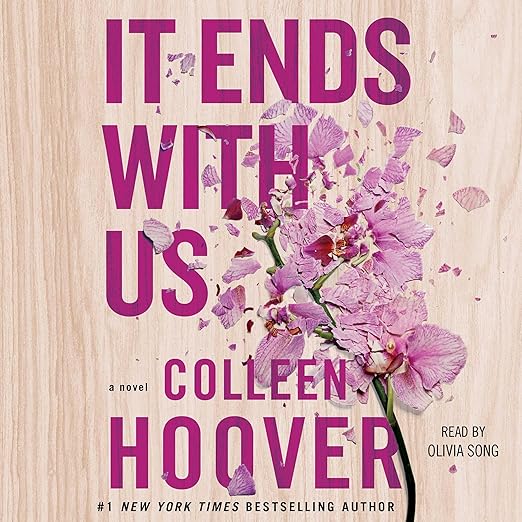
I read It Ends with Us for the first time in print the year it came out, back in 2016, when it had not yet accumulated the cultural weight it carries now. I came back to the audiobook version sometime later, partly because of the film release starring Blake Lively and Justin Baldoni, and partly because I was curious how Olivia Song’s performance would handle material that I already knew was going to be hard. The answer is: better than I expected, and in ways I did not entirely anticipate.
Colleen Hoover’s novel is often described as a romance, which is technically accurate but functionally misleading. It is a romance in the way that certain films about love are also films about violence – the love is real and the tenderness is real, but neither is what the book is ultimately about. What Hoover is doing here is tracing the architecture of intimate partner abuse: how it establishes itself inside a relationship that begins with genuine feeling, how it repeats, how it justifies itself through love, and how extraordinarily difficult it is to break free of even when you understand exactly what is happening to you.
Our Take on It Ends with Us
Lily Bloom is not a passive character or a victim stereotype. She is an entrepreneur, she is ambitious, she is self-aware about her own history with her father’s violence. And that self-awareness is precisely what makes her story so hard to read. Hoover is showing us that knowledge does not equal escape. Lily knows the pattern. She has seen it. She has consciously built a life meant to avoid it. And she still ends up inside it.
Reviewer Breanne, whose four-star review is one of the most measured in the dataset, wrote that the novel explores love, trauma, and the strength it takes to break painful cycles. She called it deeply relatable. That word – relatable – is one that gets flattened in marketing language, but here it does real work. The statistics on how many readers have recognized their own experiences in Lily’s story suggest that Hoover has written something more documentary than fictional in its emotional specificity.
Why Listen to It Ends with Us
Olivia Song’s narration is the audio version’s defining quality. She reads Lily as someone who is always thinking, always processing, always editing her own emotional responses for an audience she cannot name. There is a restraint in Song’s performance that mirrors the way Lily moves through her own story – careful, careful, and then suddenly not careful at all. When the moments of violence arrive, Song does not telegraphs them with tonal shifts. They arrive as they do in real life, within the context of an ordinary afternoon, and that choice is devastating in the best possible sense.
One reviewer wrote that she did not cry during the book but cried several days later, looking back on Lily’s story. That delayed response is something the audiobook actually facilitates. When you are listening rather than reading, the experience sits slightly differently in your body, and Song’s patient, interior performance creates the conditions for that kind of retrospective impact.
What to Watch For in It Ends with Us
The novel has attracted some criticism for the complexity of how it portrays Ryle, who is simultaneously written as someone Lily loves deeply and someone who harms her. Some readers have found the sympathy the narrative extends to him difficult to accept. Hoover’s intention, most clearly articulated in the framing of Atlas Corrigan and in Lily’s own interior arguments, is to show that this ambivalence is not a failure of the protagonist’s judgment but a feature of how abuse actually works inside loving relationships. Whether that depiction sits well with individual readers depends on their own experience and on how much they need the novel to deliver clear moral verdicts.
The appearance of Atlas as a structural counterweight to Ryle works better on paper than it might seem from the synopsis. His presence is not the love-triangle mechanic it appears to be. He is a reminder, a baseline, a measure of what Lily has always known real gentleness to look like.
Who Should Listen to It Ends with Us
This is a novel for readers who want fiction that takes emotional difficulty seriously rather than using it as a plot lever. If you want a romance that is primarily comforting, this is not that book. If you want a novel that genuinely grapples with why intelligent, capable women stay in abusive relationships – and does so without reducing the answer to lack of self-worth – then It Ends with Us delivers something rare. Listeners who are currently in or recently out of similar situations should approach with care and on their own terms. The film adaptation reportedly prompted significant increases in domestic violence hotline calls, which tells you something real about the book’s reach into lived experience.
Frequently Asked Questions
Does Olivia Song’s narration handle both the romance and the abuse sequences effectively, or does one work better than the other?
Song handles both with equal skill, but her management of the abuse sequences is what makes the performance distinctive. She resists any impulse to signal those moments in advance, which makes them land with the same disorienting ordinariness that Hoover builds into the prose. The romance sequences are warmer and more open, which makes the contrast functional rather than jarring.
Is It Ends with Us appropriate for readers who have personal experience with domestic abuse?
The novel depicts intimate partner violence with specificity and without exploitation. Many readers with personal experience have found it cathartic or clarifying; others have found it difficult to be inside Lily’s perspective for extended periods. It is worth knowing before you start that the abuse is not presented as a brief incident but as an ongoing pattern that the novel traces in real time. Content warnings for physical and emotional abuse apply throughout.
How does the audiobook compare to reading the novel in print, particularly for the emotional impact?
The audiobook’s impact is more gradual and interior. Song’s restrained performance keeps you inside Lily’s experience in a way that can feel quieter during the listen and more accumulative afterward. Several reviewers have described a delayed emotional response – understanding the book’s full weight days after finishing it. That effect seems more common with the audio version than with print.
Should I read the sequel, It Starts with Us, before or after listening to this one, and does this audiobook end on a cliffhanger?
It Ends with Us has a complete arc with a definitive ending – it does not leave major plot threads unresolved. It Starts with Us picks up Lily’s story afterward and focuses on what comes next for her and Atlas. Most readers and listeners find starting with this first novel the right approach, since its emotional resolution is more powerful when you have not yet seen where things go.