Quick Take
- Narration: Hillary Huber has narrated Ferrante before and it shows – the cadence is consistent with the novels, which makes the shorter essays feel continuous rather than disconnected.
- Themes: Female experience and authorship, private identity under public scrutiny, the gap between life and fiction
- Mood: Precise, intimate, occasionally incomplete
- Verdict: Essential for Ferrante completionists, slighter than Frantumaglia or the novels, and not a starting point for new readers.
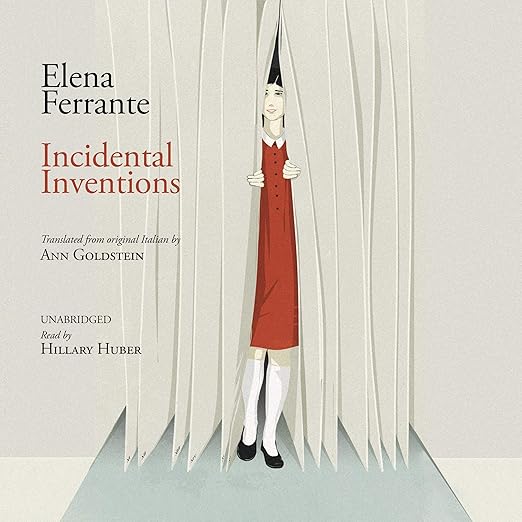
I have read all four Neapolitan novels and most of Frantumaglia, and I came to Incidental Inventions with some skepticism about what a collection of newspaper columns could add to my understanding of Ferrante. The essays originated as weekly pieces for The Guardian in 2018, written at the editors’ suggestion on topics as disparate as first love, climate change, and watching her own novels adapted for television. At just over three hours, narrated by Hillary Huber, this is the briefest Ferrante audiobook available in English – and, depending on what you bring to it, either a satisfying aperitif or a slightly unsatisfying main course.
I listened to it on a Sunday morning with nowhere to be, which turned out to be exactly the right conditions. This is not a book to rush – it rewards slow attention and occasional pausing to sit with a thought before moving on to the next one.
Our Take on Incidental Inventions
What Ferrante describes in her farewell note is a “prolonged interlocution” with Guardian editors, a year of writing on assigned subjects while maintaining her characteristic anonymity. The result is a collection that feels like watching a novelist think at speed on constraint. She is not performing for the column format; she is genuinely working through ideas that, as she says, she hopes to develop “within real narrative mechanisms.” Readers of the Neapolitan novels will recognize the preoccupations: female enmity and solidarity, the experience of being seen through fiction, the discomforts of public and private identity. The essays are short and precisely made, and translator Ann Goldstein – who has translated all of Ferrante’s major fiction – keeps the prose rhythmically consistent with the novels. That continuity matters more in audio than it might on the page.
Why Listen to Incidental Inventions
Hillary Huber is an excellent choice for this material. She has narrated several of Ferrante’s works in English and has developed an ear for the author’s particular cadence – the way sentences build through accumulation, the way a thought that seems to arrive at one destination reveals it was heading somewhere entirely different. One reviewer described the writing as having “no sugar coating of existence – just real and genuine communication,” and Huber’s delivery honors that quality without over-dramatizing it. For listeners who have spent extended time with the Neapolitan series, there is a specific pleasure in hearing Huber read these shorter, more direct reflections – they illuminate how consistent Ferrante’s concerns are across radically different forms and contexts.
What to Watch For in Incidental Inventions
The completionist reviewer who called this “much less interesting than Frantumaglia or her novels” is not wrong – this is a slighter work than either of those. The column format imposes brevity that occasionally truncates an idea just as it becomes interesting. Some essays feel more fully realized than others, and the topical subjects – specific political moments from 2018, particular cultural events of that year – date in ways that the more personal and literary essays do not. This is, fundamentally, a book for Ferrante devotees rather than an entry point. Those hoping to encounter the author for the first time through this collection will miss much of the resonance that existing readers bring to even her smallest observations.
Who Should Listen to Incidental Inventions
Dedicated Ferrante readers who want to hear the author thinking outside the novel form will find genuine reward in these three hours. The essays function as windows into the preoccupations that drive the fiction – a careful listener will recognize ideas that appear in embryonic form here and developed more fully in the Neapolitan novels and later work. One reviewer framed it aptly: these are “the seeds of future novels, the timely reflections of this internationally beloved storyteller.” New listeners should start with the Neapolitan series or with Frantumaglia, which is deeper and more revealing. For everyone already inside Ferrante’s world: this is brief, precise, and worth your Sunday morning.
Frequently Asked Questions
Do you need to have read the Neapolitan novels before listening to Incidental Inventions?
Yes, ideally. The essays assume familiarity with Ferrante’s fiction and public persona. Newcomers will find the writing engaging on a sentence level but will miss much of the resonance – particularly in essays that address the experience of adaptation and the relationship between author and characters.
How does Hillary Huber’s narration compare to her work on the Neapolitan novels?
Consistent and well-calibrated. Huber has narrated multiple Ferrante works in English and has developed an ear for the author’s rhythms. The shorter, more discursive essay format presents different challenges than novel narration, and she handles the tonal variation well.
Is Incidental Inventions similar to Frantumaglia?
In subject but not in depth. Frantumaglia is a more expansive collection of letters and interviews that gives more sustained insight into Ferrante’s thinking and creative process. Incidental Inventions is shorter and less comprehensive – more a curio than a document. Listeners interested in Ferrante’s inner life should read Frantumaglia first.
What topics do the Guardian essays cover?
The range is wide: first love, climate change, enmity and solidarity among women, motherhood, the experience of watching her novels adapted for film and television, aging, political events from 2018. The variety is part of the interest but also part of what makes the collection feel uneven – some subjects draw out more interesting responses than others.