Quick Take
- Narration: Kate Reading is a consummate historical romance narrator, her pacing and warmth suit Leonora and Rook’s dynamic well, and she handles the comic secondary characters with appropriate lightness.
- Themes: Desire versus duty, class and national identity, the cost of reputation in a rigid society
- Mood: Warm and slow-burning, with flashes of wit and genuine emotional stakes
- Verdict: A satisfying close to the Chessmen trilogy that leans into emotional sincerity over high drama, not the series’ most electric entry, but genuinely well-crafted.
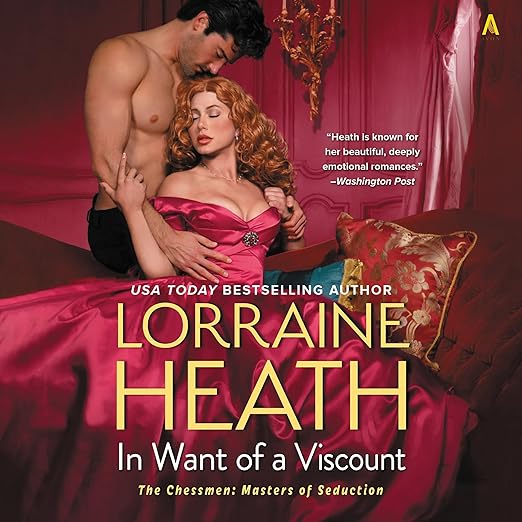
I finished this one on a Saturday afternoon when I had no obligations and a pot of tea going cold beside me. That is exactly the right context for In Want of a Viscount, it is the kind of historical romance that does not demand anything of you except that you slow down and let it work. Lorraine Heath’s third book in the Chessmen: Masters of Seduction series pairs Rook (John Castleton, Viscount Wyeth) with Leonora Garrison, an American inventor’s daughter who has come to England looking for investors, not love. The setup has a transatlantic friction that Heath uses smartly, and the listen went by faster than I expected.
The series premise is elegant: a group of men who gather at the Elysium, an exclusive club that exists outside polite society’s rules. Heath has used the club to great effect across the trilogy as a space where desire can be admitted without social consequence, at least temporarily. Here, Leonora visits the club in search of her first kiss and encounters Rook before either of them knows who the other is. That anonymous encounter sets the emotional trajectory of the entire book, and Heath handles the will-they-won’t-acknowledge-each-other tension with real craft.
Our Take on In Want of a Viscount
This is a romance built more on emotional texture than on plot mechanics, and Heath’s prose earns that approach. Rook is a viscount who has spent his adult life constructing a reputation that is the exact opposite of his libertine father’s legacy. The irony, that he finds himself wanting to abandon that reputation the moment he holds Leonora in the Elysium, is the book’s central engine, and Heath keeps returning to it in ways that feel earned rather than repetitive.
One reviewer offered the sharpest honest note about this entry: compared to the preceding books in the Chessmen trilogy, this one is quieter, less kinetic. “Humdrum” was the word used, and while I think that undersells what Heath achieves here, there is something to the observation. The conflict does not escalate with the velocity of some historical romance, and the mother subplot, Leonora’s selfish, outlandish mother provides most of the comic interference, feels more farce than real dramatic weight. But the central love story between Johnny and Nora is genuinely moving, and Heath does something specific and intelligent with Leonora’s position as an American woman seeking commercial independence in Victorian England. That tension between needing an investor and wanting a man is not just window dressing; it shapes every scene they share.
Why Listen to In Want of a Viscount
Kate Reading’s narration is a significant asset. She has spent decades in historical fiction and brings an ease to period dialogue that younger or less experienced narrators sometimes struggle with. Her Leonora has just enough American bluntness to contrast with the drawing-room circumspection of the English characters around her, and her Rook is warm without being soft. The result is a listening experience that feels comfortable in the best sense, you trust the narrator and can give yourself over to the story.
Fans of Heath’s earlier work in this series, or in her other Victorian and Regency romances, will find exactly what they expect and likely enjoy themselves thoroughly. Several reviewers noted the appearances of characters from previous Chessmen books, and Heath handles those cameos well, giving readers something to recognize without letting the subplot distract from Leonora and Rook.
What to Watch For in In Want of a Viscount
The dowager subplot, the search for her children that one reviewer mentions, runs quietly through the book and pays off in ways that feel emotionally resonant if you have followed the series. If you are coming to this as a standalone, it will register as background texture rather than a driving concern, which is fine; Heath does not require you to have done the homework. But if you have read the earlier entries, the resolution of this thread adds a layer of warmth to the final act that stands on its own merits.
Also worth noting: the Elysium club itself functions as more than a plot convenience. Heath uses it as a genuine space of permission, a place where the rules that constrain both Leonora and Rook in their daily lives temporarily do not apply. The contrast between who they can be inside the club and who they must be in society is where the novel’s real emotional argument lives.
Who Should Listen to In Want of a Viscount
This is a natural listen for historical romance readers who have spent time with Heath’s work, particularly the Chessmen series. It works as a standalone but rewards prior investment. Anyone who enjoyed the first two Chessmen entries and wants a satisfying conclusion will find this delivers on those terms. Readers expecting the pacing of a plot-driven thriller will find it too slow; this is a character-first romance and is best approached on those terms.
Frequently Asked Questions
Can In Want of a Viscount be listened to without reading the first two Chessmen books?
Yes, Heath writes it to function as a standalone. Characters from the previous entries appear, but the central romance between Leonora and Rook does not require prior knowledge to follow or enjoy.
How explicit is the content in this audiobook compared to typical historical romance?
Heath writes at the more sensual end of mainstream historical romance, intimate scenes are present and written with specificity, but this is not erotica. It sits comfortably within the genre’s standard range.
Is Kate Reading the narrator across the full Chessmen trilogy?
Based on available metadata, Kate Reading narrates this third entry. Listeners who enjoy her performance here and want to continue or revisit the series should verify narrator credits for Books 1 and 2, as anthology series sometimes feature different narrators across entries.
Why do some reviewers find this the weakest entry in the trilogy?
The consensus among mixed reviews points to pacing, the conflict between Leonora and Rook resolves with less dramatic tension than the earlier books, and Leonora’s mother provides comic relief that some find delightful and others find a distraction. Heath prioritizes emotional sincerity over plot escalation here.