Quick Take
- Narration: Virtual Voice AI narration, this affects the listening experience in meaningful ways and is worth knowing before you buy, particularly for a slice-of-life romance that depends on emotional nuance.
- Themes: Starting over in a literally alien context, geek identity and unexpected romance, the question of what comes after adventure
- Mood: Warm, unhurried, and quietly joyful, the exact opposite of a propulsive plot
- Verdict: A lovely extended visit to the Touchstone world for devoted series readers, though the AI narration is a real limitation for this emotionally dependent material.
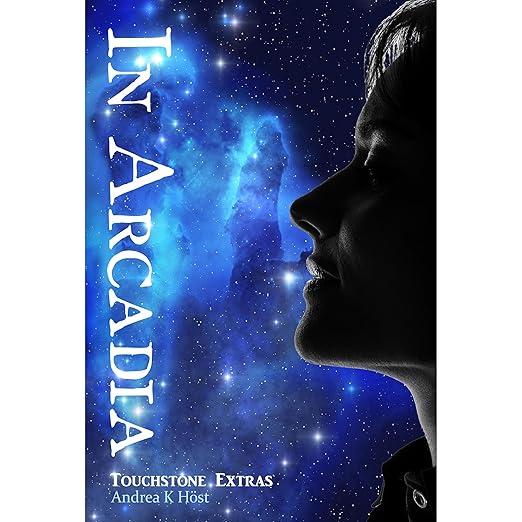
I had not read the Touchstone Trilogy before I came to In Arcadia, which is, per the author’s own note in the synopsis, a mistake. The book describes itself as backstory-heavy and readable as a standalone but necessarily full of spoilers for the prior series. I can confirm both of those things are accurate. I followed the plot without difficulty; I almost certainly missed most of the emotional resonance that readers who know Cassandra’s story would bring to this book. I am noting that upfront because it matters for how you approach this review.
What I can say with confidence is that Andrea K. Host (the umlaut over the o is in the original) writes the kind of fiction that generates devoted readership rather than casual interest. In Arcadia centers on Laura Devlin, who has followed her daughter Cass to Tare, a futuristic clone of Earth that operates as something very close to a utopia by the standards of the world Laura came from. She has psychic grandchildren, a daughter who is immensely famous in this new world, and a military organization called KOTIS that has apparently decided her entire family is government property. Against all of that, she meets Gidds Selkie, a military officer described as chipped from flint, and is surprised to find herself considering the possibility of a second chance at something she had not planned for.
Our Take on In Arcadia
The author describes this as a slice-of-life fade-to-black romance, and that description is doing important work. This is not a book where things happen in the conventional plot sense. The conflict is internal and interpersonal. The world-building arrives through observation rather than action. The emotional stakes are personal rather than civilizational. For readers who came to the Touchstone Trilogy for Cass’s world-altering adventures, this book is a quiet afternoon in a place they love rather than another adventure in it.
That can be exactly what you want, or it can feel like not enough. Reviewers who loved the series are divided on that question in interesting ways. Some describe In Arcadia as deeply satisfying, a resolution and a deepening of the world they have come to care about. Others wish for more narrative momentum. Both responses make sense given what the book actually is.
Why Listen to In Arcadia
The narration here is handled by Virtual Voice, which is Audible’s AI text-to-speech system. This is relevant and worth addressing directly. AI narration has improved substantially, but for a slice-of-life romance that depends on emotional nuance, the hesitation between Laura and Gidds, the warmth of found family, the specific texture of someone who has been burned before allowing herself to be tempted again, the limitations of synthetic narration are most apparent. The prose carries enough of that nuance that the story comes through, but listeners who are sensitive to the difference between human and AI performance will notice it consistently.
At just over seven hours, the book is well paced for what it is. It does not overstay its welcome, and the leisurely pace feels deliberate rather than slack. The world-building that arrives through Laura’s observational intelligence is the book’s most consistently effective quality, and it does not require emotional performance from the narrator to land.
What to Watch For in In Arcadia
The series designation here is Touchstone, Book 5, which places it after the main trilogy and after at least one other related work. Jumping in at book five without the prior context means you will be meeting characters that series readers love in circumstances whose emotional weight you cannot fully access. This is particularly true of Cass, whose presence in this book as Laura’s famous and extraordinary daughter is clearly intended to produce a specific emotional response in readers who watched her become who she is.
There are also, per at least one reviewer, some typos and punctuation errors in the underlying text. In a human narration, these would be smoothed over in performance. With AI narration, the text is reproduced more literally, which means any textual roughness surfaces more directly in the listening experience.
Who Should Listen to In Arcadia
Frequently Asked Questions
Is In Arcadia readable without having read the Touchstone Trilogy first?
The author explicitly addresses this: it can be read as a standalone but contains inevitable spoilers for the prior series and assumes familiarity with the world and characters. The plot is followable; the emotional resonance is significantly reduced without the prior context.
How much does the Virtual Voice AI narration affect the listening experience?
For a slice-of-life romance that depends on emotional nuance and the texture of developing relationships, the AI narration is a real limitation. The prose is strong enough that the story comes through, but listeners sensitive to synthetic narration will find it consistently noticeable.
Is the romance between Laura and Gidds developed fully within this book, or does it require knowledge of previous installments?
The romance is self-contained within In Arcadia, Laura and Gidds’s relationship develops from its beginning within this book and does not require prior knowledge of either character. The world-building context around them is what benefits from series familiarity.
How does In Arcadia compare in tone and pace to the main Touchstone Trilogy?
It is significantly quieter. The Touchstone Trilogy involves world-altering events and genuine action; In Arcadia is the author’s own description as a slice-of-life romance, set in the same world but centered on observation, relationship, and the question of what comes after adventure rather than adventure itself.