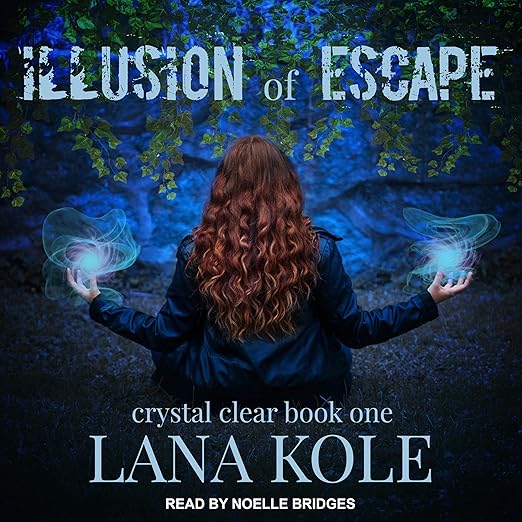
Quick Take
- Narration: Noelle Bridges handles the reverse-harem dynamic with clear character differentiation, giving each of the four male leads a distinct voice that prevents the ensemble from collapsing into a blur.
- Themes: Reluctant chosen-one discovery, loyalty and brotherhood, trust earned through action
- Mood: Propulsive and lightly comedic, with genuine emotional investment in the ensemble
- Verdict: Illusion of Escape earns its series-opener status by building a world that feels inhabited and leads who feel distinct, which is harder in a reverse-harem format than the genre’s popularity might suggest.
A close friend had been recommending this series to me for the better part of a year. I kept putting it off, partly because I had read enough reverse-harem urban fantasy to have developed a reflexive defensiveness about the format’s tendency to collapse into indistinguishable love interests and a heroine defined entirely by her reactions to them. Lana Kole’s Illusion of Escape, Book 1 of the Crystal Clear series, is different enough from that pattern that I spent the first half quietly revising my assumptions.
The book was originally published in 2019 and arrived on audio via Tantor in September of that year. It has accumulated 762 ratings at 4.4, which is a strong base for an independent paranormal romance that launched a series now substantial enough to have generated a sequel series from the same author. The fact that the author’s newer work is apparently what drove readers back to discover this book is informative about the kind of loyalty Kole generates.
Our Take on Illusion of Escape
Moriah Copeland is a social worker, focused on children the system overlooks, who has suppressed or been unaware of magical abilities she carries. Her dream life has been a space where she experiences her worst fears and, separately, a genuine emotional connection with someone she cannot quite identify. When the dream connection turns out to be real, and when three men with an urgent problem show up at what was supposed to be a promising second date, the book’s logic springs to life quickly.
The four male leads, Kaiser, Walker, Remington, and Levi, are distinguished primarily through temperament rather than simply through physical description. Kai carries the dramatic volatility that one reviewer found tiresome and another found entertaining. Walker’s protective instincts reflect the three-year separation that has hollowed out the group’s sense of completeness. Remi brings playfulness. Levi operates in a register of quiet intelligence. The magic-driven explanation for Walker and Mori’s connection, the soul-deep bond established through her dream presence, is given a structural grounding through the magic system that prevents it from feeling purely convenient.
Why Listen to Illusion of Escape
Noelle Bridges is the right narrator for this material. The reverse-harem format’s primary technical challenge in audio is voice differentiation among a group of male leads who risk sounding similar when read by a single narrator. Bridges solves this with enough tonal and rhythmic variation that each character retains his distinct register across scenes. Mori’s wit, which several reviewers specifically praised as making her feel genuinely capable rather than passively chosen, comes through with the necessary sharpness in Bridges’s delivery. The comedy beats land.
The book moves quickly once the initial setup is established. The pacing is deliberate during the first act, while Mori is being introduced to the existence of the magical world and the men who need her help, and then accelerates substantially. One reviewer admitted a slow start that clicked dramatically once Mori met Remi and Walker, which matches the structural shape of the listening experience well. The investment in the early character work pays returns in the second half.
What to Watch For in Illusion of Escape
The magic system uses a spelling convention, magycal, magekynd, that appears consistently throughout the text and has attracted occasional eye-rolling from reviewers who find the alternate spellings distracting. This is a stylistic choice Kole makes to mark magical terminology within what is otherwise contemporary language, and its effect will depend entirely on individual tolerance for this kind of speculative worldbuilding signaling. It is not a plot issue but it is a persistent surface-level stylistic one.
The kidnapping element deserves mention. The four men’s introduction to Mori involves taking her against her will as a means of persuading her to help them. This is a plot mechanic the book acknowledges and attempts to address through the subsequent dynamic, but it is a common convention in paranormal romance that not every reader is comfortable with as a romantic setup. Kole handles the aftermath with some care, but listeners who find kidnapping-as-meet-cute irrecoverable will have that noted as a barrier.
Who Should Listen to Illusion of Escape
Paranormal romance readers who specifically enjoy reverse-harem configurations and are looking for a series with a strong ensemble rather than a single romantic lead are the natural audience. The Crystal Clear series has generated enough investment from readers that the first book functions more like an entry point to a sustained world than a standalone story.
Listeners who prefer their urban fantasy on the lighter, comedic side of the tone spectrum will find the balance of humor and genuine stakes satisfying. This is not a dark or heavy listen. It is fast, funny, occasionally touching, and built around characters who are genuinely distinct enough to care about individually. For a format that too often delivers interchangeable love interests, that distinction is earned.
Frequently Asked Questions
Does Illusion of Escape work as a standalone or does it require the rest of the Crystal Clear series?
The book functions as a series opener that resolves its immediate plot question while establishing larger narrative threads. The first volume creates enough closure to feel complete on its own, but the world and characters are built for a sustained series. Most readers who enjoyed it continued to subsequent volumes.
How does Noelle Bridges handle narrating four distinct male leads as a female narrator?
Bridges differentiates the four leads through tonal and rhythmic variation rather than through performed voice acting. The result is clear enough that each character retains his register across scenes without requiring theatrical technique. Multiple listeners noted that the differentiation was effective in preventing the ensemble from collapsing into a blur.
Is the reverse-harem format explicit in Book 1, or does that develop across the series?
The setup is established in this volume and the romantic tensions are clearly multi-directional, but Book 1 is primarily about trust-building and the immediate threat that brought the group together. The series develops the relationships progressively rather than resolving them in the opening book.
Is the magic system in Illusion of Escape detailed enough to be engaging, or is it mostly background?
The magic system has genuine internal logic. The spell book that shows each mage only the spells within their magical alignment is one specific example that reviewers noted as clever. It is not a hard magic system in the Brandon Sanderson sense, but it is consistent enough to make the magical conflict meaningful rather than arbitrary.