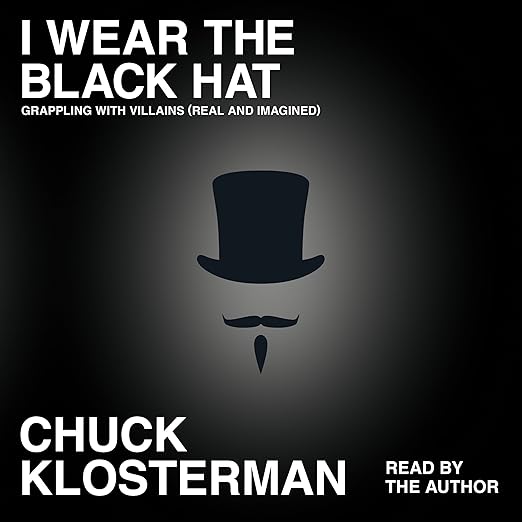
Quick Take
- Narration: Klosterman reading his own work is a genuine pleasure: wry, slightly flat-footed in the best way, perfectly calibrated to the essays’ self-interrogating humor.
- Themes: American villainy, moral ambiguity in pop culture, the ethics of public resentment
- Mood: Intellectually playful and genuinely funny, with darker undertones
- Verdict: Vintage Klosterman doing what only Klosterman does, though listeners expecting a unified theory of villainy will find the book more ruminative than conclusive.
I have a reliable test for whether a book of cultural criticism is doing real work or merely being clever: I ask whether the ideas in it change how I see the culture around me after I finish. I Wear the Black Hat passes this test. I listened to it over a few evenings while cooking dinner, and for the following week I found myself applying Klosterman’s questions about villainy to news stories, conversations, and fiction I had not thought to connect to his framework. That residual effect is relatively rare in essay collections.
Klosterman is a polarizing figure in cultural writing, and the reviews for this book reflect that. His defenders find him one of the few critics who takes popular culture seriously as a site of genuine moral inquiry. His detractors find him self-indulgent and prone to treating his own pop culture obsessions as universally shared. Both assessments contain truth. The question is whether the pleasures of his best work outweigh the frustrations of his most indulgent passages, and for me, with this book, they do.
The Central Claim and Why It Works
Klosterman’s thesis, stated early and returned to throughout, is that the cultural villain is the person who knows the most but cares the least. This formulation is more precise than it sounds. He is not arguing that intelligence makes people villainous or that caring is a virtue: he is making a claim about the specific combination of awareness and indifference that generates a particular kind of cultural contempt. The person who understands the rules, understands why others follow them, and refuses to is a different kind of moral problem from the person who breaks rules out of ignorance or impulse.
He works this through a set of case studies that range from the famous (O.J. Simpson, Hitler, Bill Clinton) to the deliberately odd (the Eagles, Bernhard Goetz, a kid Klosterman knew for one week in 1985). The juxtaposition of moral registers is characteristic of his method and is either his greatest strength or his most irritating habit, depending on your tolerance for it. One reviewer compared him to David Foster Wallace doing pop culture at a bar, which is reductive but not entirely wrong. The comparison works best in the chapters where Klosterman is performing intellectual seriousness about things that do not conventionally merit it.
Where the Argument Rambles and Where It Lands
A critical reviewer noted that Klosterman’s path can feel like a college dorm conversation under the influence of mind-altering substances, and this is not an unfair description of some chapters. The essay on Machiavelli, for instance, is genuinely interesting about a third of the time and self-indulgent for the rest. Klosterman is aware of his own tendency to wander and occasionally foregrounds this self-awareness, which is simultaneously the most Klosterman thing possible and a partial antidote to the frustration it causes.
The chapters that work best are the ones where he stays closest to his central claim without straining for provocative contrarianism. The essay on O.J. Simpson is genuinely probing, the material on the Eagles and the question of whether a band can be a cultural villain is one of the funniest and most original things in the book, and the Don Henley chapter manages to make you think about a song you have heard hundreds of times as though for the first time. These are the moments where Klosterman’s particular combination of erudition and pop-cultural obsession produces something no other critic would have written.
What It Sounds Like When Klosterman Reads Klosterman
Author-narrated essay collections live or die on whether the author’s reading voice matches the essay’s implied speaking voice. Klosterman’s does, and this is more than a trivial observation. His essays are written in a register of wry, almost reluctant intelligence, the voice of someone who has thought too hard about things that probably do not deserve this much thought and is fully aware of this irony. His reading matches this exactly. He does not perform the humor; he delivers it with the flat affect of someone making a point he suspects is both important and absurd.
This is not a conventionally polished narration in the way a professional voice actor’s would be. Klosterman’s cadence is conversational and occasionally slightly halting, which for this material is exactly right. The essays feel spoken rather than read, and the intimacy this creates is one of the audiobook’s genuine advantages over the print edition. Listeners who prefer the measured tones of a studio professional may find it takes adjustment; those who prize authenticity of register will feel immediately at home.
Who the Audience Actually Is
Dedicated Klosterman readers will find this essential. If you have read his earlier essay collections and come back for more, you know what you are getting and this book delivers it at or above the level of his previous work. For listeners new to him, this is not the worst entry point but Sex, Drugs, and Cocoa Puffs or But What If We’re Wrong? might provide a friendlier introduction before this one’s specific obsessions make full sense.
Teenagers and young adults seem, based on reviews, to respond to this book with particular enthusiasm, which makes sense. The questions Klosterman asks about who we decide to hate and why are exactly the questions that feel most urgent when you are working out your own moral framework for the first time. The fact that those questions are answered with reference to the Eagles rather than Dostoevsky is precisely the point.
Frequently Asked Questions
What is Klosterman’s actual definition of a cultural villain, and how does he apply it?
He argues that the villain is the person who knows the most but cares the least. The definition refers specifically to someone who understands social rules and the reasons others follow them, but who refuses to follow them anyway, not out of ignorance but out of indifference. He applies this framework to figures including O.J. Simpson, Machiavelli, Bill Clinton, and the Eagles, among others.
Is I Wear the Black Hat more of a unified argument or a collection of loosely related essays?
It is a hybrid. There is a central thesis that Klosterman returns to throughout, but the chapters function as standalone essays with varying degrees of connection to that thesis. Some reviewers found the structure satisfyingly cumulative; others found it rambling. The book rewards readers who enjoy associative thinking more than those who want a linear argument built toward a single conclusion.
How does Klosterman’s self-narration affect the experience of listening versus reading?
Klosterman reads in a conversational, slightly flat-footed style that matches his writing voice precisely. The essays feel spoken rather than performed, which gives the audiobook an intimacy that works well for this kind of cultural criticism. Listeners who enjoy the sense of a writer thinking out loud will prefer the audio. Those who want polished delivery might find a more conventionally trained narrator’s version preferable.
Is this book appropriate for a teenage audience despite its adult cultural references?
Several reviewers specifically noted that teenagers responded to the book with enthusiasm, and Klosterman’s core questions about who we decide to hate and why are ones that resonate strongly at that age. There is adult language throughout, and the cultural references span from the 1980s onward, so some context will be lost on very young listeners, but the moral and philosophical questions are broadly accessible.