Quick Take
- Narration: Ann Leary reads her own essays, and it shows in the best way. The timing on the humor is precise in the way that only someone who lived through the stories can deliver.
- Themes: people-pleasing and its costs, celebrity adjacency and its absurdities, recovery and family love
- Mood: Warm and wry with occasional gut-punch sincerity, like a good dinner party conversation that turns unexpectedly honest
- Verdict: Uneven across essays by design, since the collection covers a wide tonal range, but the highs are genuinely funny and the emotional undercurrent carries through.
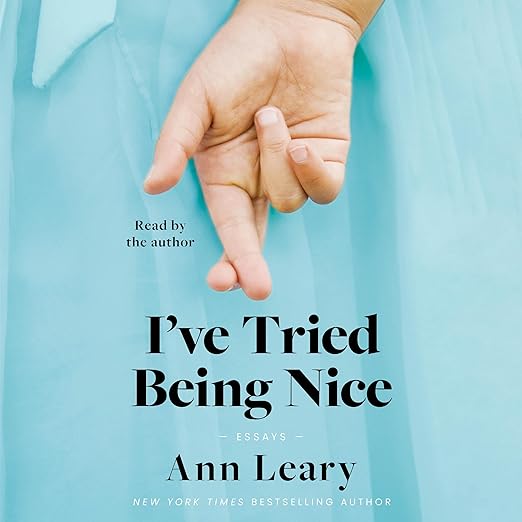
I started I’ve Tried Being Nice on a flight, which turned out to be perfect. Ann Leary’s essays are exactly the kind of company you want when you are trapped in a metal tube at 35,000 feet with no particular appetite for anything too demanding. I laughed at the bat invasion story loud enough that the person in the middle seat glanced over. At least one reviewer apparently had the same experience on a plane and did not care either.
The collection comes from a writer who has spent years living at an interesting angle to celebrity. Married to Denis Leary, whose career put them on red carpets neither of them was entirely prepared for, Ann Leary has observed fame from the sidelines with the particular clarity of someone who is paying close attention but not quite in the frame. That vantage point is the book’s comic engine and its emotional center.
Our Take on I’ve Tried Being Nice
Publishers Weekly gave it a starred review and called it ‘a gem,’ and Oprah Daily described it as ‘zany and relatable,’ both of which are accurate but undersell the tonal range. Leary moves between outright farce (the ballroom dance lessons she takes with her actor husband are the kind of story that makes you glad someone else went through it so you could hear about it) and genuine vulnerability. The essays on alcoholism and recovery are not played for laughs, and that refusal to make her struggles charming is what distinguishes the collection from the standard celebrity-adjacent memoir.
The title is the thesis. Leary spent a long time trying, and often failing, to be the person that social situations seemed to demand. The recovery she writes about is not only from alcoholism but from the more diffuse addiction to others’ approval. The Boston Globe’s comparison, a talk with your wisest friend, lands because Leary is honest about the ways she was not, for a long time, particularly wise about herself.
Why Listen to I’ve Tried Being Nice
The self-narrated audiobook format is close to ideal for this material. Leary has been reading her own work aloud for years, and the timing is the timing of someone who knows where the jokes land because she has tested it. The line-reading on the red carpet stories, in particular, has a deadpan specificity that would be impossible to replicate with a third-party narrator. The Washington Post described it as essays ‘from a lifetime of wanting to be liked,’ and there is something appropriate about hearing Leary deliver that assessment in her own voice.
At five hours and forty-six minutes, the collection does not overstay its welcome. Essay collections in audio can drift if the tonal register is too consistent, but Leary varies pace and emotional temperature enough that the listen never becomes numbing. A reviewer who was primarily a fiction reader described finding the essays entertaining from the first sample, which suggests the book works even for listeners who do not typically gravitate toward the form.
What to Watch For in I’ve Tried Being Nice
One honest reviewer with three stars gave a plain assessment: some essays were boring enough to skim. That is a fair warning. Essay collections are constitutionally uneven. Leary’s strongest essays are genuinely excellent, but the collection includes quieter pieces, including some about the family’s dogs, that land differently depending on how much patience you have for that register. The reviewer who skimmed and moved on was not wrong to do so. The format allows for it in a way that a novel does not.
Listeners who come to the book primarily for the celebrity-adjacent material, the Denis Leary stories, the Hollywood observations, will get those and find them funny. But the book asks more of you if you are willing to follow it into the more personal territory. The emotional core is the recovery narrative and the family writing, and those sections reward engagement in a way the comic pieces alone do not.
Who Should Listen to I’ve Tried Being Nice
Recommended for listeners who enjoy personal essay collections in the vein of Nora Ephron or David Sedaris but want something that carries more emotional weight than pure humor writing. Fans of Ann Leary’s fiction will find the essays an interesting window into the sensibility behind the novels. Those who need structural coherence in a listen, a narrative arc, a building argument, may find the essay format unsatisfying regardless of the individual pieces’ quality.
Frequently Asked Questions
Is the audiobook meaningfully different from the print edition because of Leary’s self-narration?
Yes. The comic timing in the essays benefits significantly from being delivered by the person who wrote and lived them. The red carpet fiasco stories and the ballroom dance anecdotes in particular gain from Leary’s deadpan delivery. If you are deciding between print and audio, this is one where audio is the stronger recommendation.
How candid is the book about Leary’s alcoholism and recovery?
Genuinely candid, and notably, those sections are not softened into inspiration-speak. Leary writes about her relationship with alcohol with the same honesty she brings to the comic essays, which makes the recovery material land harder and feel more real than the typical celebrity-recovery chapter.
Do I need to know who Denis Leary is to enjoy the book?
No, though some of the Hollywood and red carpet material gains additional texture if you know his career arc. The book works perfectly well as a portrait of someone navigating fame-adjacent life from the sidelines, and the funniest material does not require celebrity context to land.
Is the essay about bat invasions as funny as it sounds?
Yes. It is one of the collection’s stronger comic pieces and earns its reputation as the kind of story you read aloud to whoever is nearby. Leary commits to the escalating absurdity with full conviction.