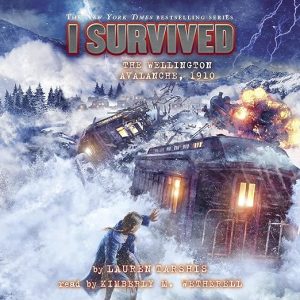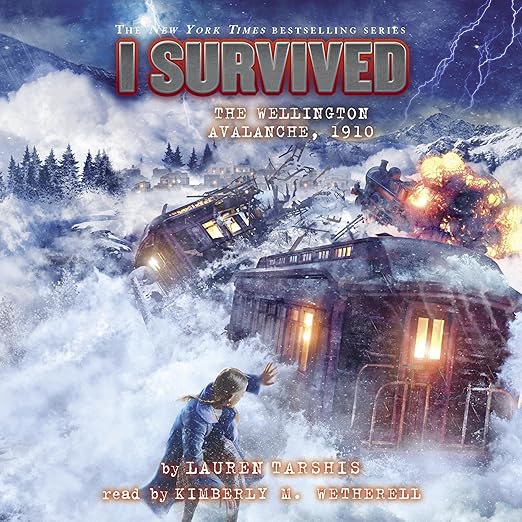
The winter of 1910 in the Cascade Mountains was one of the most catastrophic in American railroad history, and yet most people have never heard of the Wellington avalanche. That obscurity is part of what makes this audiobook so valuable: Lauren Tarshis has a gift for locating the disasters that shaped American life and building child-centered survival narratives around them that feel urgent rather than academic. I Survived the Wellington Avalanche, 1910, the 22nd entry in Tarshis's I Survived series, narrated by Kimberly M. Wetherell, brings that obscure and terrifying event directly into a young listener's imagination with the kind of visceral, page-turning focus that has made the series a classroom staple and a household name.
The facts alone are staggering. Two trains stranded in the Cascades for six days by drifts twenty feet high, passengers choosing between waiting and attempting a dangerous mountain hike, and then, just after midnight on March 1, a lightning strike releasing a ten-foot wall of snow that sent both trains tumbling a hundred and fifty feet. Ninety-six people died. Tarshis anchors this historical reality to the perspective of one fictional girl who survived, and that narrative choice is what allows the audiobook to function both as an adventure story and as a genuine introduction to the historical event. The I Survived format has always understood that children learn history most effectively through a single, specific pair of eyes rather than through sweeping overview.
Wetherell Builds Dread Through a Patient Countdown
Wetherell's narration is precisely calibrated for the series' audience. She does not talk down to young listeners, but she is consistently alert to where the material might tip from thrilling into genuinely frightening, and she modulates her delivery accordingly. The countdown of days, one day stranded, then two, three, six, is handled with a patient accumulation of dread that serves the story's tension without losing the forward momentum that keeps younger listeners engaged. Reviewers have described their children as obsessed with this series, and Wetherell's performance is a significant part of why the audiobook experience is so immersive.
At 2 hours and 7 minutes, the runtime is perfectly suited to the intended audience. Young readers can complete the whole story in a single sitting, which is exactly right for a narrative that builds continuously toward its climactic avalanche. There is no structural padding, no digressive backstory, and no moment where the pace drops below the level of engagement. Tarshis and Wetherell together produce an audiobook that demonstrates what the format can do for history education: the disaster is not a chapter in a textbook but a lived experience. The comparison to other series entries is instructive: this installment's relatively obscure historical event means that many young listeners will have genuinely no frame of reference, which makes the audiobook even more effective as a discovery tool.
Cascade Tunnel Construction Followed the Avalanche
The I Survived series has built its reputation on finding the intersection between historical accuracy and child-friendly storytelling, and this installment demonstrates that combination at a high level. The Wellington avalanche changed American railroad engineering permanently, prompting the construction of the Cascade Tunnel to replace the exposed section of track, and Tarshis works that historical consequence into the narrative's emotional resolution without turning it into a lesson. The fictional protagonist's transformation, she emerges from the snow forever changed herself, mirrors the historical changes to the landscape and the industry.
Parents and educators who have used the series as a bridge between recreational reading and classroom learning will find this entry particularly useful. The event is genuinely obscure enough to surprise even knowledgeable adults, and the audiobook format makes it accessible in car rides, bedtimes, and classroom listening sessions. One grandparent reviewer noted that grandchildren cannot wait for each one, and that enthusiasm reflects the series' consistent ability to make historical content feel personally relevant.
Short Sentences Make the Body Feel Danger
Pay attention to how Tarshis handles the decision-making that stranded passengers faced. The audiobook does not flatten this into a simple binary of brave versus cowardly choices. Some passengers hiked out and survived; others waited and died; the protagonist's situation is more complicated than either outcome. This moral and logistical complexity is handled with the kind of care that respects young listeners' capacity to hold ambiguous outcomes in mind.
Wetherell's pacing in the avalanche sequence itself is worth noticing. The event happens with terrible speed in historical reality, and the narration captures that speed without sacrificing clarity. The disorientation of being buried, the cold, the silence, the uncertainty about which way is up, is rendered in short declarative sentences that do precisely what good audio storytelling does: they make the listener's body respond to the danger even though the protagonist is fictional and the event was over a century ago.
Eight to Twelve, With Curious Adults Too
This audiobook is an ideal choice for listeners ages eight to twelve, though the series' fan base consistently includes younger children listening with parents and older middle-grade readers who find the format satisfying between longer novels. It works well in classroom contexts, particularly during units on early twentieth-century American history or transportation technology. Adults who want to learn about the Wellington disaster through a narrative rather than a documentary will also find the audiobook genuinely gripping. Those who require extensive historical context or scholarly apparatus will want to supplement with adult nonfiction, but as an introduction to a neglected American disaster, this production stands on its own. The series' track record of turning obscure historical events into compelling audio experiences makes this entry a reliable recommendation for any family building a listening library with educational depth.
Is this audiobook appropriate for sensitive younger listeners who might be frightened by disaster content?
The content is intense but handled with the young audience firmly in mind. The avalanche sequence is vivid and the death toll is mentioned, but Tarshis and Wetherell keep the focus on the survivor's experience rather than dwelling on graphic suffering. Parents of sensitive children under eight may want to preview the climactic sequence.
Does this audiobook require any prior knowledge of the I Survived series to enjoy?
No. Each I Survived installment is completely self-contained with a different historical event and different fictional protagonist. You can begin anywhere in the series, including here at entry 22.
How accurate is the historical content in this audiobook?
Lauren Tarshis is known for thorough historical research and typically includes author's notes with facts and recommended reading. The Wellington avalanche details, including the six-day stranding, the March 1 lightning strike, and the ninety-six deaths, are historically accurate. The protagonist is fictional but grounded in the documented experience of survivors.
At just over two hours, is this audiobook long enough to feel complete, or does it feel rushed?
The 2-hour-and-7-minute runtime is entirely appropriate for the intended age group and narrative scope. The story builds steadily without feeling truncated. It is paced for a single focused listening session rather than a multi-day listen.