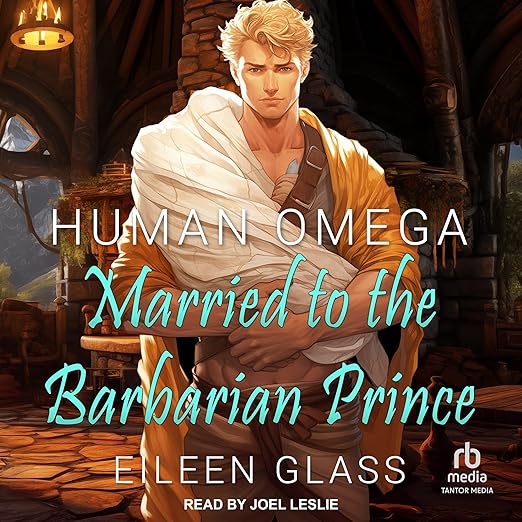
Quick Take
- Narration: Joel Leslie handles the multi-character alien cast with clear differentiation and genuine comedic timing, his take on Pykh’s blundering sincerity is particularly effective.
- Themes: Found family in alien societies, omega-verse dynamics, post-war social reintegration
- Mood: Warmly funny with real emotional payoff
- Verdict: A satisfying series conclusion that trades action for character depth, best approached after reading the earlier Pykh books.
I was halfway through a late-evening listening session when Carter finally got his happy ending and I realized I had been holding a cold cup of tea for about forty minutes without noticing. That is the particular power of a series finale that actually delivers, not spectacle, but resolution. Human Omega: Married to the Barbarian Prince is the fourth book in Eileen Glass’s Pykh series, and it is the one that pays out what the previous three were earning.
Let me be transparent about where I am coming from: I had not listened to the preceding books before this one. I came in as an outsider to the fleaf’akhie world, the Gemini Twins mythology, and Carter’s particular history. I caught up quickly enough to follow the plot, but I want to flag for prospective listeners that this is emphatically a series book. The emotional resonance depends on accumulated investment. The payoffs are specifically proportional to what you have already put in. If you are new to Eileen Glass, start at book one.
That said, the architecture of Glass’s world is legible enough that an outsider can understand what is happening, even if the weight of it does not fully land. Carter, a human omega whose name the fleaf’akhie cannot pronounce, arrives seven months pregnant seeking shelter in an alien stronghold. His mates, Siel the war hero and Pykh the so-called brainless barbarian, accompany him. The stronghold’s Council Leader Ruahyr has every reason to turn them away. He does not, and what follows is an extended examination of what life looks like when people who were defined by conflict try to build something domestic instead.
The Omega Who Chose His Mates for Battle, Not Love
The setup is compact and clever. Carter arrived in this world and built his family for strategic reasons: Siel is capable, Pykh is muscle. What Glass has been doing across four books is dismantling that original calculus and showing how love assembles itself out of proximity and shared crisis even when it was never the intention. By book four, the reader, or listener, is supposed to understand that Carter’s relationship to his own masculinity and his own capacity for love has fundamentally changed. Those who have followed the series will feel that transformation as earned. Those coming in cold will receive it as information.
Reviewer H. West, who called this their favorite book in the series, noted that the pacing is slower and the action lighter than the previous entries, and that this is a feature rather than a bug. The book is structured as an extended happy ending, not the thin, rushed kind that often disappoints readers of long series, but an actual sustained inhabitation of what the characters’ lives look like once the war is over. That is a harder thing to write well than a climax, because there is no external pressure organizing the material. Glass holds it together through character consistency and through the secondary characters, particularly the complex omega Ruahyr and the once-loathed General Iethuth, who get their own resolution arcs.
Reviewer Meg specifically praised that the aliens in this series are genuinely alien in their behavior and social structures, not just humans with unusual aesthetics. That observation holds for this volume. The fleaf’akhie societal customs, the politics of the stronghold, the way Carter’s presence is processed by a community with no category for him, all of it feels internally consistent with a world that has its own logic, even when that logic is being sketched rapidly in a fourth book that has limited time for worldbuilding exposition.
Pykh’s Arc and Why It Matters
The character who gets the most meaningful development here is Pykh himself. The brainless barbarian who could not count coins turns out to have a history, a people, and a depth that the earlier books only gestured at. Glass handles his arc with more care than the comic framing might suggest. The revelations about where Pykh came from and who his people are arrive in the book’s final section, and reviewer Altairjones specifically mentioned not seeing the last ten percent coming. That surprise is only possible if Glass has been disciplined enough not to over-hint across three prior volumes, which she has been.
By the time those revelations land, they feel earned rather than retrofitted. Pykh’s character development, as reviewer H. West described it, is well-rounded and in-depth, an accurate summary of what Glass accomplishes with a character who begins as comic relief and ends as one of the more emotionally complete figures in the series. The fact that his arc is completed here, rather than stretched into a fifth book, reflects a kind of structural integrity that is rarer in long fantasy series than it should be.
What Joel Leslie Brings to the Alien Cast
Joel Leslie narrates a cast that includes characters with names like Ruahyr, Iethuth, Affek, and Auk, along with Carter and his mates. This is not easy work. Leslie maintains consistent vocal signatures for each without letting the pronunciation demands slow the narrative momentum. His performance of Pykh leans into the character’s blunt earnestness without making him a joke. His Carter reads as someone whose affect has genuinely shifted over the course of four books, there is a relaxation in the characterization that matches what reviewers describe as Carter finally being comfortable in his own identity.
Reviewer Shannon mentioned minor complaints about certain plot resolutions, which is fair, at 17 hours and 48 minutes, the book has space to breathe but also space to indulge. A few secondary character wrap-ups feel tidier than they probably should. But these are the complaints of a reader who cares enough about the world to notice, which is itself a kind of compliment to the series as a whole. Leslie navigates the longer runtime without losing energy or consistency, which at nearly 18 hours is a genuine achievement.
Who Should Listen and Who Should Skip
Readers who have been following Carter, Pykh, and Siel through the earlier books will find this a rewarding conclusion. Fans of omega-verse science fiction with genuine alien worldbuilding, as opposed to humans-with-ridges, will appreciate Glass’s commitment to her fictional society’s internal logic. Skip this if you have not read books one through three; the emotional stakes are entirely context-dependent. Those who prefer action-forward plots over character-focused resolutions may find the pacing slow, but for the core audience, that slowness is precisely the point. The 4.6 rating across 900 reviews reflects an audience that largely got what it came for.
Frequently Asked Questions
Can Human Omega: Married to the Barbarian Prince be read as a standalone?
It is technically possible to follow the plot, but the emotional resonance depends heavily on the previous three books. You will miss the significance of Pykh’s backstory revelations and Carter’s character arc without that context.
Is this book appropriate for readers who are sensitive to explicit content?
The synopsis notes it contains mature themes. The Pykh series is adult omega-verse fiction, so listeners should expect romantic and sexual content, though reviewers suggest this particular volume is more domestic and emotional in tone than action-heavy.
Does Joel Leslie’s narration work for a series with a large cast of alien characters?
Yes. Leslie maintains distinct and consistent vocal identities for characters with difficult alien names throughout the 17-plus hour runtime, which is a real technical achievement for a cast this size.
Does the series have a definitive ending here or does it continue?
Based on reviewer responses, book four is structured as a series conclusion for Carter’s storyline, multiple reviewers describe it as a satisfying ending for the main characters, including a resolution for Pykh’s origins that reviewer Altairjones described as a complete surprise in the final ten percent.