Quick Take
- Narration: Watsky reading his own essays is the only version that makes sense; his spoken-word rhythms and self-deprecating timing make the audio format feel native to the material.
- Themes: Failure as education, identity and embarrassment, the pursuit of artistic authenticity through catastrophe
- Mood: Ribald and disarming, with sudden emotional sincerity
- Verdict: Anyone who has ever done something catastrophically ill-advised and survived it with their sense of humor intact will recognize themselves in these pages.
I was somewhere in the middle of my Sunday afternoon, half-committed to a walk I had promised myself I would take, when I put on How to Ruin Everything mostly because the title felt appropriate for my mood. I had been aware of George Watsky as a performer but had not spent much time with his music, which meant I was coming to this collection without the fan-shaped lens that clearly colors a lot of the reviews. What I found was a debut essay collection that functions as something more interesting than a celebrity memoir and more honest than most personal development dressed up as confession.
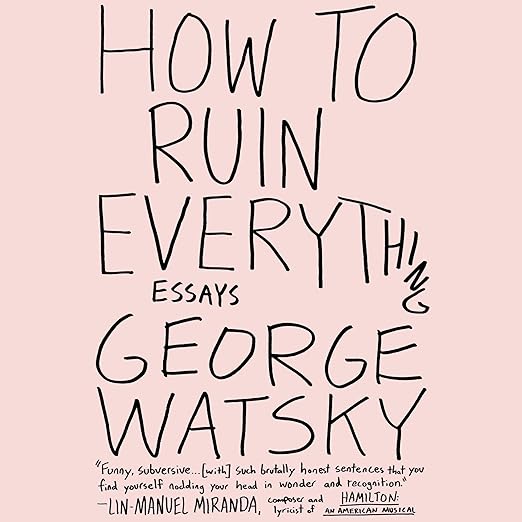
Lin-Manuel Miranda’s blurb calls the writing funny, subversive, and capable of excavating brutally honest sentences. That framing is accurate but undersells how structurally varied the essays are. Watsky is not working from a single register. He moves between the absurd, the genuinely disturbing, and the quietly revelatory within a single piece in a way that suggests a writer who has thought seriously about craft rather than just transcribed anecdotes.
The Art of Chronicling Your Own Disasters
The essay about becoming an international ivory smuggler is the one that gets mentioned most in reviews, and it earns that attention. It is structurally audacious: a story that begins as comedy and ends somewhere altogether more uncomfortable, without ever losing the reader’s trust in the narrator. Watsky’s willingness to let himself look genuinely foolish rather than charmingly self-deprecating is what separates these essays from standard confessional fare. There is a difference between writing about failure in a way that reassures the reader you came out fine, and writing about failure in a way that holds the weight of what it actually cost you. Watsky mostly manages the latter.
The middle-school rap battle essay is at the other end of the tonal spectrum: pure comedy, the kind that builds to a punchline through accumulation of absurd detail. His account of his epilepsy is neither of these things. It is the essay where the collection announces larger ambitions than entertainment, and it is the one that lingered with me longest after I finished that walk I had started.
What Watsky Narrating Watsky Means for the Audio
There are essay collections that suffer when read by their authors, because what works on the page as prose does not always survive the author’s own relationship with the material. Watsky is an exception to this pattern, and the reason is specific to who he is: a spoken-word artist whose writing already carries the cadences of performance. Hearing him deliver his own sentences is not like watching a novelist read their book in a flat monotone at a reading. It is closer to hearing a song performed by the person who wrote it rather than a cover version. The self-deprecating timing he brings to the embarrassing episodes feels native rather than performed. One reviewer described his voice as capturing something that goes beyond the confidence of his stage persona, showing instead a comforting side that the essays are designed to reveal, and that is precisely right.
The running time of five hours and thirty-eight minutes is appropriate for the material. These are not long essays, and the collection has the rhythm of something you could dip in and out of across several sessions, or consume in a single sitting as at least one reviewer did.
Knowing When an Essay Collection Has Earned Its Blurb
New York Times bestseller status and a Lin-Manuel Miranda endorsement create a certain kind of expectation worth examining honestly. This collection earns the attention it received, but not uniformly. The strongest essays carry genuine literary ambition and execute on it. The weaker ones feel like the kind of material that works in a personal essay workshop but does not quite survive outside that context. The collection is, as one reader noted, the work of a versatile writer with a promising career ahead rather than a fully realized one. That assessment from 2016 holds up as a description of where Watsky was as a writer when this came out, which is not a slight: it is the correct framing for an impressive debut that announces a voice without yet defining its full range.
For listeners who are already Watsky fans, this is the essential companion to the music: it provides the backstory and the interiority that the songs gesture toward but do not always have room to develop. For listeners coming in cold, it works as a standalone introduction to a genuinely distinctive voice who approaches both his art and his embarrassments with the same disarming seriousness.
Who Should Listen and Who Might Step Back
This is not a book for readers who want essays that leave them feeling comfortable. Watsky’s best work here makes you sit with the discomfort of recognition rather than resolving it quickly. If you come to essay collections for insight presented with formal elegance, you may find the register too loose and conversational. If you come to them for the experience of feeling like you spent several hours in the company of someone thinking honestly about what it means to be alive and frequently getting things wrong, this is worth your time and then some.
Frequently Asked Questions
Do I need to know George Watsky’s music to appreciate How to Ruin Everything?
No. Several reviewers came to it without prior familiarity and found it fully accessible as a standalone essay collection. Knowledge of his music provides additional context but the essays stand entirely on their own.
Is the ivory smuggling essay as wild as it sounds?
It is, and it is also structurally the most ambitious piece in the collection. What begins as comedy becomes genuinely uncomfortable, and Watsky does not let himself off the hook. It is the essay that best represents what the collection is attempting.
How does Watsky handle the essays about his epilepsy?
With honesty and without sentimentality. The epilepsy essay is where the collection steps away from comedy and into something more vulnerable and lasting. It is the piece that gives the collection its emotional weight and reveals that the book has ambitions beyond entertainment.
Is this audiobook appropriate for younger listeners who follow Watsky’s music?
The collection is described as ribald and contains mature content in several essays. It is aimed at an adult audience. Parental discretion is reasonable for listeners under sixteen, regardless of their familiarity with his music.