Quick Take
- Narration: Terry Deary narrating his own work is the point of the whole enterprise. His timing and conspiratorial energy make the gross-out facts land exactly as intended.
- Themes: Viking history, death and violence without glamorization, comic history education
- Mood: Anarchic and irreverent, with a genuine educational backbone
- Verdict: At one hour it feels almost too short, but within that window it does everything Horrible Histories does best.
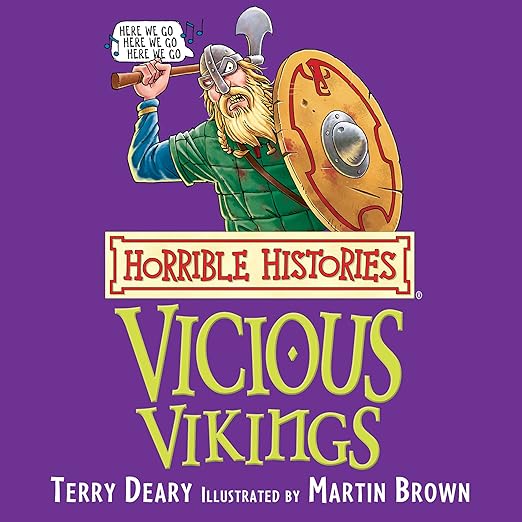
My nephew, who is nine and regards most educational material with deep suspicion, once told me that Horrible Histories is not actually about history, it is about how weird humans are. He is correct, and that is precisely why the series has endured. I came to the audio version of Vicious Vikings partly to see whether the format could preserve what makes these books work in print, which is the combination of genuinely educational content and an authorial voice that refuses to be reverent about anything.
The answer is yes, emphatically, because Terry Deary narrates his own material. This is not a detail to skip past. Deary’s relationship with his audience is built on a particular kind of shared irreverence, a sense that history as taught in school is a conspiracy to bore children, and that the real story is far stranger and bloodier and funnier than anyone will admit. When he reads his own sentences, that relationship is intact. When someone else reads them, something is lost.
Vikings in Wedding Dresses and Corpses on Trial
The content here is exactly what the synopsis promises: genuinely strange facts about Viking culture delivered with timing and relish. The Thor-in-a-wedding-dress story refers to the Norse myth of Thor disguising himself to retrieve his stolen hammer, which is both historically attested mythology and objectively funny. Corpses on trial sounds like pure invention until you realize it references real legal practices from Viking-adjacent medieval culture. Deary is not making things up. He is selecting the facts that no responsible history teacher would lead with, and presenting them without apology.
This is the pedagogical genius of the Horrible Histories series that adults sometimes underestimate: the hook is the grotesque, but the retention is real. Children who learn that Vikings had elaborate funeral practices involving ship burials and human sacrifice remember that. Then, five years later in a classroom, when someone mentions the Norse concept of honor in death, they have a foothold. Deary has always understood that you get children into the tent with the spectacle, then you teach them something real.
The One-Hour Runtime and What It Tells You
At exactly one hour, this is among the shortest audiobooks I review for children’s nonfiction. For some subjects that would be a problem. Here it is not, partly because the format was always episodic rather than narrative, and partly because an hour is actually the right amount of time to spend with content this dense in novelty. The reviewers who praised it uniformly described it in terms of immediate re-use: grandchildren quoting it, families returning for additional volumes. That response suggests the content has landed and taken root, which is the only metric that matters for children’s educational audio.
Who Should Listen and Who Should Skip
The sweet spot is children aged seven through twelve with any interest in history at all, particularly those who find standard historical narrative dry. This is also the rare children’s audiobook that works well for adults who want entertainment without pretension. The reviewer who described himself and his partner as older folks who found the story intriguing is not unusual: Deary’s irreverence is genuinely funny at any age. Listeners who prefer their history solemn or who are sensitive to content about death and violence should note the subject matter, but for a nine-year-old who thinks history is boring, this is close to a guaranteed conversion.
Frequently Asked Questions
Is Terry Deary’s self-narration significantly better than a professional reader would be for this material?
Yes, noticeably so. The timing of Horrible Histories humor depends on a conspiratorial tone that Deary has refined across years of writing and performing these books. A professional narrator reading cold would likely get the words right but miss the rhythm.
How graphic is the content about Viking violence and death?
The violence is presented in the Horrible Histories tradition: historically accurate but filtered through dark comedy rather than depicted graphically. Children who enjoy the books will find the audio equivalent. It is not appropriate for very young or sensitive listeners, but the target audience of ages 7-12 generally handles this register well.
Is this a good starting point for the Horrible Histories series, or should listeners begin elsewhere?
Each Horrible Histories title is self-contained, so Vicious Vikings works perfectly as an entry point. The format does not require any prior knowledge, and the Viking subject matter tends to hold particular appeal for the age group.
Does the one-hour runtime include meaningful historical content, or is it mostly jokes?
Both, deliberately and inseparably. Deary’s method is to present real historical facts through the lens of dark comedy, so the humor and the information are the same content. Listeners will come away with genuine knowledge about Norse mythology, Viking customs, and medieval legal practices.