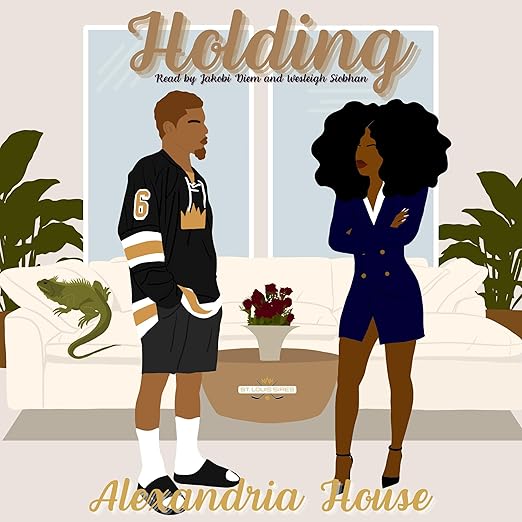
Terrence and Krystle Ford spend most of this audiobook proving that a broken marriage and a second chance are not opposites so much as two ends of the same rope. Alexandria House's Holding, the second entry in her St. Louis Sires series, is a dual-timeline romance that earns its angst rather than manufacturing it, tracking a St. Louis lineman and his ex-wife from childhood friendship through marriage, separation, and the slow, unglamorous work of finding their way back. At six hours and eleven minutes, it is a tight, focused listen rather than a sprawling saga, and that tightness works in its favor.
Is Holding Worth Your Time?
What sets Holding apart from a standard sports-romance premise is how much weight House puts on a struggle she keeps largely unnamed within the synopsis itself, one reviewer describes it as 'a silent struggle that can be a killer,' built around themes of awareness, survival, and patience as much as romance. That vagueness reads as deliberate restraint rather than a gap, letting the audiobook unfold the specifics on its own terms rather than announcing the twist upfront. House resists the easy trap of making that struggle the entire emotional engine of the book. Multiple reviewers specifically praise that the story does not become depressing despite its heavier material, crediting House with keeping humor and warmth present throughout.
The dual-timeline structure is the book's biggest formal risk, cutting between the earlier relationship and its present-day aftermath, and reviewers are split on how well it lands. One calls the pacing occasionally slow for readers who dislike back-and-forth timelines; another found the same device made the eventual reunion more thrilling. Both reactions are reasonable. Dual timelines ask more of a listener's attention than a linear plot does, since audio removes the visual chapter-heading cue print readers use to reorient themselves, and House is asking listeners to track two versions of the same couple without that visual anchor.
The title itself does real double duty worth pausing on. Holding is football terminology, a penalty called against an offensive lineman like Terrence for illegally restraining a defender, and House repurposes that specific meaning as a metaphor for exactly what keeps Terrence and Krystle apart: an instinct to hold on too tightly, or hold back too much, rather than trusting the relationship to survive open hands. That kind of title-as-thesis choice is a small craft signal, but a meaningful one, that House is thinking carefully about structure rather than just assembling romance-genre beats in sequence.
The Best Parts of Holding
Jakobi Diem narrates, and a contemporary African American sports romance built on childhood-friends-to-spouses-to-exes territory needs a narrator who can differentiate not just two characters but two eras of the same two characters, the easier, unguarded chemistry of the earlier timeline against the more careful, wounded version of Terrence and Krystle in the present. That is a real vocal-acting challenge, subtler than switching between distinct characters, since it requires the same voice to age and change without losing continuity. Based on the structure House has built, this book asks a lot of its narrator specifically because the emotional stakes live in that contrast.
At just over six hours, Holding also makes a strong case for single-sitting or single-commute listening. Series romance readers often juggle long series with uneven pacing across entries, and a tightly scoped book that resolves its central relationship within one focused runtime is a genuinely different listening experience than a sprawling multi-book arc demands. For anyone easing into audio romance without wanting to commit to a fifteen-hour series entry, this length is a real selling point, not just a runtime footnote.
Contemporary African American sports romance has grown into one of digital publishing's most consistently strong categories, and Holding fits a specific, well-loved lane within it: the athlete hero whose on-field identity matters less to the plot than his private capacity for change. House keeps Terrence's football career as backdrop rather than spectacle, which keeps the emotional focus exactly where a character-driven romance needs it, on what Terrence and Krystle actually have to work through together, not on game-day drama standing in for real intimacy.
Before You Commit to Holding
This is billed as book two of the St. Louis Sires series, and while the synopsis reads as self-contained, the childhood-neighbors history between Terrence and Krystle suggests earlier context from book one may deepen the emotional stakes rather than being strictly required. Series romance readers who like maximum payoff should consider starting with book one if it is available, though nothing in the synopsis or reviews indicates this entry is inaccessible on its own.
The synopsis flags mature content directly, and reviewer commentary about angst and a serious underlying health struggle confirms this is not a light, breezy romance despite its short runtime. Expect emotional weight alongside the steamier content implied by the mature-themes label. One reviewer's specific praise, that House avoids making the struggle depressing, is a genuine skill worth noting, but listeners sensitive to health-crisis storylines woven into a romance plot should go in with that expectation set.
The dual-timeline pacing deserves one more mention as a practical listening note: if slower, more deliberate scene-setting frustrates you in audio specifically, where you cannot skim ahead the way a print reader might, budget for an adjustment period in the earlier chapters. Reviewers who embraced the structure describe exactly that adjustment paying off once the two timelines start visibly converging toward the present-day reunion.
The St. Louis Sires series structure, each entry apparently built around a different player on the same team, is a common and effective romance-series model, since it lets returning readers revisit a shared world and supporting cast without requiring a single continuous plot across entries. For Holding specifically, that means Terrence and Krystle's story can carry real emotional weight on its own terms, with whatever teammates and friends appear around the edges functioning as connective tissue to the wider series rather than plot obligations this specific book has to resolve.
Should You Listen to Holding?
Readers of contemporary African American romance who want real emotional stakes attached to their happily-ever-after, not just tension for tension's sake, will find Holding delivers. It is also a strong pick for sports-romance fans who want the athlete's world to matter to the plot without dominating it, and for anyone who enjoys second-chance stories where both people have to individually change before they can reunite.
Skip it if dual-timeline pacing genuinely frustrates you as a listener, or if you would rather avoid a romance plot built around a serious unnamed health struggle. Readers looking for a fluffy, low-stakes read should also look elsewhere, House is clearly working toward something with more emotional weight than that here.
Frequently Asked Questions
Is the Holding audiobook part of a series I need to start earlier?
It's book two of Alexandria House's St. Louis Sires series. The synopsis reads as self-contained, but the childhood history between Terrence and Krystle may land with more weight for listeners who've already heard book one.
How explicit is the Holding audiobook?
The synopsis flags mature themes directly, and reviewer comments about intense angst confirm this leans into steamier content alongside its emotional core, not a clean or sweet romance.
Is Holding a sad audiobook?
It touches a serious, largely unnamed health struggle, but multiple reviewers specifically praise Alexandria House for keeping the tone warm and even funny rather than letting the story become depressing.