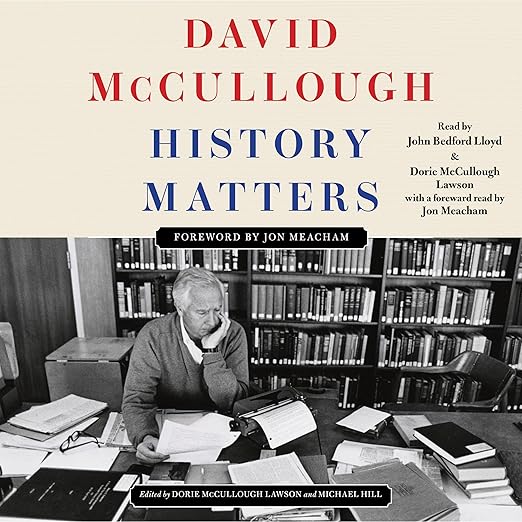
Quick Take
- Narration: John Bedford Lloyd carries McCullough’s essay prose with appropriate gravity and warmth, capturing the avuncular scholarly voice that readers of the print editions will recognize; a good match for posthumous material that needs to feel inhabited rather than archival.
- Themes: American character and political leadership, the relationship between historical empathy and present understanding, the influence of mentors and artists on intellectual life
- Mood: Reflective and quietly urgent, like a long conversation with someone whose time is running short
- Verdict: An honest, gracefully edited final testament from one of America’s most beloved popular historians, essential for McCullough devotees and a fine entry point for readers who never managed his longer biographies.
There is something particular about listening to a posthumous collection. The author is gone. The words were written at different points across a long career. Someone else has assembled them into a shape they may or may not have recognized. I listened to History Matters over a weekend in late autumn, which felt appropriate. David McCullough died in 2022. This collection, edited by his daughter Dorie McCullough Lawson and his longtime researcher Michael Hill, arrived in 2025. The gap between writing and publication gives the whole thing an elegiac quality that the essays themselves, which are largely not elegiac at all, don’t quite account for but which the listening experience carries anyway.
McCullough spent his career arguing that history is not a subject but a perspective: that understanding what happened requires inhabiting the consciousness of the people who lived it, not just cataloguing events from a comfortable distance. History Matters collects essays and speeches that return to that argument from multiple angles, touching on famous figures like Harry Truman and George Washington, and less famous ones like the painter Thomas Eakins and the writer Paul Horgan. Together they sketch the intellectual autobiography of a man who believed, with unfashionable conviction, that the past was not a burden but a resource, and that forgetting it was the most dangerous thing a society could do.
What a Posthumous Collection Can and Cannot Do
Reviewer Longstreet observed that for longtime McCullough readers, nothing in this book will be particularly new or earthshaking, and that is accurate. These essays do not revise or extend his arguments in ways that would surprise someone who has read John Adams or The Wright Brothers. What they do is reveal the intellectual infrastructure behind those books: the writers who formed him, the figures who moved him, the convictions that he returned to throughout his career not because he was repeating himself but because he genuinely could not escape their importance.
Jon Meacham’s foreword situates the collection in the context of McCullough’s legacy, which is useful framing without being excessive. The editorial apparatus is light and respectful, which is the right call. There is a temptation with posthumous collections to over-annotate, to contextualize everything into submission, and Lawson and Hill have resisted it. The essays largely speak for themselves, which is precisely what McCullough would have wanted. Reviewer Raymond Smith described it as allowing one last sit-down with an extremely good history writer, and that is as accurate a summary of the listening experience as I can offer.
Truman, Washington, and the Case for Character
McCullough kept returning to Harry Truman throughout his career, and several essays in this collection illuminate why. Truman is for McCullough the exemplary case of the historical figure whose private character proved adequate to public responsibility despite no obvious reason to expect it. The essays here approach Truman from different angles, looking at specific decisions, specific moments of self-doubt, specific letters to Bess. The cumulative effect is of a man who is increasingly well-understood rather than merely well-known.
The Washington material is similarly focused on character over chronology. McCullough was less interested in Washington’s military genius than in the question of what it cost him to be who he was, and a few of the essays get at that cost with psychological specificity that made his longer books work. Reviewer Bama Fan, who admits to lacking stamina for the full Truman biography, found these shorter essay treatments of the same figure genuinely illuminating, which suggests the collection is doing something useful: distilling decades of historical attention into accessible, concentrated form without losing the intelligence that made the longer work valuable.
The Personal Essays and What They Reveal
The sections where McCullough writes about his own formation as a writer and historian are the most unexpected and rewarding parts of the collection. The books he loved as a child, the figures who mentored him, his early sense of what narrative could do: these pages have a warmth that the historical essays, however graceful, don’t quite match. For a man known for writing about other people’s lives, these glimpses of his own inner life feel genuinely generous. Reviewer Francis O. Walker referenced Peter De Vries’s phrase about the difference between the vileness of man and the wonderfulness of people, and said McCullough’s essays consistently focus on the latter. That is exactly right, and it explains both the books’ strengths and their deliberate limits.
John Bedford Lloyd’s narration supports all of this without drawing attention to itself. He has the right register for McCullough’s prose: unhurried, slightly formal, capable of warmth without becoming sentimental. Reviewer Longstreet described the audio experience as making it easy to picture McCullough as an avuncular, folksy older man who also happened to be a renowned scholar, and Lloyd achieves that balance consistently across nearly six hours.
Who Should Pick This Up
Listen if you have read and loved McCullough’s longer books and want a final, more intimate encounter with the thinking behind them. Listen also if you have always meant to read him but were intimidated by the length of Truman or John Adams: these essays offer the essential McCullough in digestible form. The collection will not surprise those who already know his work well, but it will deepen it in ways that feel like genuine gifts from a long conversation finally drawing to a close. Skip only if you need your history audiobooks to deliver new information or argument rather than a deepening of familiar convictions.
Frequently Asked Questions
Is History Matters accessible to listeners who haven’t read McCullough’s longer books?
Yes, fully. The essays are self-contained and McCullough’s gift for contextualizing historical figures for general readers is fully present here. That said, listeners who know Truman or John Adams will get additional resonance from seeing how the shorter essays relate to those longer treatments.
How were the essays in this collection selected, and by whom?
The collection was edited by McCullough’s daughter Dorie McCullough Lawson and his longtime researcher Michael Hill. It includes previously unpublished essays alongside others written at different points in his career, all centered on his core interest in the importance of historical understanding.
Does John Bedford Lloyd’s narration suit McCullough’s prose style?
Most listeners found it a very good match. Lloyd has a measured, dignified delivery that honors McCullough’s somewhat formal but accessible style. One reviewer specifically noted how easy it was to picture McCullough himself while listening, which is about the best endorsement a narrator of posthumous material can receive.
Given that this is a posthumous collection, does it feel unfinished or incomplete?
No. The editing is careful and the essays are presented as finished pieces in their own right, not as drafts or fragments. The posthumous context adds an emotional dimension to the listening experience, but the essays themselves feel fully realized rather than provisional.