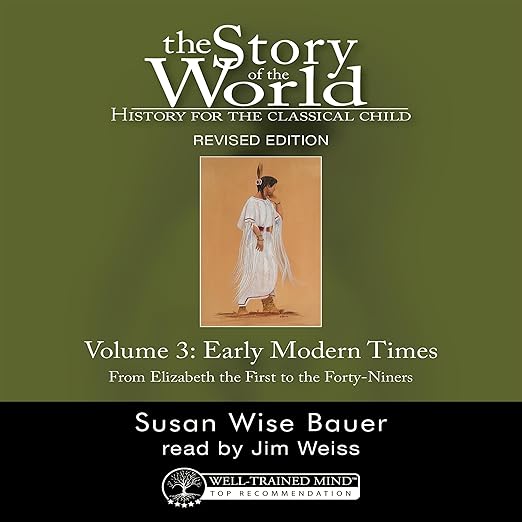
What would it look like to teach world history to a child without turning it into a parade of dates and battles? That question drives Susan Wise Bauer's Story of the World series, and the third volume, History for the Classical Child: Early Modern Times (Revised Edition), is where the project reaches what many homeschooling families consider its fullest expression. This audiobook, narrated by Jim Weiss, covers the major historical events of 1600 to 1850 across every continent, weaving together the stories of cultures that most conventional history curricula treat as separate subjects if they address them at all. The revised edition brings updated scholarship and a fresh edit to a text that has already sold over 1.3 million copies in various formats.
The framing device is a storybook format rather than a textbook register, which is both the book's central pedagogical choice and its most significant artistic achievement. Bauer writes history as narrative, which means that the Mughal Empire, the Thirty Years War, the Ming Dynasty, and the colonial Americas are presented not as separate tracks of human experience but as chapters in a single world story unfolding simultaneously. At 11 hours and 25 minutes, that story has room to breathe.
Weiss Sounds Like a Grandparent on a Long Drive
Jim Weiss is one of the great narrators of children's educational audio, and his work on this audiobook demonstrates why. His voice carries the quality of genuine engagement with the material rather than professional neutrality, and the distinction matters enormously in a format designed to hold young listeners across hours. Where a clinical narrator might make Bauer's history feel like a lecture, Weiss makes it feel like the kind of story a knowledgeable grandparent tells on a long drive. Reviewer William Koepcke, a 75-year-old adult listener, noted that the books make complicated subjects easy to read, not overly bogged down in too much detail, and that they are fun to read for all ages. That assessment of the text extends to the performance, which is calibrated for a wide age range without condescending to either end of it.
Reviewer Mandy Hansen described homeschooling her daughter with this series and finding that two years later she still refers back to things she learned from it. That kind of retention is partially a function of how Bauer structures the narrative, but it is also a function of the audio format. Stories heard aloud in a storytelling voice enter memory differently than information extracted from a textbook, and Weiss understands this at a level that makes his narration an active pedagogical tool rather than a passive delivery mechanism.
Press Play and the History Lesson Begins
The audiobook format suits this material in a particular way that is worth articulating. The Story of the World series is explicitly designed as a project for parents and children to share, and the audio version removes the logistical burden of a parent reading aloud from a print book while driving, cooking, or managing a household. Homeschooling families consistently use this audiobook as the centerpiece of their history curriculum precisely because it requires no prep: press play and the history lesson begins. The companion activity books and maps sold separately add the interactive dimension that the audio alone cannot provide, but the conceptual and narrative foundation is entirely self-contained in the listening experience.
For families new to the classical education model, this series is the most accessible entry point to the method. The narrative arc across the four Story of the World volumes builds from ancient history through the modern era, and this third volume sits at the point where global interconnection becomes visible in the historical record. The stories of trade routes, colonial expansion, and cross-cultural encounter that define the 1600-1850 period are naturally suited to Bauer's multi-continent structure.
Siblings Transition Without Jarring Discontinuity
The revised edition's updates are primarily scholarly and structural rather than dramatic. Listeners familiar with earlier editions will notice a smoother integration between the continental chapters and some updated framing around colonial history. The core text and narrative approach are unchanged, which means families who have used older editions for some children and are continuing with younger siblings can transition without jarring discontinuity.
The audiobook does not include the companion activity book questions or the map work that accompanies the print edition. Those materials are sold separately and are designed to follow up on each chapter with hands-on reinforcement. Families using this strictly as an audio resource will get the narrative history but miss the structured review that many homeschooling curricula build around the activity books. For purely casual or supplemental listening, this is not a concern. For families using Story of the World as their primary history curriculum, the audio works best alongside the print companion materials.
Accessible Without Being Thin
This audiobook is the right choice for homeschooling families covering world history in the 1600-1850 range, for children aged roughly 6 to 14 depending on the complexity of use, and for adults who want a beautifully narrated overview of early modern world history. Reviewer Charlesetta noted that both she and her son learned from it as a homeschooling team. The series is not remedial or simplified: it is written to be accessible without being thin. Adults who love history and have found other survey-level audiobooks too dry or too fragmentary will find Bauer's storybook approach a genuine pleasure across the full runtime.
Does this audiobook work as a standalone, or do you need to have heard the earlier Story of the World volumes first?
Each Story of the World volume can be used independently as a history survey for its period. That said, this is book 3 in a chronological series, and families using it as a curriculum will get more from it in sequence. The narrative does not assume prior knowledge of the earlier volumes for comprehension.
Is the Jim Weiss narration consistent across all four Story of the World audiobooks?
Jim Weiss narrates across the series, which means families building the full audio collection get a consistent voice across all four volumes. His performance style, which emphasizes storytelling warmth over instructional delivery, is a deliberate choice that works particularly well for the series' narrative-first approach to history.