Quick Take
- Narration: Wesleigh Siobhan handles the contemporary romance register with warmth and precision, making both Rob and Iris feel like people rather than archetypes.
- Themes: Recovery from prior relationships, the burden of family obligation, love as something that happens to you rather than something you choose
- Mood: Warm and honest, with real weight underneath the romantic surface
- Verdict: Christina C. Jones at the top of her form, delivering a romance that earns its emotional stakes through character depth rather than plot convenience.
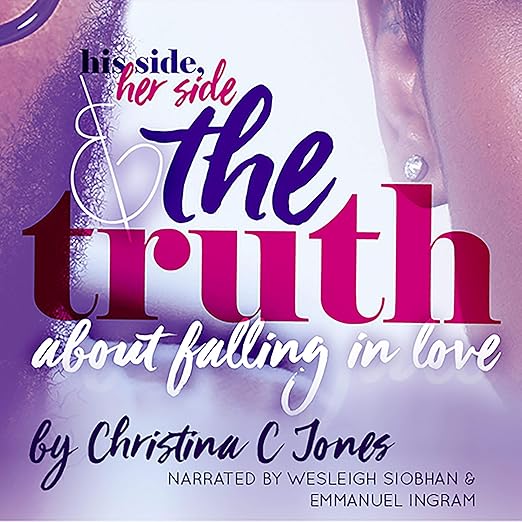
I picked up His Side, Her Side, and the Truth About Falling in Love on a Sunday afternoon when I had a few hours that asked for nothing in particular. The title alone made me slightly skeptical: that construction, with its His Side and Her Side framing, can signal the kind of he-said-she-said romantic comedy structure that I find more exhausting than charming. What Christina C. Jones actually delivers is something considerably more interior and honest than the title implies. By the time I was an hour in, I had stopped skepticism entirely and was simply following two people I had grown to care about toward something neither of them was ready for.
The premise is simple in the way that good contemporary romance premises usually are. Rob has just crossed the country for a new job and is still carrying the weight of a five-year relationship that ended badly, the woman he thought he would spend his life with having made choices he could not have anticipated. Iris is managing her family’s cascading needs, a father in jail for shooting her mother, siblings who do not pull their weight, a job she has to hold down, and a personal life she has deliberately reduced to the minimum required for breathing. Neither of them is looking for what they find in each other. Jones writes this without irony. She means it literally. These are two people whose lives are full in the wrong ways, and who meet at the exact wrong moment, which turns out to be the right one.
The Dual POV Structure and Whether It Works
The dual perspective structure, alternating between Rob and Iris, is where Jones’s craft is most visible. The challenge with this structure in romance is avoiding the trap where the two perspectives just confirm the same emotional beats in sequence, with one character thinking what the other felt and vice versa in a loop. Jones sidesteps this by giving Rob and Iris genuinely different emotional languages. Rob’s sections are more expansive, more given to examining the logic of what he is feeling. Iris’s sections are more compressed, more guarded, more aware of the ways that hope can be a liability when you are already managing too much. The difference between them creates friction that survives their growing attraction, and that friction is what makes the romance feel real rather than inevitable in a way that forecloses the pleasure of the journey.
What the Cookie Scene Actually Does
Reviewer J Dubb mentioned a specific scene involving a cookie near the end of the book as the moment that solidified the emotional payoff, without being willing to spoil it. I will respect that same discretion. What I will say is that Jones understands how to use small specific gestures to carry the weight of large emotional revelations. Rob’s thoughtfulness throughout the book, the reviewer noted, was consistent enough that the gesture read as character rather than plot device. That kind of earned sentimentality, where the meaningful moment works because it has been prepared by dozens of smaller consistent choices across 8.5 hours of audio, is harder to write than it looks. Jones does it well enough that multiple reviewers across several years still mention the scene specifically. That is the measure of a properly landed emotional beat.
Wesleigh Siobhan’s Contribution to the Dual Narrative
A dual POV novel lives or dies in audio by whether the narrator can make the shift between perspectives feel like a shift in interiority rather than just a change in chapter heading. Wesleigh Siobhan succeeds at this without the exaggerated distinction that some narrators reach for. Rob and Iris do not sound like different species; they sound like two people from the same world who have arrived at different emotional postures within it. The contemporary vernacular of the dialogue, including the social media-adjacent voice that reviewer Seasoned Reader’s enthusiastic response captures, lands without irony. Siobhan plays it straight where some narrators would wink at the audience, and that is the correct call. Jones’s characters deserve to be taken seriously even in their most heightened moments.
The Reader This Romance Was Built For
This is first-rate contemporary romance for listeners who want emotional weight alongside the warmth. The multicultural tag reflects that Rob and Iris both carry specific cultural and class contexts that Jones writes with care rather than gesture, and the family dynamics are specific enough to feel drawn from lived experience rather than assembled from genre conventions. The 4.7 rating across nearly 1,000 reviews, including the reviewer who came back to re-read it immediately after finishing, reflects an audience that finds the book as satisfying on return as on first encounter, which is the highest possible endorsement of whether a romance’s emotional architecture actually holds. This free audiobook delivers a complete and generous love story at 8.5 hours, which is exactly the right length for a dual POV romance: long enough to let both characters feel fully inhabited, not so long that the tension dissipates before the resolution. Reviewer Kayle’s description of finding two unread CCJ books and spending the entire weekend reading them twice captures the specific pleasure of reading a writer whose work generates that kind of loyalty. Skip it if you want a lighter or more comic romance. Come to it if you want two people whose flaws feel specific rather than generic, whose relationship develops through accumulated honesty rather than misunderstanding and reconciliation, and whose happy ending feels like something they built rather than something that happened to them.
Frequently Asked Questions
Is this book part of a series, and does it need to be read in order?
Yes, this is book one in the Truth and Lies series by Christina C. Jones. It functions as a standalone with a satisfying romantic resolution, but the series continues with other characters from the same world.
How does the his-side her-side dual POV structure work in practice over 8.5 hours?
Jones gives Rob and Iris genuinely distinct emotional voices rather than simply mirroring the same beats. Rob tends toward expansive self-examination; Iris is more compressed and guarded. The difference sustains interest through the alternating structure.
Does the book handle Rob’s baggage from his prior relationship in a realistic way, or is it resolved too quickly?
Reviewer P noted that Rob continues accepting his ex’s calls out of guilt and should probably have been in therapy. The baggage is treated realistically and takes most of the book to work through. It is not a quick-fix narrative.
Is Wesleigh Siobhan the right narrator for both Rob’s and Iris’s perspectives?
Yes. Siobhan differentiates the two voices through emotional register rather than exaggerated characterization, which suits Jones’s naturalistic style. The contemporary dialogue lands without condescension or ironic distance.