Quick Take
- Narration: Kingsolver reads her own essays with warmth and a dry wit that feels exactly right – intimate rather than performed, like a letter read aloud.
- Themes: The natural world and human belonging, motherhood and community, political conscience and everyday life
- Mood: Quietly luminous and reflective, occasionally sharp-edged
- Verdict: An essay collection worth returning to in pieces – best taken slowly, one piece per sitting, not consumed in a rush.
I came to this one late on a rainy Tuesday evening, when I had exactly the kind of brain that cannot hold a novel but still wants something to think about. A short essay before bed felt like the right prescription. I ended up staying up an hour longer than I intended, somewhere in the middle of Kingsolver writing about oysters observing high tide in the middle of Illinois – a troop of them, displaced and stubbornly following their internal rhythms – and thinking that this image alone was worth the whole audiobook. That is the thing about her essays: they pull you in through side doors.
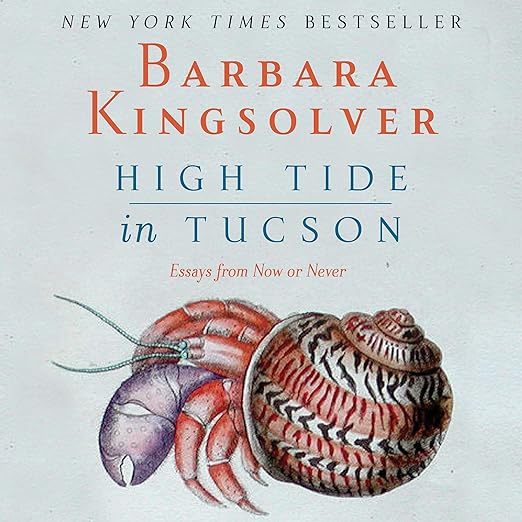
High Tide in Tucson was first published in 1995, and Kingsolver narrates this audiobook herself. That fact matters more than it usually would. Her fiction voice – the careful, architected sentences she builds in novels like The Poisonwood Bible or Prodigal Summer – is present here, but unbuttoned. She is funnier in person, so to speak. She is also more willing to be uncertain, to turn a subject over a few times before she decides what she thinks about it. Listening to her read her own sentences, I noticed how she pauses before landing on a conclusion, as if testing its weight.
Our Take on High Tide in Tucson
This is a collection that rewards patience. Across its range of subjects – modern motherhood, the history of private property, the ethics of an invasive wild pig in a garden, what a museum of atomic bomb relics does to the people who walk through it – Kingsolver circles back to the same abiding question: how do we find instructions for living in a world that offers no user manual? She approaches this through a scientific eye and a poet’s appetite for metaphor, and the combination is unusual enough to be genuinely interesting. One reviewer called these essays “nonfiction of imagination, wit, eccentric, and intelligence,” which is accurate in its way, though it undersells the underlying seriousness of purpose.
The weakest essays in the collection are the travel pieces. At least one reviewer mentioned exactly this, and I agree. When Kingsolver is grounded in a specific tension or observed phenomenon, she is extraordinary. When she is simply moving through a place and reporting back, the prose loses some of its particularity. That unevenness is worth naming because it shapes the listening experience, especially in a single long session. But the strong essays are genuinely strong – pieces like “Stone Soup,” about divorce and the myth of the nuclear family, carry real persuasive weight even to readers who would push back on her conclusions.
Why Listen to High Tide in Tucson
The author-as-narrator decision is the most compelling reason to choose the audio format. Kingsolver’s voice has a quality that is hard to describe without sounding vague: she sounds like someone who has thought carefully about language for a very long time. Not affected, not professorial. Just deliberate. She gives weight to commas in a way that printed text cannot quite replicate, and her timing in the funnier passages – particularly the ones involving her daughter or her ongoing domestic battles with an escaped hermit crab named Buster – is genuinely comic. At under three hours, this is also one of those audiobooks that fits inside a few commutes or a long walk, which suits the essay form well. You can finish one piece and sit with it before moving to the next.
What to Watch For in High Tide in Tucson
Readers who are significantly to the right of Kingsolver politically will have a harder time with certain essays. Several reviewers flagged this directly – one noted that Kingsolver sometimes slips into what feels like moral superiority despite gestures at modesty, and that observation is not entirely unfair. Her political convictions are baked into pieces like “The Memory Place” and “Stone Soup,” not sprinkled on top. They are structural. If you have strong objections to her worldview, some essays will feel like being lectured at from a beautiful porch. That said, another reviewer who describes herself as more conservative than Kingsolver wrote that this is one of her all-time favorite books, which suggests the prose itself – its grounded, practical texture – can outpace the ideology for readers willing to let it.
Who Should Listen to High Tide in Tucson
This collection is worth your time if you are already a Kingsolver fan curious to see her thinking on the page without the scaffold of plot, or if you read writers like Annie Dillard, Rebecca Solnit, or Terry Tempest Williams and want something in that orbit – nature-adjacent and politically aware but always coming back to the personal. It also suits listeners who prefer short form: the essay format means no commitment beyond the piece you are currently in. If you need momentum, a throughline, or a story with a clear beginning and end, this is not the right fit. And if the political dimension would actively interfere with your enjoyment, that is worth knowing going in rather than discovering at essay four.
Frequently Asked Questions
Does Kingsolver narrating her own essays change the experience significantly?
Yes, meaningfully. She brings a dry humor and a sense of deliberate pacing to the pieces that would be harder to convey through a third-party narrator. If you are drawn to this collection, the audio version is worth choosing specifically for her reading.
Is this collection best listened to all at once or in separate sittings?
Separate sittings suit it better. Each essay stands alone and benefits from a moment of reflection after it ends. At under three hours total, it is tempting to play through in one go, but the pieces land harder if you give them a little space.
How political does it get, and is that distracting?
Several essays have clear liberal leanings – ‘Stone Soup’ in particular argues a specific position on divorce and family structure. Readers who disagree with Kingsolver ideologically have described the book as both irritating and irresistible, so it depends on your tolerance for persuasive prose that argues from a fixed point of view.
Are all the essays equally strong, or are some noticeably weaker?
There is real variation. The travel essays tend to be the weaker entries – more observational, less driven by a specific question or tension. The strongest pieces, including the title essay about the hermit crab and ‘Stone Soup,’ are among the best things Kingsolver has written in any form.