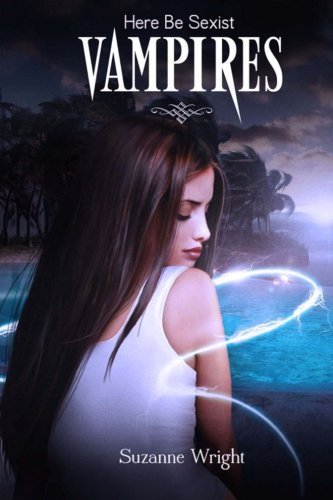
Sam Parker, the protagonist of Suzanne Wright's Here Be Sexist Vampires, is a Sventé vampire who has been told her entire supernatural life that her breed is too tame, too human-like, too lacking in raw power to belong in any serious fighting force. When she earns an invitation to test for a place in the Grand High Master's private army, she arrives into a room full of Pagori and Keja vampires who see her gender and her breed simultaneously and dismiss both. The audiobook, narrated by Justine Eyre, drops the listener immediately into this hostile environment, and the context opening works precisely because the prejudice Sam faces is not metaphorical: it is institutional, systematic, and enforced by a Pagori commander named Jared who she finds herself craving despite knowing exactly what kind of conviction he is operating under.
What Wright does well is make the competence demonstration genuinely satisfying rather than purely symbolic. Sam does not overcome the sexist environment through a single dramatic moment that converts her detractors all at once; she demonstrates capability repeatedly, in different kinds of situations, against different kinds of resistance. The world-building establishes clear stakes for what she is proving: the Sventé breed being regarded as too tame is not just social prejudice but has a specific meaning in the context of an army preparing for an incoming attack on the Grand High Master's home. Sam's energy whip is her primary fighting technique, and it is characteristic of Wright's approach that she gives her protagonist a weapon that requires precision and control rather than raw strength, speaking directly to the argument about what kind of vampire is actually capable of sustained combat.
The romance is built on genuine friction. Jared is not a misunderstood hero with a soft center visible from the first chapter: he is specifically antagonistic to Sam's presence in ways that feel rooted in real conviction rather than performative posturing. The enemies-to-lovers arc functions here because the antagonism is substantive and sustained. Sam's craving in spite of herself is a standard romance setup, but Wright executes it by making both the obstacle and the attraction specific to who these characters actually are. He is wrong about a particular thing in a particular way, and the romance's progression is tied to whether and how that wrongness is confronted and changed over time.
The book contains explicit content, as the synopsis directly states: vampy sex and a romance story with real bite. Wright does not treat this as incidental to the plot or separate from the competence-demonstration arc; the physical and the romantic are connected to Sam's overall project of being taken seriously as a complete person rather than dismissed as a category. That integration is one of the stronger structural choices in the book.
The Best Parts of Here Be Sexist Vampires
Justine Eyre is a consistently reliable narrator for paranormal romance, and her work here is well-suited to Sam's first-person voice. Sam is written in close first person, which means the listener spends the entire 10-hour-and-29-minute audiobook in a perspective that is witty, combative, and genuinely attracted to someone she is simultaneously frustrated by. Eyre handles the tonal swings between the sarcasm Sam deploys in public and the internal acknowledgment of what she actually feels with the kind of precision that paranormal romance particularly requires: the listener needs to believe both registers simultaneously without either one undermining the other.
The pacing holds through the extended setup before the romantic dynamic begins to shift. Wright takes time establishing the army's social structure, the breeds' relative positions, and the specific nature of the Pagori-Sventé prejudice before allowing the romance to develop momentum. This is structural patience that pays off: the emotional territory that Sam and Jared eventually navigate is more charged because the listener understands exactly what is at stake for both characters and why the pull they feel is so inconvenient for each of them.
Before You Commit to Here Be Sexist Vampires
The world-building is set up primarily in service of the romance and the competence demonstration, which means some of the larger political context, the impending attack on the Grand High Master's home, functions more as a deadline than as a fully developed threat in this first volume. Listeners who want deep lore and political complexity in their paranormal world-building may find the balance tilts toward romance. That is an appropriate trade-off for the genre, but worth knowing before you start.
The title is accurate and the book does not treat the sexism as background texture. It is foregrounded throughout the narrative, and the manner in which Sam addresses it, primarily through demonstration rather than argument, is the book's central pleasure. The iron-willed female vampire with an energy whip description in the synopsis is accurate and should be understood as a promise rather than a marketing flourish.
Should You Listen to Here Be Sexist Vampires?
Paranormal romance listeners who want their enemies-to-lovers arc built on friction that feels genuinely rooted in character rather than manufactured as a plot mechanism will find this rewarding. Justine Eyre's narration is a real asset for listeners who prioritize vocal performance quality. The explicit content is present and real, positioning this as adult paranormal romance rather than upper-YA. Readers new to Suzanne Wright's catalog can start here; the book establishes its world fully within this first volume and the romantic arc receives substantial resolution without requiring immediate continuation into subsequent books.
- Voice: Justine Eyre handles Sam Parker's sharp, combative first-person voice with the right mix of dry wit and underlying heat, capturing both the sarcasm and the reluctant desire without flattening either into a single register.
- Big ideas: Competence as a form of seduction, institutional prejudice dismantled from within, enemies-to-lovers built on genuine substantive friction
- Atmosphere: Charged and irreverent, with real action sequences and escalating romantic tension throughout
- Worth it?: A paranormal romance that earns its enemies-to-lovers arc because the sexism the protagonist faces is specific and the way she dismantles it is satisfying on both the practical and romantic levels.
Is Here Be Sexist Vampires audiobook the first in a series?
Yes. This is the opening book of Suzanne Wright's Dark in You series. It establishes Sam Parker and the vampire world fully within the novel, and the primary romantic arc receives resolution within this volume, though the larger world and cast of characters continue across subsequent books.
How explicit is the content in this audiobook?
The synopsis specifically describes explicit vampy sex and a romance with real bite. This is adult paranormal romance with genuine heat rather than implied or suggested content. Listeners who prefer fade-to-black romance should factor this into their decision before purchasing.