Quick Take
- Narration: J.Y. Kora gives Sadie a warmth and self-deprecating humor that works well for the character’s arc, keeping the tone light even in the more emotionally fraught scenes.
- Themes: Rejection and worthiness, found family through fated mates, identity discovery
- Mood: Warm and romantic with shapeshifter fantasy trappings, emotionally satisfying rather than dark
- Verdict: A reverse harem paranormal romance that delivers on its central promise of a rejected heroine finding three kings who truly see her, with some epilogue construction that divided readers but does not undermine the core story.
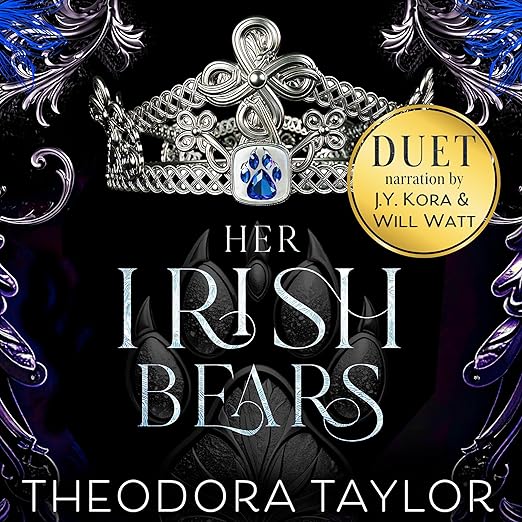
I listened to most of Her Irish Bears on a Sunday afternoon, which is exactly the right context for Theodora Taylor’s brand of paranormal romance. The setup is efficiently absurd in the best way: Sadie, a six-foot-tall, plus-sized she-wolf from a cloistered Canadian village, signs up for a Bridal Exchange trip to Scotland hoping to find a mate among wolves desperate enough for brides that they cannot afford to be choosy. They turn out to be choosy. She gets kidnapped by Irish wolves. The Irish wolves also do not want her. She ends up with three bear kings who turn out to be her mates. And then she discovers she is not actually a wolf at all.
That last twist is where the novel opens into something more interesting than its premise initially suggests. Sadie’s entire life of rejection was built on a misidentification, and the question the novel asks is what it does to a person to spend their formative years believing they are fundamentally unlovable within the only world they know.
Our Take on Her Irish Bears
Taylor is a confident genre writer who understands that reverse harem paranormal romance works best when the emotional stakes for the heroine are real rather than purely circumstantial. Sadie is not simply the recipient of three kings’ attention; she is a person who has been told she is too big, too odd, too other for long enough that she does not immediately know how to accept being cherished. J.Y. Kora’s narration gives her the right voice for this: self-deprecating, a little surprised by her own reactions, and genuinely funny in the scenes where the story allows for humor. The kings are differentiated enough to function as distinct characters rather than a collective prize. Ciran in particular attracted strong reader attachment, described in one review as seeming like some type of god or possessing otherworldly gifts, which is as high a paranormal romance compliment as exists.
Why Listen to Her Irish Bears
At nine and a half hours, the audiobook has space to develop Sadie’s internal journey alongside the external plot. Taylor does not rush the kings’ differentiated relationships with her, which allows the eventual acceptance on all sides to feel earned rather than granted. The worldbuilding of Sparo is coherent, and the sense that this novel connects to a larger series gives it texture without requiring prior investment. The 4.2 rating across 374 reviews reflects significant readership engagement, though the slightly lower score for this genre suggests the epilogue critique is more widespread than a handful of outlier opinions.
What to Watch For in Her Irish Bears
The epilogue is the most consistently flagged weak point in reader feedback. Multiple reviewers describe it as jumping too far forward from the main story’s conclusion, leaving a gap that raises questions the epilogue does not fully resolve. One reviewer specifically mentions difficulty navigating between past and present within the epilogue structure, and the resolution of a secondary character named Naomi divided readers. This is worth knowing going in so you can calibrate expectations rather than arriving at the ending cold and feeling blindsided. The mother figure in the story also generated strong reader reactions, with several people expressing anger on Sadie’s behalf that felt unresolved at the close. Taylor seems aware of these tensions given the series continues, and some threads may be picked up in subsequent books.
Who Should Listen to Her Irish Bears
Readers who enjoy reverse harem paranormal romance, plus-size heroines with genuine emotional arcs, and shapeshifter worldbuilding will find this squarely within their wheelhouse. The series-embedded nature of the story means readers of earlier Irish Shifters books will get the most from the character connections. Listeners who prioritize tidy epilogues and fully resolved secondary storylines should know that Taylor leaves some threads for the series to address. Those looking for something dark or conflict-heavy in tone will find this warmer and more emotionally buoyant than their preference.
Frequently Asked Questions
Is Her Irish Bears part of a series and do I need to read previous books first?
It is listed as book two in the Irish Shifters series. The main story is self-contained, but the emotional resonance of character relationships, particularly connections to events and people from book one, is richer with prior series context.
What specifically divided readers about the epilogue?
Multiple reviewers describe the epilogue as set too far in the future from the main story’s ending, with a time-jump that raises questions about intervening events. The resolution of a character named Naomi was also specifically called out as unsatisfying by several readers who otherwise loved the book.
How does J.Y. Kora handle Sadie’s voice given that she starts the story with deep rejection-rooted insecurity?
Kora plays Sadie with warmth and a self-aware humor that makes her sympathetic without making her passive. The narration tracks the gradual shift in Sadie’s self-perception across the novel, which is the primary emotional arc the story is built around.
Does the novel explain why Sadie was rejected by her home village and the Scottish wolves before the Irish bears claimed her?
Yes. The revelation that Sadie is not actually a she-wolf explains the nature of her lifelong rejection. The novel treats this as a meaningful twist rather than a casual plot device, connecting her misidentified nature to the specific bears whose species she actually shares.