Quick Take
- Narration: Andrea Parsneau is the fixed star of The Wandering Inn audio editions. By book fourteen she has given individual voices to dozens of recurring characters with such consistency that longtime listeners can identify a character from a line of dialogue before the narration confirms it.
- Themes: Adventuring economies and guild politics, the violence latent beneath ordinary life, friendship tested by external threat
- Mood: Epic in scope, intimate in execution, with tonal swings between cozy camaraderie and sudden devastation
- Verdict: Volume 14 of The Wandering Inn continues one of the most sustained feats in contemporary serialized fiction, and Parsneau's narration remains the ideal delivery mechanism for pirateaba's relentless world-building.
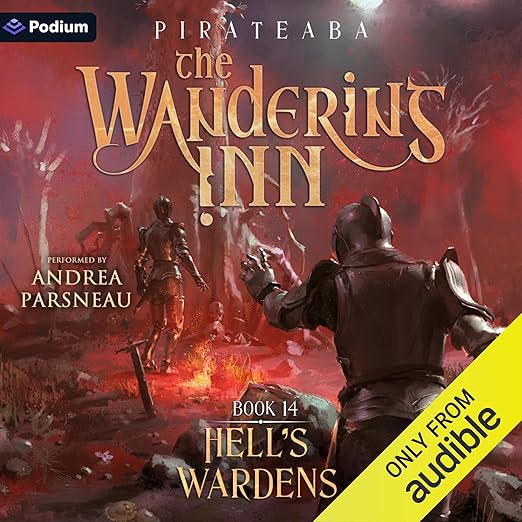
Pirateaba's craft, visible across millions of words of The Wandering Inn, reaches a particular intensity in Hell's Wardens, the fourteenth entry in a series that has built one of the most densely populated fictional worlds in English-language genre fiction. The audiobook runs twenty-six hours and thirty-two minutes, narrated by Andrea Parsneau, and it marks what longtime fans have called the best volume yet, a claim that carries real weight when it's made about book fourteen by people who have been reading since volume one. This is not a book for newcomers to the series. But for listeners already inside the world pirateaba has built, this entry delivers something that serialized fiction rarely achieves: genuine escalation after a very long run.
What pirateaba Delivers
The central plot thread involves the Horns of Hammerad, Pisces, Ceria, Ksmvr, and Yvlon, navigating simultaneous threats: a Wistram Academy mage team pursuing Pisces with revenge as the stated motive, and a dangerous contract to serve as security for a road-building project cutting through the Bloodfields. That setup sounds straightforward, but pirateaba rarely allows a threat to remain what it appears to be, and the Bloodfields specifically function as a location that reshapes the logic of every scene set near them. The novel's geography has always been a character, and nowhere is that more true than around this particular stretch of poisoned land.
The book also expands well beyond its central quartet. Players of Celum arriving at Invrisil, Terandrian Knights moving through Izril following the Witch of Webs confrontation, Foliana's characteristic off-screen chaos, pirateaba manages these parallel storylines with the confident coordination of someone who has been running this world long enough to know exactly how much tension each thread can hold before it needs to be released. One reviewer noted feeling pulled between wanting to race through to the next volume and wanting to slow down and stay in this one. That oscillation is a signature experience of the series at its best.
The tonal range in this volume is particularly demanding. Pirateaba moves from extended sequences of genuine warmth and humor, the cozy life of people who have survived extraordinary things and are now, briefly, allowed to simply exist in community, into violence and grief without warning and without sentimentality. A reviewer described it as "cozy life and fun, then suddenly tears everywhere," which is an accurate report rather than an emotional spoiler. The series has always done this, but the transitions in volume fourteen are faster and the stakes higher than in earlier entries.
What pirateaba Gets Right
Parsneau's narration is the definitive argument for audio over text for this series. By the fourteenth volume, she has inhabited these characters long enough that her vocal choices feel less like performance and more like memory. The distinction she draws between Ksmvr's careful, halting speech and Ceria's drier register, between Yvlon's physical directness and Pisces's layered defensiveness, is not just accurate to the text. It's interpretive. She has opinions about these people, and those opinions are present in how she reads them. New listeners occasionally note that certain character voices took adjustment, but regular listeners at this point in the series cannot imagine the text without Parsneau's voice attached to it.
The twenty-six-hour runtime is not padding. Pirateaba's world-building operates on an accumulative model: small observations made early in the series return as load-bearing details much later, and the dense prose requires attention that the audio format makes more sustainable over long sessions than reading does. The audiobook format also softens the transition between the novel's tonal registers, because Parsneau handles the shifts without editorial commentary, letting the darkness arrive with the same vocal register as the warmth that preceded it.
The subplot involving Foliana, the Three-Color Stalker, is worth flagging for series veterans as a particular highlight in this volume. Foliana operates with a deliberately off-kilter logic that Parsneau has been rendering with great comic precision across previous books, and her sections in volume fourteen have an absurdist quality that functions as tonal relief between the more intense Horns-centered sequences. Pirateaba uses Foliana's chapters to do worldbuilding that the main plot doesn't need to carry, and the result in volume fourteen is some of the most entertaining material the character has generated in the series. The Terandrian Knights subplot, meanwhile, adds political context from another part of the world that has been largely offscreen and rewards listeners who have been paying attention to the series' larger geographic scope.
Where pirateaba Loses Some Ground
Volume fourteen is not an entry point. Listeners who attempt to start here will encounter hundreds of characters, an elaborate magic system with specific internal rules, faction politics spanning multiple continents, and a protagonist, Erin Solstice, whose significance to the plot is felt through her absence as much as her presence, since she has been central to the series arc in ways that require previous context to understand. The series reward for committed listeners is real, but the prerequisite is genuine. Start at volume one.
The Bloodfields as a narrative location also require a specific kind of patience. Pirateaba uses the approach to this territory to build tension across an extended portion of the book rather than delivering immediate payoff. Listeners who find that pacing satisfying, the long approach, the accumulation of dread, will find this volume operates at the series' highest level. Those who prefer tighter action-focused plotting may find some of the expansion sections long.
Who Should Pick Up Hell's Wardens
Series veterans, specifically those who have already listened to or read through volume thirteen, are the only realistic audience for this audiobook. If you've stayed with The Wandering Inn this long, volume fourteen justifies the commitment. The series reward structure functions on the long arc, and this entry delivers on setups planted books earlier with satisfying specificity. Parsneau's performance at this stage of the series is a sustained achievement worth experiencing in audio.
If you're curious about The Wandering Inn but haven't started, the correct entry point is volume one, where Parsneau is also excellent and the world is appropriately smaller. Attempting volume fourteen as a standalone would be like starting a television series on its penultimate season finale.
Before You Listen
Is Hell's Wardens accessible as a standalone audiobook for someone new to The Wandering Inn?
No. This is the fourteenth volume of a series with hundreds of characters, interlocking political storylines, and plot threads that have been developing for millions of words across previous entries. Newcomers will have no context for the Horns of Hammerad, the Bloodfields, the Wistram Academy, or the relationships that make the emotional stakes in this volume hit hard. Start with volume one.
How does Andrea Parsneau's audiobook narration compare to reading the web serial version?
For listeners who have followed the series in audio from early on, Parsneau's narration has become inseparable from the characters. Her voice work is particularly strong in the ensemble scenes, where she differentiates between multiple characters in conversation without losing the comedic or emotional timing of the exchanges. Readers who started with the web serial and are considering switching to audio will find the transition requires some adjustment but is generally recommended by the fan community.
Does the audiobook's 26-hour runtime represent the complete volume, or are sections omitted?
The audiobook represents the complete published volume. Pirateaba writes at exceptional length, and the runtime is a function of the book's scope rather than any expansion of the material for audio. Listeners who have worked through previous volumes in the series will be familiar with this scale.
Is there a trigger warning for content in this volume?
The Wandering Inn contains violence, death of named characters, and emotionally intense sequences throughout the series, and volume fourteen continues that pattern. Pirateaba handles these moments with narrative purpose rather than gratuitousness, but listeners who found earlier volumes difficult in those respects should expect similar content here. The series does not soften as it progresses.