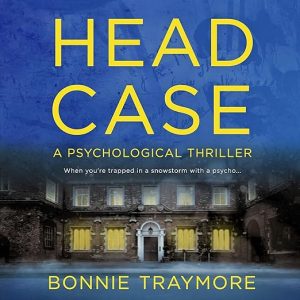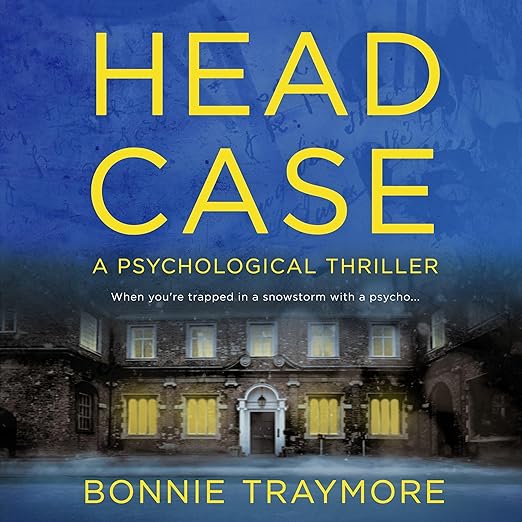
A breakup sends Cassie Romano from sunny San Diego to a snowed-in private school in the Catskills, and Bonnie Traymore uses that isolation deliberately, stranding her protagonist somewhere genuinely difficult to leave right as a colleague turns up dead. Head Case sets up a classic closed-circle psychological thriller premise, an academy cut off by winter weather, a death everyone else is content to call an accident, and a narrator with secrets of her own that make her reluctant to start asking questions. Robin McAlpine narrates this audiobook, and reviewers describe real surprise around its central mystery, even when they are otherwise divided on how well the rest of the novel holds up.
Head Case Puns on Cassie's Own Suspicions
Traymore leans into a genuinely well-worn but reliable structure, San Diego sunshine traded for Catskill isolation, a fresh start curdling into loneliness and boredom well before the plot's central death even happens. That setup does real work establishing Cassie's psychological state before the mystery kicks in, since she is already unmoored, already questioning the choices that got her there, which makes her reluctance to investigate her colleague's death read as genuine self-preservation rather than a plot contrivance.
The novel withholds its central reveal well enough to genuinely surprise at least some listeners. Becca's review is direct about this: she 'wasn't expecting the actual murderer to be who it was,' adding that she 'had someone else pegged for it' entirely, which is exactly the kind of misdirection a psychological thriller needs to earn its ending rather than simply delay it.
The title itself carries a deliberate double meaning. Head case works as slang for someone psychologically unstable, which could describe the dead colleague, Cassie herself, or the culprit once revealed, but it also puns on the literal case Cassie finds herself investigating inside her own head, piecing together fragments of suspicion without any formal authority to do so. Traymore leans on that ambiguity throughout, keeping listeners genuinely unsure for long stretches whether Cassie's instincts are sound detective work or a symptom of her own unresolved crisis.
Cassie's own decision to leave San Diego for the Catskills reads, on reflection, as its own quiet piece of foreshadowing, a woman running from heartbreak toward the most physically isolating environment she could choose, snow, mountains, a small enclosed campus, rather than toward somewhere that might have offered genuine community or distraction. That choice says as much about her state of mind at the story's outset as anything she directly narrates, and Traymore trusts listeners to notice the irony without spelling it out.
One especially effective plot device deserves its own mention: Cassie receives a cryptic letter from her dead colleague days after the death, a piece of epistolary unease that immediately undercuts the official story of an accident without yet explaining how or why. That kind of delayed-message device is a reliable genre engine, and Traymore uses it here to keep Cassie, and the listener, actively suspicious rather than passively waiting for answers to arrive. The private-school name itself, Falcon Ridge Academy, carries the vaguely elite, vaguely ominous quality genre readers will recognize instantly as a signal of secrets simmering beneath a respectable surface.
McAlpine Narrates a Christie-Style Closed Circle
Robin McAlpine's narration handles Cassie's guardedness well, letting the character's own withheld secrets color her narration of events without tipping the audiobook's hand about what those secrets actually are too early. That balance, a narrator whose voice suggests more is being held back without ever confirming it outright, suits a story built around a protagonist who is simultaneously investigating a death and avoiding her own past.
SA_ostrich's review frames the setup efficiently: a teacher who unwisely takes on an unusual teaching position, only to have a colleague die shortly after she arrives, with Cassie refusing to accept the official explanation. That reviewer's overall take lands as measured rather than rapturous, useful context for listeners deciding whether the premise alone is enough to justify the roughly six-hour runtime.
The isolated-academy setup places Head Case in a long lineage of closed-circle mysteries stretching back to Agatha Christie's classic snowbound and island-bound whodunits, where a small, contained cast and no easy way to leave the scene do as much narrative work as the mystery plot itself. Traymore updates that formula with a contemporary private-school setting and a protagonist whose own baggage complicates her objectivity in a way Christie's more detached narrators rarely allowed, giving old bones a genuinely modern psychological angle.
Rachael's Three Stars Call It Not Thrilling
Not every listener connected with the execution. Rachael Ashak-Benson gave the book three stars and was candid about her mixed experience, admitting she is not entirely sure why she stuck with it and calling the result 'not really that thrilling' with a plot she felt 'lacks in depth.' That is a real counterpoint to Becca's enthusiasm about the twist, and worth weighing before committing, especially for listeners who prioritize atmosphere and prose depth over a strong final reveal.
At six hours and fifteen minutes, this is a brisk listen for a psychological thriller built around a closed academic setting with a fairly wide cast of suspects, teachers, students, and administrators all plausibly connected to the death. Listeners who prefer slower-burn atmospheric builds, with the isolated snowbound campus doing more sustained atmospheric work throughout, may find the pacing here leans more toward plot mechanics than mood once the investigation gets going.
The Catskill Mountains setting itself deserves a specific mention: upstate New York in December carries real, grounded isolation, unlike a more generic remote location a lesser thriller might use as vague set dressing. Traymore uses the actual practicalities of a snowbound campus, canceled roads, limited contact with the outside world, a small year-round staff, to make Cassie's isolation feel earned rather than contrived, which strengthens the psychological pressure the plot depends on.
Falcon Ridge Suits Misdirection Fans, Not Prose Lovers
Fans of academic-setting psychological thrillers with a genuine whodunit engine, rather than a slow literary character study, are the best audience here, especially listeners who enjoy being actively misdirected toward the wrong suspect the way Becca describes experiencing. The isolated boarding-school setting and Cassie's own buried secrets give the book a reliable genre engine that delivers exactly what psychological-thriller fans show up expecting.
Listeners who enjoy dark academia atmosphere layered onto a genre mystery, rather than dark academia as the primary draw, will find Falcon Ridge Academy's isolated, snowbound setting does real work even if the prose itself, per some reviewers, does not linger there as long as die-hard atmosphere fans might want.
Substantial prose depth and richly developed secondary characters, the specific gap Rachael Ashak-Benson's review points to, are not this book's strength, so readers who need those elements to feel satisfied should temper expectations, since this is a plot-forward thriller that prioritizes its central mystery's payoff over lingering literary texture.
- Narrator: Robin McAlpine gives Cassie a guarded quality that hints at hidden depths without giving anything away early.
- Subjects: Isolation and secrets, small-community suspicion, grief masking guilt.
- Tone: Tense and wintry, with a strong late twist.
- Bottom line: A brisk, plot-forward psychological thriller with a genuinely surprising reveal, though thinner on atmosphere and depth than some listeners want.
Common Questions
Is the ending of Head Case genuinely surprising as an audiobook listen?
Reviewer Becca specifically praised being caught off guard by the killer's identity, calling it the twist she least expected.
How long is the Head Case audiobook?
It runs six hours and fifteen minutes, a brisk runtime for a psychological thriller with a fairly wide cast of suspects.
Does Robin McAlpine's narration give away Cassie's secrets early in this audiobook?
No, the narration maintains a guarded quality that suggests Cassie is holding something back without confirming what it is until the story is ready.
Are the reviews for this audiobook consistent in their praise?
No, reactions are mixed. While some reviewers praise the twist, at least one found the story thin on depth and only moderately thrilling despite finishing it.