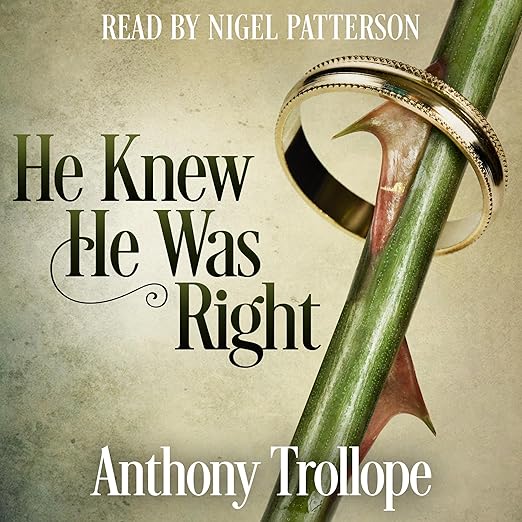
Quick Take
- Narration: Nigel Patterson handles Trollope’s sprawling Victorian ensemble with clarity and patience, though the 30-hour runtime demands a committed listener.
- Themes: Jealousy as a path to madness, the rights and autonomy of women in 19th-century marriage, generational change and social mores
- Mood: Dense and novelistic, by turns darkly comic and quietly tragic, Trollopian in the best sense
- Verdict: One of Trollope’s most psychologically intense novels, and the right audio production for listeners willing to spend thirty hours with a man methodically destroying himself over a suspicion he cannot prove.
I came to He Knew He Was Right after finishing The Way We Live Now and developing the specific Trollope reader’s problem: you want more, but you know his novels are long, and the commitment has to be considered. At thirty hours and thirty-two minutes, this one asks more than most. I started it on a long international flight and continued across two weeks of commuting and evening sessions. By the end I was genuinely disturbed, which I mean as a compliment to Trollope.
The 1869 novel is often described as his masterpiece, a claim that usually generates argument among Trollopians, but it has a legitimate case. The central story of Louis Trevelyan, driven by jealousy of an old family acquaintance his wife Emily has befriended, is a sustained psychological portrait of a man consuming himself from the inside. Trollope is not usually thought of as a writer interested in madness. This novel changes that assessment.
Our Take on He Knew He Was Right
What makes the book remarkable, and what multiple reviewers note with some surprise, is that Trollope does not structure the quarrel as a simple case of wronged wife and cruel husband. Reviewer Dr. Emily Kurtz observed that the wife was in the wrong and was abusing her privileges for at least three quarters of the novel, a reading that the text genuinely supports. Emily Trevelyan’s stubbornness is as real as Louis’s jealousy, and Trollope is interested in how two people who are not fundamentally wrong can still destroy each other through pride and the inability to yield. It is a novel about what happens when being right becomes more important than being married.
The secondary plots, which include courtship subplots, questions of women’s autonomy in multiple registers, and what one reviewer called the myriad nuances of the male-female dynamic, are not distractions from the central tragedy but a kind of counterpoint. Trollope shows the full spectrum of Victorian marriage across different characters, from partnerships of genuine affection to social arrangements that barely pretend to be more. The result is a panoramic social novel that happens to have a psychological thriller at its center.
Why Listen to He Knew He Was Right
Nigel Patterson’s narration is steady and clean. Trollope’s prose is dense with reported speech and free indirect discourse, and Patterson maintains enough differentiation across the large cast to keep the listener oriented without resorting to exaggerated vocal performance. The thirty-hour format is demanding, but Trollope’s pacing is that of the serial novel he was writing for, designed for absorption over time rather than sprint reading. In audio that actually works in the book’s favor: it can unfold across days the way it was originally consumed across weekly installments, and the character development accumulates with the kind of gradual weight that creates the most devastating final impression.
What to Watch For in He Knew He Was Right
The length is a real commitment and not everyone will find Trollope’s discursive style rewarding enough to sustain it. Those who want plot efficiency will struggle with a book that takes genuine interest in minor characters’ marriage prospects for long stretches. The novel’s darkness also surprises listeners who come in expecting Trollope’s usually gentler social comedy. Louis Trevelyan’s descent into paranoia and physical deterioration is not handled at arm’s length. Reviewer Shawn Henk described it as an amazing, yet tragic example of what the mind can do, and that is accurate; this is not comfortable listening even when it is compelling.
Who Should Listen to He Knew He Was Right
Readers who have enjoyed Trollope’s other work and want to encounter his most psychologically intense novel will find this essential. Literary fiction listeners drawn to Victorian social and psychological exploration, who might come to Trollope through George Eliot or Wilkie Collins, will find the comparison worthwhile. The reader who noted shades of Thackeray’s Vanity Fair in the Colonel Osbourne parallel is identifying a real kinship in how both authors use jealousy as a social diagnostic. If you are curious about Trollope but this is your first encounter, consider starting with Barchester Towers or The Way We Live Now before committing thirty hours to his darkest work.
Frequently Asked Questions
Is He Knew He Was Right a good starting point for a reader new to Trollope?
It is not the most accessible entry point. The length and the psychological darkness are better appreciated with some prior Trollope experience. Barchester Towers or The Warden offer more typical starting points that showcase his wit and social observation before committing to this more demanding novel.
How does Nigel Patterson’s narration handle the large cast of secondary characters?
Patterson manages the ensemble effectively enough that listeners can track the primary and secondary characters without confusion. He does not overdifferentiate voices in ways that call attention to the performance, which suits Trollope’s narration style. The risk at thirty hours is listener fatigue, but Patterson’s clarity helps sustain attention.
Is the portrayal of Emily Trevelyan sympathetic, or is she presented as the wronged party?
She is more complex than that framing suggests. Trollope gives Emily genuine stubbornness and pride that complicate easy sympathy, and multiple readers note that her behavior in the quarrel’s early stages is genuinely difficult to defend. The novel’s moral intelligence lies in refusing to assign simple fault.
How does He Knew He Was Right compare to other Victorian novels dealing with jealousy, such as Othello or Vanity Fair?
The Othello comparison is less apt than it might seem, since Louis’s suspicion is never proven justified and Trollope is more interested in the psychology of jealousy than in the question of guilt. The Vanity Fair connection, particularly around Colonel Osbourne paralleling the Marquis of Steyne, is sharper: both novels use a third-party male figure to reveal rather than create the fractures in a marriage.