- Performance: Allie Shae leans into both sides of the enemies-to-lovers dynamic, giving the demon's hostility and the witch's guardedness equal weight.
- What it covers: enemies-to-lovers, forbidden attraction, sapphic paranormal romance
- Feel: Hot, tense, and unapologetically spicy
- Our call: A strong pick for Court of Chains fans and sapphic romantasy readers who like their tension drawn out.
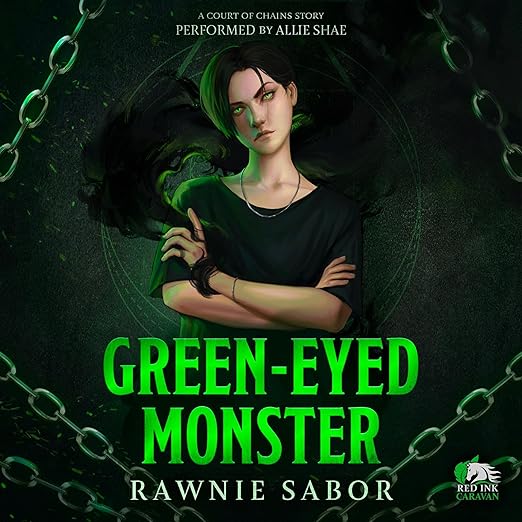
What happens when an Envy demon fixates on the one witch she's sworn to despise? That's the setup Rawnie Sabor runs with in this audiobook, Green-Eyed Monster, book three in the Court of Chains series, where the demon Vex and the witch Angela Norwood spend 21 hours and 11 minutes circling an attraction neither of them wants to admit to. Angela breaks witch law for a living and usually gets away with it; Vex claims to hate witches on principle, right up until Angela's smirks and secretive research start living rent-free in her head.
What We Made of It
The enemies-to-lovers mechanics here run on a genuine power imbalance: Angela risks being burned at the pyre for her arcane research, while Vex's interest in exposing her doubles as an excuse to stay close to someone she can't stop watching. Sabor lets Vex's stated hatred and her actual obsession sit in open contradiction for most of the book, which is exactly the tension the enemies-to-lovers structure depends on to work.
Series continuity matters here. Reviewer Suzette, who'd been waiting for this installment 'ever since being introduced' to Vex, framed the sin-based structure directly: 'I think of all the sins, Envy has to be one of the most complicated, if not the most.' The prior book centered a different character built around Pride, and that pattern, one sin, one protagonist, one entry, gives the series a clear organizing logic across its Court of Chains world.
A political intrigue layer runs alongside the central romance too: outside enemies have taken notice of Angela's research, forcing Vex into an actual strategic choice, protect the Court of Chains or let the threat play out. That subplot keeps the book from being pure relationship drama; Vex's eventual decision to act carries real stakes for characters beyond just herself and Angela.
Sabor's handling of Vex's internal contradiction, genuine ideological hatred of witches sitting alongside genuine obsession with one specific witch, avoids the trap of making the hatred feel purely performative from the start. Vex's disgust reads as real for the opening chapters, which makes her gradual capitulation to attraction feel like an actual character arc rather than a foregone conclusion the book was always winking at.
The Court of Chains name itself does real thematic work across the series: chains function as both literal magical binding and metaphor for the constraints of law, role, and expectation that each protagonist has to break free of before their story resolves. Angela's chains are the witch laws she keeps breaking; Vex's are her own stated convictions about what she's supposed to hate.
Why Listen to Green-Eyed Monster
Allie Shae's narration has to carry two conflicting internal registers at once: a guarded, secretive witch and a demon whose hostility keeps sliding into open fixation. Reader Tacie's description of the book gets at exactly that tension, calling it 'exactly the kind of sapphic demon-witch enemies-to-lovers chaos I crave at 2am when I want to feel destroyed and mended at the same time.'
Reviewer Kiara backed up the craft specifically, praising 'amazing pacing for action' and noting the book 'has got a cinematic feel,' adding that 'the tension between the main characters is well developed.' That combination, a well-paced plot alongside genuine character-driven tension, is what separates a strong entry in a long-running romantasy series from one that's just coasting on the premise.
At 4.8 stars from 778 ratings, this is an unusually consistent level of praise, a genuinely strong signal for book three of an ongoing series where fatigue or diminishing returns often start to show. That kind of sustained rating strength suggests Sabor is deepening the Court of Chains world rather than just repeating a successful formula.
The 21-hour runtime gives the slow-burn structure real room to breathe; rather than rushing the enemies-to-lovers turn, Sabor lets Vex and Angela's dynamic escalate gradually across many smaller interactions before the relationship shifts fully, which rewards listeners who prefer a drawn-out burn over an instant, thinly-motivated turn toward romance.
What Might Not Land
Set expectations accurately on content: Kiara described this as 'high spice,' and that should be read as a direct signal rather than a vague genre label. This is a paranormal romance built around genuine heat, not one that fades to black at key moments, so calibrate accordingly if that's not what you're looking for.
At just over 21 hours and as book three, new listeners have real world-building depth to catch up on if they're new to the series. Kiara notes the book 'can be read stand-alone,' but also says the broader 'world building is worth going back' for, meaning new readers get a complete story here while missing some of the accumulated context longtime series readers bring with them.
If you're tracking the series' organizing structure, each entry apparently centers a different demon built around a different deadly sin, Pride in the prior installment, Envy here, which is worth knowing if you want to anticipate where future entries might go, or if you're deciding whether to start with this specific sin's story or go back to the beginning first.
Because the pyre threat for witches breaking the rules is a real, stated stake in this world rather than a vague background detail, the tension around Angela's secretive research carries genuine consequence throughout; this isn't a fantasy setting where the rules feel decorative, and Sabor uses that groundwork to keep tension high even outside the central romance.
This long romantasy volume suits episodic listening better than a single sitting; the book's structure, built around escalating smaller interactions between Vex and Angela rather than one continuous crisis, lends itself naturally to picking up and putting down across several days rather than a single binge.
Who Should Pick Up Green-Eyed Monster
Recommended for sapphic romance readers, paranormal and urban fantasy romance fans, and anyone who specifically enjoys enemies-to-lovers built on real narrative tension rather than surface antagonism. Existing Court of Chains readers who've been waiting for Vex's story specifically will find this delivers on that anticipation.
It's also worth a listen for readers generally interested in demon-and-witch pairings within urban fantasy romance more broadly, even without deep prior investment in this specific series; the Court of Chains world is developed enough to be legible on its own terms without requiring extensive genre homework beforehand. Longtime paranormal romance readers who enjoy a series that keeps raising its own stakes book to book, rather than resetting to a safe formula each time, will find plenty to like in how this installment builds on what came before.
Skip it if explicit, high-spice content isn't for you, since this book leans fully into that register rather than softening it. Also skip it if spending 21-plus hours inside a single romantic arc, however well-paced, feels like more time than you want with one couple.
Do I need to listen to the first two Court of Chains audiobooks before Green-Eyed Monster?
Not strictly. Reviewers confirm it can be read stand-alone, though the series' broader world-building rewards going back to the earlier books, and returning fans will recognize more of the context around Vex and the Court.
How explicit is the Green-Eyed Monster audiobook's spice level?
High. One reviewer specifically described it as 'high spice,' and the book builds toward genuine explicit content rather than fading to black, so listeners should plan accordingly.
Is the Green-Eyed Monster audiobook a sapphic, F/F romance?
Yes, it centers a romance between the demon Vex and the witch Angela Norwood, an enemies-to-lovers arc between two women within Rawnie Sabor's paranormal Court of Chains world.