Quick Take
- Narration: Andrea Parsneau is the definitive voice of pirateaba’s Wandering Inn universe, and her performance here carries the full weight of a complex ensemble in a gloomy, high-stakes setting.
- Themes: Performance as power, corruption within institutions, the moral ambiguity of the undead
- Mood: Dense, atmospheric, and rewarding for invested readers; rich with Wandering Inn-verse texture
- Verdict: A strong third installment in the Singer of Terandria series that deepens Cara’s world considerably, though it demands prior investment in both this series and the parent universe.
Pirateaba is one of the most ambitious writers working in web fiction today, and that ambition creates a particular kind of listener investment that is difficult to explain to the uninitiated. By the time I had reached Ghostsong, the third book in the Singer of Terandria series, I had been living with this author’s world across millions of words. That investment is what Ghostsong asks of you, and what it repays.
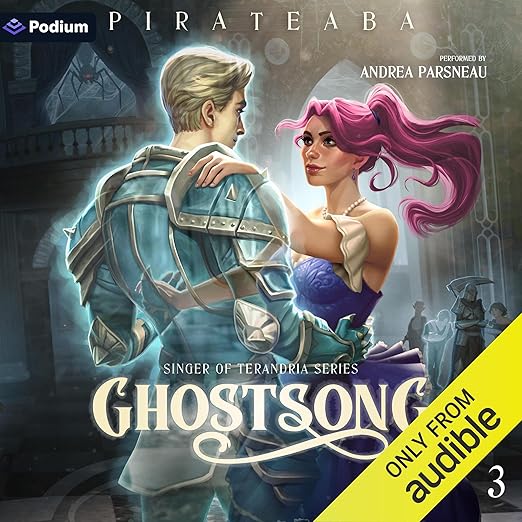
Ghostsong picks up Cara’s story in Menorome, the City of Repose, the capital of Noelictus, a kingdom defined by its gloomy relationship with death and the undead. She arrived in previous books as a performer trying to make a living in a foreign kingdom; what she finds in the capital is considerably more complicated. A corrupt Hunter’s Guild, a dangerous Baron operating in the shadows, a spider’s web of political intrigue, undead rising in ways that suggest something is deeply wrong with Noelictus’s foundations, and a ghost knight, Sir Dalius, whose relationship with Cara develops into one of the more emotionally interesting dynamics in this corner of the Wandering Inn-verse.
Our Take on Ghostsong
Pirateaba writes with an unusual willingness to hold moral complexity. The undead in Noelictus are not simply monsters; Ghostsong develops the idea that secrets buried in the grave are not always evil, which gives Cara’s singer abilities a thematic weight they earn across 20 hours. The institutional corruption at the Hunter’s Guild is rendered with the same texture that makes the Wandering Inn’s political maneuvering so compelling: bad actors with coherent internal logic, good people compromised by structural incentives, and protagonists who are powerful but not omnipotent.
Reviewer Lonnie Moore describes pirateaba as weaving a tapestry of stories together like Anansi the mythical spider, and that analogy captures something real about the author’s method. Multiple plotlines that seem unconnected converge in ways that feel earned rather than contrived. The rival nation poised to invade, the court intrigues, Cara’s developing relationship with the ghost knight, the mystery of what exactly is corrupting Noelictus’s undead order, these threads are handled with patience.
Why Listen to Ghostsong
Andrea Parsneau has narrated pirateaba’s work across the full Wandering Inn audiobook series, and her performance here represents years of accumulated familiarity with this world’s particular tonal requirements. She handles Cara’s range, from comedic fish-out-of-water moments to genuine grief and anger, with a fluency that newer narrators could not achieve. The ghost sequences in particular require a narrator who can hold emotional weight without melodrama, and Parsneau does this consistently.
At 20 hours and 41 minutes, Ghostsong is substantial but not padded. Pirateaba is a writer who earns runtime. The density here is informational and emotional rather than dilatory. Listeners who bounced off the Wandering Inn’s longer installments because of pacing concerns will find the Singer of Terandria series more compressed, though still demanding significant commitment.
What to Watch For in Ghostsong
This is emphatically a Book 3. Beginning here would be not just disorienting but actively incoherent. The relationships, the stakes, and the emotional resonance of the ghost knight arc all depend on Books 1 and 2 of the Singer of Terandria series, which in turn assumes at least basic familiarity with the Wandering Inn universe. The reviewer who called it a superior series, even above the parent Wandering Inn, is a reader deep in that ecosystem.
The classification system, denoted by bracketed titles like [Singer], [Baron], [Knight], is central to the world’s mechanics and is explained in earlier books rather than here. New readers who encounter these brackets without context will find them confusing rather than evocative.
Who Should Listen to Ghostsong
If you are already in the Wandering Inn-verse and have been following the Singer of Terandria series, Ghostsong is exactly what you have been waiting for: a deepening of Noelictus’s mysteries and a significant development in Cara’s relationships with both the living and the dead. If you are not yet in this universe, start at the beginning of the Wandering Inn or at the first Singer of Terandria book. The investment required to get here is substantial, but the readers who have made it consistently describe it as worth making.
Frequently Asked Questions
Can Ghostsong be listened to without reading the earlier Singer of Terandria books?
No. This is Book 3 of the series, and it builds directly on characters, relationships, and plot threads established in Books 1 and 2. It also assumes familiarity with the Wandering Inn universe’s class-bracket system.
Is the Singer of Terandria series connected to the main Wandering Inn series?
Yes, it is a spinoff set in the same world but following a different protagonist. The main series and this spinoff share worldbuilding, and some characters cross over, but the Singer of Terandria follows Cara, who is distinct from the Wandering Inn’s primary cast.
How does Andrea Parsneau’s performance in Ghostsong compare to her work on the main Wandering Inn series?
Parsneau has narrated both series extensively, and reviewers consistently describe her Ghostsong performance as exceptional. Her familiarity with pirateaba’s world and Cara’s specific voice deepens the performance beyond what early series narrations can achieve.
What is the ghost knight subplot about, and is it a central or peripheral storyline?
Sir Dalius, a ghost knight, develops a significant relationship with Cara throughout the book. This is one of the central emotional threads of Ghostsong, not a side plot. The relationship explores what pirateaba is doing thematically with the question of whether secrets in graves are inherently evil.