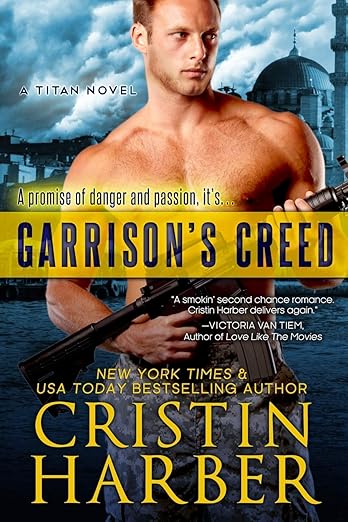
Cristin Harber's Garrison's Creed audiobook opens on a collision that encapsulates both the best and the most challenging aspects of second-chance romance as a genre: the man who believes his college sweetheart died a decade ago walks into an enemy compound and finds her bleeding out behind a sniper's rifle. The setup is constructed to produce maximum emotional impact from a single scene, and Harber executes it cleanly. The credibility question, how Nicola survived and why Cash was never told, is held as the novel's central information puzzle, and the spy thriller architecture that Harber builds around the Titan Group black ops team gives the romance a structural frame that would not exist in a purely contemporary second-chance story. Jeffrey Kafer narrates the audiobook, and his delivery of Cash's internal conflict, a man who has spent a decade deciding that love was incompatible with his profession, is measured enough to stay on the right side of brooding without tipping into melodrama.
The Titan Group, described as a black ops organization operating outside conventional military command, gives Harber a narrative sandbox that allows the story to move between international terrorism, domestic criminal networks, and personal history without any single element overwhelming the others. The mole investigation that forms the thriller spine of Garrison's Creed provides a constant structural tension that functions independently of the romance, which means the book does not need to manufacture romantic conflict to sustain narrative momentum. The conflict is already there, embedded in the operational situation both characters are navigating.
What Cristin Harber Delivers
The character construction for Nicola is the book's most careful work. CIA agents who survive reported deaths in fiction often suffer from a credibility problem: the narrative convenience of their survival strains against plausibility, and the reader's goodwill toward the romance depends on accepting a premise that is inherently difficult to make convincing. Harber solves this by keeping Nicola's survival circumstances opaque across the first half of the book, which means Cash's confusion mirrors the reader's, and both arrive at the explanation at the same moment. That structural alignment of character emotion and reader information is a specific technique that Harber handles with more discipline than the romantic thriller genre usually manages.
Nicola's operational competence is established early and maintained consistently. She is not rescued by Cash because she is incapable of defending herself. She is rescued because the operational odds have genuinely stacked against her, and the distinction matters enormously for how her character reads through the remainder of the book. The romance dynamic between Cash and Nicola depends on being a partnership between two people who are each dangerous in their own right, and Harber does not compromise Nicola's agency in service of the romance's emotional beats. Cash's protective instinct toward her is established as a specific emotional response to a specific person rather than as a generic masculine impulse toward a woman in danger.
What Cristin Harber Gets Right
Jeffrey Kafer's narration is well matched to the Harber's writing rhythms. The Titan Group chapters, which operate at the pace and register of tactical military fiction, benefit from Kafer's ability to maintain urgency without making the action sequences feel performative. The second-chance emotional beats, which require a different register entirely, are handled with a restraint that keeps Cash's decade of suppressed feeling legible without requiring the narration to push them. Kafer is a narrator with significant experience in the romance-thriller category, and that experience shows in how he negotiates the tonal demands of a book that is asking him to do two different things in alternate chapters.
The audiobook format suits Garrison's Creed particularly well because the alternating POV structure, Cash's tactical present and Nicola's operational past, benefits from the tonal consistency a single narrator's voice can impose across both perspectives. Rather than using dual narrators to distinguish the two characters, Kafer manages the distinction within a single voice, which gives the audiobook a sonic coherence that dual-narrated romance thrillers sometimes sacrifice for character differentiation. The consistency of his delivery through the mole investigation's more procedural sections keeps the pace from sagging between the action and romance peaks.
Where Cristin Harber Loses Some Ground
The Titan Group series context is not required to follow Garrison's Creed, but Harber's world has a depth of organization and backstory that suggests prior entries would enrich the supporting characters. The Titan team members who appear around the edges of Cash and Nicola's story have enough personality and history implied by their interactions that readers who invest in this book will likely want to explore other entries in the series. The black ops organizational structure is sketched efficiently but not exhaustively, which is the right choice for a series entry but means some of the world's procedural logic operates on implicit assumptions.
The mole investigation that forms the thriller spine concludes decisively within this volume, and the double-agent reveal is handled with enough setup that it does not feel arbitrary. However, the resolution of the international terrorism dimension that surrounds the mole plot is compressed into the final sections of the audiobook, and some listeners have found the action climax moves faster than the romantic and investigative build that preceded it. Harber is clearly calibrated for series pacing rather than single-volume completeness, and the ending functions as a satisfying arc conclusion while also positioning the world for future entries.
Who Should Pick Up Garrison's Creed
Listeners who want military romance with a functioning thriller spine, rather than a romance with military setting as decoration, will find Garrison's Creed delivers on both dimensions with more discipline than much of the category manages. Jeffrey Kafer's narration is a genuine asset and will be familiar and welcome to listeners who have followed his work in the romance-thriller space. Second-chance romance readers who are comfortable with a high-stakes operational backdrop and an extended mole investigation subplot will find the combination generates more sustained tension than either element would produce alone. Readers who prefer their romance center stage with action as secondary texture should be aware that Harber gives both dimensions comparable weight throughout the book.
- Read by: Jeffrey Kafer narrates Garrison's Creed, bringing his established romance-thriller delivery to Cash Garrison's perspective; his voice suits the black ops military register and handles the second-chance emotional beats without overselling them.
- At its heart: Second-chance romance, military black ops, CIA undercover operations
- Vibe: Taut and propulsive, with an emotional undercurrent that keeps the action from overwhelming the romance
- Short version: Garrison's Creed audiobook is a strong second-chance military romance with a genuinely high-stakes spy setup, and Jeffrey Kafer's narration gives Cash Garrison the grounded solidity the character needs.
Before You Listen
Does Garrison's Creed audiobook work as a standalone, or do I need to have read earlier Titan Group books?
The book functions as a standalone with a self-contained romance arc and a mole investigation that resolves fully within this volume. The Titan Group world has depth that prior entries would enrich, particularly around the supporting team members, but Harber provides enough organizational context for new listeners to follow Cash and Nicola's story without prior series investment.
How does Jeffrey Kafer handle the split between military thriller and second-chance romance in the Garrison's Creed audiobook?
Kafer uses tonal differentiation within a single voice rather than shifting dramatically between registers, which gives the audiobook a sonic coherence that suits the story. His delivery in the Titan Group tactical chapters has the urgency of military fiction without becoming performative, and he handles Cash's suppressed decade of feeling with a restraint that keeps the emotional beats credible.
Is Garrison's Creed a spicy romance audiobook or does it focus more on the thriller elements?
Harber gives both dimensions comparable weight. The romance between Cash and Nicola is central and emotionally developed, but the spy thriller elements, including the mole investigation, the international terrorism backdrop, and the CIA undercover operation that opens the book, are not subordinate to the romance. Listeners expecting a light military romance backdrop will find the operational content more substantive than that framing suggests.