Quick Take
- Narration: Rebekah Thompson delivers the worked examples and activity prompts with a clear, encouraging register, though some of the interactive elements, drawing angles, geometry sketches, are format constraints that no narrator can fully resolve.
- Themes: Math confidence building, puzzle-based learning, practical problem-solving
- Mood: Encouraging and energetic, practical and gamified
- Verdict: Strong supplementary math enrichment for confident learners or those needing a confidence boost, with the caveat that the visual and interactive elements in the original content require listener adjustment in audio format.
Math anxiety is one of the most persistent and well-documented educational challenges in middle school, and it tends to calcify around ages 10 to 13, precisely the window this book targets. I have a cousin who teaches seventh grade math and describes this cohort as the make-or-break years: students who get through without deciding math is something they simply cannot do tend to stay engaged; those who don’t often opt out mentally before high school begins. Any resource that genuinely addresses that window deserves honest attention.
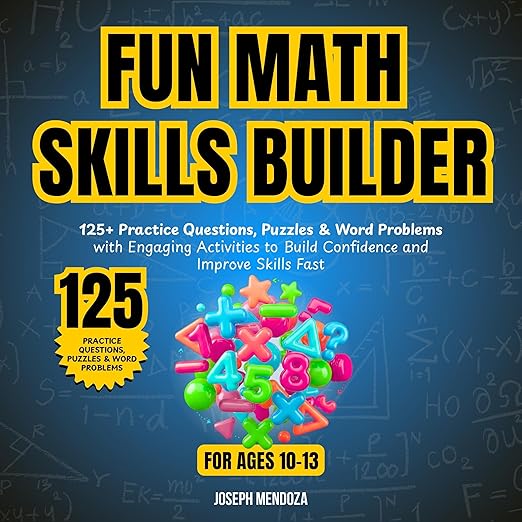
Joseph Mendoza’s Fun Math Skills Builder for Ages 10-13 approaches the problem through gamification, 125+ practice questions, puzzles, word problems, brain games, and what the synopsis calls a geometry scavenger sketchbook. The premise is that engagement and confidence are the primary barriers for this age group, and that a math resource that feels more like a game than a worksheet has a better chance of reaching learners who have already decided they are not math people. Rebekah Thompson narrates with a clear and motivating delivery that matches this tone.
What the 125+ Questions Actually Cover
Reviewers describe the content range as impressive for the format: doodle geometry, drawing angles, triangles and polygons, mixed-level practice questions, and real-life word problems. The inclusion of word problems calibrated to be relatable to the 10-13 age range is a smart design choice, the classic criticism of math education is that it feels disconnected from anything a child would actually encounter, and word problems that reference familiar scenarios address that gap directly. The step-by-step confidence-building progression is described by one reviewer as helping kids understand math in a fun, friendly, and stress-free way, with the emphasis on stress-free being the operative goal.
The perfect 5.0 rating across five listeners is a thin sample but a consistent signal. One parent described the moment of watching their son solve problems independently as the measure of success, not mastery of any specific concept, but the experience of self-directed problem-solving that produces confidence. That is exactly the psychological outcome this kind of resource is designed to produce, and the fact that it appears to be landing that way is meaningful.
The Audio Format and the Interactive Elements
This is where honesty about format matters. The Fun Math Skills Builder includes visual elements, geometry sketches, doodle activities, a scavenger sketchbook, that are interactive in the print edition and necessarily become verbal prompts in audio. Rebekah Thompson handles this by describing the activities, but the experience of physically drawing an angle or sketching a triangle while listening is something the listener has to self-facilitate. Parents who purchase this as an audio resource will get the best results if they have paper available for children to work alongside the audio, particularly for the geometry sections.
The word problems and logic puzzles translate more cleanly to audio format than the visual activities do. For these sections, Thompson’s clear narration gives listeners the setup and the time to work through the problem before the solution is provided, which preserves the problem-solving experience reasonably well. The mixed format of the book, some content audio-native, some requiring visual adaptation, means the experience is uneven rather than uniformly strong or weak.
Who Benefits Most from This Resource
This works best as a supplementary confidence builder rather than a primary curriculum tool, which is clearly how its most satisfied users are deploying it. Children who are catching up on missed skills, those who want to get ahead before a new school year, and those who simply enjoy puzzles and games will find this an engaging option. The audio format is a reasonable delivery mechanism for the verbal and logical content, though parents should be prepared to pause and engage with the interactive visual activities rather than treating this as a passive listen. For children who enjoy being challenged without being tested, Mendoza has built a resource that takes their engagement seriously.
Frequently Asked Questions
Can a child listen to this independently, or does it require parental involvement?
The verbal and problem-solving content works for independent listening by confident 10-13 year olds. However, the visual and interactive elements, including geometry activities, doodle sections, and the scavenger sketchbook, work best with paper available so the child can work alongside the audio. A parent who is present for the interactive sections can help ensure those activities are used as intended rather than skipped.
Does this audiobook cover specific middle school math curriculum, or is it enrichment-oriented?
It is enrichment and confidence-building oriented rather than curriculum-aligned to specific standards. The content includes geometry basics, word problems, logic puzzles, and mixed-level practice at a general middle school level, but it is not designed to systematically cover any particular grade’s curriculum. It works best as a supplement to classroom learning rather than as a standalone math program.
How does Rebekah Thompson’s narration handle the word problems, does the listener have time to work through them before the answer is given?
Thompson’s narration is calibrated to allow listeners time to engage with the problems before solutions are provided, which preserves the problem-solving experience reasonably well in audio. The geometry and visual activities are less audio-native and may require manual pausing, but the word problem sections work effectively as a listen-and-solve format.
Is this book appropriate for children who are behind in math, or is it designed for children who already enjoy math?
The book is explicitly designed for both, children who are catching up, getting ahead, or simply want to enjoy numbers are all named as target audiences in the synopsis. The graduated difficulty and game-oriented framing make it accessible for children who lack confidence in math, while the more challenging puzzles and brain games give confident learners engaging material to extend themselves.