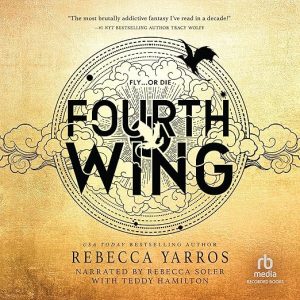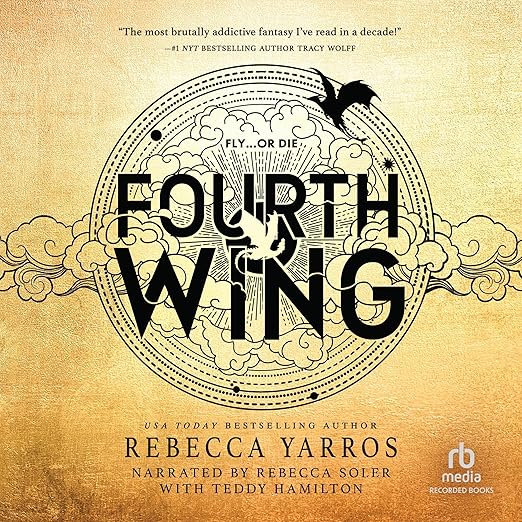
I resisted Fourth Wing for almost a year after its initial publication. The sheer scale of the enthusiasm around it, the TikTok posts, the waitlists, the friend group texts, made me instinctively cautious. Very large amounts of hype have occasionally produced very large amounts of disappointment, and I had been in that position before with fantasy romance. I finally started it on a Friday evening with a deliberately skeptical posture, fully expecting to find the machinery of the genre working smoothly but not much more. By Sunday I was deep into the second book. I am telling you this so you understand that my recommendation here is not a capitulation to the hype, it is what happened after I tested it.
Rebecca Yarros has built a world in which a war college trains dragon riders, death rates among cadets are genuinely high, and the dragons themselves choose whether to bond with a human or incinerate them. Violet Sorrengail was supposed to enter the Scribe Quadrant, the safe, scholarly option, but her mother, a general, overrules that entirely. Now Violet, smaller and physically more fragile than her classmates, has to survive an institution where most of the other students have reason to want her dead, and where the most powerful wingleader in her cohort, Xaden Riorson, has both personal grievances against her family and a complicated gravitational pull on her attention.
Fewer Dragons Than Cadets Raises Real Stakes
The worldbuilding here is more carefully constructed than the romance-fantasy genre usually demands. The system of dragon bonding has internal logic; the war college's brutal selection structure makes tactical and narrative sense; the hierarchy among the cadets reflects real power dynamics rather than decorative social stratification. When Yarros introduces the detail that fewer dragons are willing to bond than there are cadets competing, the consequence is immediate and felt: survival at Basgiath War College is not metaphorical. People die in the opening chapters, and those deaths establish that the threat throughout the novel is credible.
The slow-burn enemies-to-lovers structure between Violet and Xaden is where the book does its most emotionally precise work. Yarros is careful not to collapse the tension between them too quickly, which means that when the dynamic shifts, it shifts with weight. Xaden is genuinely dangerous and morally complicated, he is not a safe love interest dressed in threatening clothing, which is a meaningful distinction in this genre, and Violet is not passive in the face of that. She is physically fragile and intellectually formidable, and the combination is more interesting than the standard YA-adjacent heroine. One reviewer noted the diversity and dimensionality of the supporting cast, particularly Andarna, and that observation is accurate: the ensemble is constructed with real care.
Soler Voices Violet, and Hamilton Adds Xaden
Rebecca Soler's narration is a significant part of what makes this such a successful audiobook. She finds Violet's voice immediately, the dry wit, the fear that Violet manages but does not hide, the specific texture of her intelligence, and carries it consistently across the twenty-two hours. The extended edition now includes bonus chapters read by Teddy Hamilton, which adds a welcome contrast in the sections from Xaden's perspective. The combination does something that single-narrator audiobooks cannot: it physically differentiates the perspectives in a way that reinforces the novel's central tension. If you have already listened to the original edition, the extended version is worth redownloading.
At twenty-two hours, this is a full investment of time. It earns that investment. The pacing is well-calibrated, the novel knows when to slow down for emotional scene-setting and when to accelerate into action, and Soler's performance sustains the energy across the full duration without fatigue.
Open Threads and a Spoiler Worth Avoiding
The book is the first in the Empyrean series, and it ends with both resolution and significant setup for what follows. This is not a flaw, it is how serialized fantasy works, but listeners who prefer fully closed narratives should know that certain threads are deliberately left open. The second book, Iron Flame, picks up immediately and is itself now complete, so the wait is not painful.
The novel's most emotionally intense sequence, a revelation in the final third that recontextualizes several significant earlier events, is better experienced without any advance knowledge. The book rewards listeners who have avoided specific spoilers more than most fantasy of this commercial profile. I would encourage restraint on the fan wikis and community discussions until you have finished.
War-College Romance Fans Will Feel at Home
This is well-matched to readers of romantic fantasy who want genuine stakes beneath the relationship arc, readers who find pure romance without danger unsatisfying and pure grimdark without warmth exhausting will find Yarros has calibrated the balance carefully. Fans of Sarah J. Maas's Crescent City or Jennifer L. Armentrout's work will be on familiar structural ground while experiencing something with a more specifically war-college-driven world architecture. Listeners who are ambivalent about romance as a primary driver of fantasy narrative may find the romantic focus more prominent than they prefer. But within the genre it is operating in, Fourth Wing is executed at a genuinely high level.