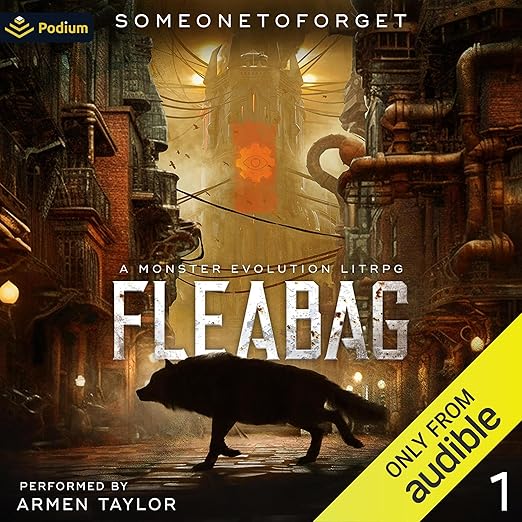
I started Fleabag late on a Friday night when I had already planned to go to sleep early. That plan dissolved somewhere in the Bone Pits. By the time the wolf had dragged itself to a deity encounter and come out the other side with something like a future, I'd abandoned any pretense of a reasonable bedtime. This is the kind of first entry in a series that does what it needs to do: it makes you want the second book badly enough to be annoyed that you have to wait for it.
SomeoneToForget - the pen name tells you something about the author's relationship to genre convention - sets the story in a toxic subterranean landscape called the Bone Pits, where mechanical nightmares share space with biological horrors. The protagonist is not a person. It is a wolf. An emaciated, wounded, probably dying wolf, crawling through the dark toward anything resembling sustenance. This is the entire opening gambit, and it works far better than it has any right to, largely because the author commits to the animal's perspective without flinching and without sentimentalizing it.
The Review
The LitRPG framework in Fleabag operates differently from most entries in the genre. Rather than a human character receiving a game-like status screen and navigating a familiar progression fantasy, the evolution system here is biological and genuinely strange. The wolf accumulates mutations, abilities, and eventually a form of intelligence that expands its consciousness in ways that feel earned rather than arbitrary. One reviewer noted that the wolf's dual nature - showing "both human and wolfish characteristics in equal measure" - is one of the book's real achievements, and I'd agree. The gradual acquisition of language, memory, and cunning is paced carefully enough that you believe it, even when the wolf's physiology is doing things that physics would object to.
The grimdark content warning in the reviews is legitimate. Reviewers flag graphic violence, and several mention struggling with particular descriptions before finding the narrative reward on the other side. This isn't gratuitous in the way pulp horror can be - it serves the world-building - but listeners with sensitivity to visceral content should go in prepared.
The Best Parts of Fleabag: A Monster Evolution LitRPG
The relationship between the wolf and Emhreeil, the injured elf it discovers in the tunnels, is where the emotional intelligence of the book becomes most apparent. Emhreeil begins as a resource - a vehicle for learning human speech - and slowly becomes something more complicated. She holds her own as a character despite entering the story broken and blind. Reviewers call her a "well written deuteragonist," noting that she neither tries to domesticate the wolf nor simply functions as a liability. The dynamic between a creature acquiring consciousness and a person stripped of her defenses is stranger and more interesting than the typical LitRPG companion setup.
Armen Taylor's narration deserves specific attention here. Voicing a non-human protagonist across a sixteen-hour audiobook requires considerable range and restraint - too much character in the wolf's early sections would feel false, too little would make the evolution passages flat. Taylor finds the right calibration, letting the intelligence accumulate in the performance the same way it does on the page. The dry humor that several reviewers mention lands in the audio format better than it might in print, arriving at moments when the wolf's emerging self-awareness produces an observation that is both animal and unexpectedly wry.
The Caveats
The LitRPG system is not always cleanly explained. One reviewer noted that the mechanics feel somewhat shoehorned in, and that the wolf's stats and the overall system remain murky throughout the first book. For readers who come to LitRPG specifically for the progression fantasy clarity - the clean leveling, the transparent ability trees - this may be a frustration. The book prioritizes survival experience over mechanical exposition, which will suit some listeners and irritate others.
Pacing is aggressive, particularly in the opening sections before the wolf's regression. If you don't connect with the animal's perspective early, the book will feel like a long road to get anywhere. Patience with the premise is essentially required, and the payoff compounds significantly in the latter half when the wolf's consciousness begins expanding in earnest.
Who Should Listen to Fleabag: A Monster Evolution LitRPG
Listeners who like LitRPG but are tired of human protagonists slotting into familiar fantasy worlds will find something genuinely different here. Fans of grimdark survival fiction, monster-perspective narratives, or unusual fantasy setups with strong world-building will also respond well. The content is heavy enough that anyone with a weak tolerance for graphic violence or body horror should approach with caution. Listeners who want clean progression mechanics and a relatable protagonist should look elsewhere - this book's strengths lie in its strangeness and its commitment to a non-human point of view.
- Narration: Armen Taylor handles an unusual challenge - voicing a non-human protagonist navigating consciousness - and delivers a performance that earns the material's ambition.
- Themes: Evolution and survival, predator psychology, human-animal connection under duress
- Mood: Grimdark and relentless, with flashes of unexpected dry humor
- Verdict: One of the more genuinely inventive LitRPG entries in recent memory, recommended for readers who don't mind getting visceral about survival.
Do you need to read prior books in the Fleabag series before this one?
No. This is the first book in the series and the story begins at the wolf's origin. There is no prior material required.
How graphic is the violence in Fleabag compared to other grimdark LitRPG titles?
Multiple reviewers flag it as notably graphic, particularly in the survival sequences. It's more visceral than typical LitRPG entries but not gratuitous - the violence serves the world and the wolf's experience. Content-sensitive listeners should be aware.
Does Armen Taylor's narration work for a non-human protagonist with limited speech for much of the book?
Yes. Taylor calibrates the performance carefully, letting the wolf's emerging intelligence surface gradually in his delivery rather than projecting human emotion onto the animal from the start. The dry humor moments land particularly well in audio.
Is the Royal Road original version of Fleabag significantly different from the Audible release?
The Audible release published by Podium Audio is a professional production of the Royal Road story, which had over a million views before the audiobook release. The core narrative is the same, though Podium productions typically involve editorial polish.