Quick Take
- Narration: Sarah Nichols gives Raina the right mix of vulnerability and steel, the Gothic atmosphere of Rothburne Abbey comes through clearly in her pacing and tone.
- Themes: False identity and true self, Gothic secrets, faith as anchor in deception
- Mood: Atmospheric and tense, with a Cinderella-meets-Jane Eyre undercurrent
- Verdict: Politano’s most complex work, the identity scheme is cleverly constructed and the twist is genuinely unexpected for a Christian historical romance.
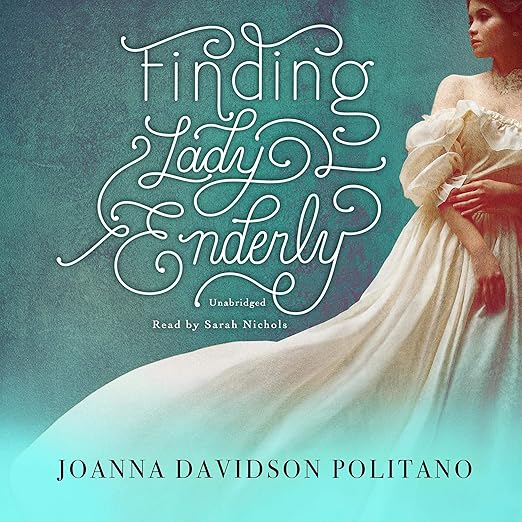
I picked up Finding Lady Enderly on the recommendation of someone who described it as “Cinderella with a Jane Eyre twist”, and that framing turned out to be surprisingly accurate. Joanna Davidson Politano has written several novels in the Victorian Christian romance space, but this one moves differently than most of what the genre produces. The Gothic atmosphere is real, the secrets are genuinely layered, and the central deception is more morally complex than the format usually allows.
Raina Bretton is a rag woman in London’s East End when she is offered the chance to leave her hardscrabble life for Rothburne Abbey, where she will impersonate a countess. The arrangement is shadowed from the beginning, one man’s convenience is always another’s scheme, and as Raina settles into satin and secrets, the abbey’s own dark history begins to press against her. The synopsis promises ruin, decay, and a threat that lurks within the mansion’s walls, and Politano delivers on all three without letting the Gothic elements overwhelm the human story at the center.
Our Take on Finding Lady Enderly
What distinguishes this from similar historical Christian romance is the structural complexity. Reviewer Stephanie McCall, who had been skeptical of Politano after a disappointing debut, found that this novel “restored her faith” in the author, specifically because of the plot complexity and the way schemes layer on top of one another. She also notes honestly that she found herself confused at times, which is a fair characterization. Politano is ambitious about her plotting here, and the reader is not always given a clear vantage point on which characters to trust. That uncertainty is intentional and it works, but it demands attention.
Reviewer Ruth D L’s summary gives a useful sense of the machinery at work: Raina, posing as a countess, discovers she is entangled in a villain’s scheme, while Sully, a man from her past presumed dead, reappears at the abbey and takes a position there to stay close to her. The blackmail element, the multiple layers of concealment, and the question of who knows what about whom give the novel a more intricate structure than the premise might suggest. The faith dimension of the story is embedded in Raina’s wrestling with her own identity, what she is performing versus who she actually is, rather than being a separate moral track running alongside the plot.
Why Listen to Finding Lady Enderly
Sarah Nichols’s narration is a significant asset. Victorian-set historical fiction lives or dies on its atmospheric rendering, and Nichols understands that Rothburne Abbey needs to feel as much like a character as any of the people moving through it. She gives Raina the right combination of wariness and determination, the rag woman who knows she is out of her depth but refuses to let that knowledge show. The Gothic passages benefit from her willingness to let silence do some of the work rather than filling every moment with dramatic coloring.
The runtime of just under ten hours is well proportioned. Politano does not pad. Each chapter earns its place, and the revelation sequence toward the end, the twist that Bookworm Extraordinaire called “quite startling” and impossible to predict, lands cleanly because the setup has been patient and specific rather than vague. The surprise is architectural: when it comes, you can see exactly how it was constructed and why you did not see it coming.
What to Watch For in Finding Lady Enderly
Readers coming for a straightforward faith-forward romance may find the Gothic complexity a slight mismatch with expectations. This is Christian historical fiction, but the spiritual content is more subterranean than explicit, it surfaces in character motivation rather than in scenes of prayer or overt theological reflection. Politano trusts the reader to track the moral dimension without having it underlined repeatedly, which is actually a more sophisticated approach, but listeners expecting the conventions of typical Christian romance may feel the book is playing a different game.
The scheme at the center of the plot is genuinely complicated, and there are moments, as McCall notes, where the threads are hard to hold simultaneously. Audio listeners specifically may want to pay close attention in the middle section where the blackmail dynamics are established; the relationships between the scheming parties are easier to track with the text in front of you.
Who Should Listen to Finding Lady Enderly
This is ideal for listeners who love Victorian-set mystery and Gothic atmosphere within a clean content framework, and who do not mind a plot that demands active tracking. If you enjoyed Winsome Blythe or Rachel McMillan’s mysteries, or if the idea of a morally complex Cinderella scheme in a decaying abbey sounds appealing, this delivers. Skip it if you need explicit faith content or prefer uncomplicated romantic arcs.
Frequently Asked Questions
Is Finding Lady Enderly part of a series, or does it stand alone?
It stands alone. While Joanna Davidson Politano has written other novels in the Victorian Christian fiction space, Finding Lady Enderly is a complete, self-contained story with its own resolution.
How explicit is the faith content in Finding Lady Enderly?
It is present but embedded rather than foregrounded. The faith dimension is expressed through Raina’s wrestling with identity and moral choice rather than through explicit scenes of prayer or theological dialogue. Listeners expecting devotional-style Christian fiction should adjust expectations.
Does Sarah Nichols handle both the Gothic atmosphere and the romantic tension in the narration?
She does, and the balance is well managed. Her Raina conveys wariness and controlled emotion rather than melodrama, which suits the material. The abbey’s atmospheric menace comes through in her pacing rather than in vocal theatrics.
Is the twist in Finding Lady Enderly something a careful reader can predict?
Several reviewers report not seeing it coming at all, Bookworm Extraordinaire described being unable to guess how the author would “work herself out of such a tight corner.” The setup is patient and specific enough that the surprise is architectural rather than arbitrary.