Quick Take
- Narration: Cathy Guisewite reading her own essays is the only right version of this audiobook. Her comic timing is intact, her warmth is genuine, and there is no gap between the voice on the page and the voice in your ears.
- Themes: Sandwich generation pressures, aging parents and adult children, post-career identity
- Mood: Warmly comedic and occasionally tearful, like brunch with a very funny and emotionally honest friend
- Verdict: Anyone navigating the simultaneous demands of aging parents and adult children will recognize themselves on nearly every track.
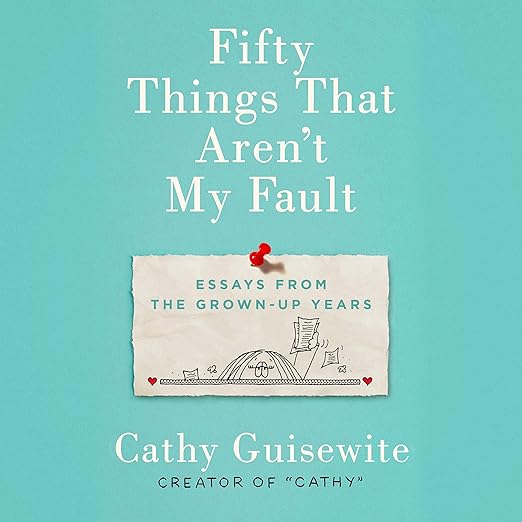
I had a hard week when I started this one. My mother had called three times about a form she couldn’t figure out, my inbox had that particular quality of relentlessness that makes you wonder what you were thinking when you built a career that required one, and I was somewhere in the middle of cooking dinner and feeling outrageously sorry for myself. I put on Fifty Things That Aren’t My Fault expecting light comfort listening, and I got something considerably more useful: the feeling that someone had been living my life and taken notes.
Cathy Guisewite, creator of the Cathy comic strip that ran for thirty-four years, spent four decades translating the specific anxieties of contemporary womanhood, food, love, work, mothers, swimsuits, into four-panel form. These essays are the prose version of that project, applied to the particular strange territory of midlife: when your parents are aging faster than you expected, your children have turned into opinionated adults who don’t need you in the ways they used to, and you are caught somewhere between them wondering where the time went and also what you are supposed to do with your hands now.
Our Take on Fifty Things That Aren’t My Fault
What Guisewite does extraordinarily well is the comedy of specific domestic catastrophe. The essay about trying to introduce her parents to TiVo, navigating the gap between what technology promises and what an eighty-something couple will actually engage with, is funny the way the best essays are funny: because the detail is so precise you assume she was watching you specifically. The essays about four decades of unorganized photographs, about helping parents downsize a lifetime into a smaller space, about what post-retirement purpose looks like when your work was your identity for four decades, these carry real weight under the jokes.
The audiobook format is not incidental here. Guisewite narrating her own essays is the way this was always meant to be experienced. Her comic timing carries over directly from performing Cathy’s anxiety in front of an audience for decades. One reviewer noted hoping she would write more prose because “it’s so good to hear her voice again,” and that double meaning, the literal voice and the creative perspective we missed, is exactly what this audiobook delivers. The warmth and the jokes are inseparable from the delivery, and no other narrator would have known where to breathe.
Why Listen to Fifty Things That Aren’t My Fault
The audience here is specific and Guisewite knows exactly who she is talking to: women who came of age with Cathy, who are now managing what she calls the panini generation, pressed from above by aging parents and from below by adult children who are simultaneously fully independent and still somehow requiring enormous amounts of parental energy. That said, you don’t need to have followed the comic strip to connect with the essays. The experiences they describe, the quiet grief of helping someone you love let go of a house, the absurdity of explaining streaming services to someone who finds the remote control genuinely threatening, are universally recognizable within roughly the right age bracket.
Several reviewers mentioned buying multiple copies to give to friends of the same age, which is about as direct a recommendation pattern as you can get. One described laughing out loud and tearing up within the same few paragraphs, which captures the emotional range Guisewite is working in. This is not comedy that keeps you at arm’s length from the difficult material. She holds both at once, which is harder to do than it looks.
What to Watch For in Fifty Things That Aren’t My Fault
The essays are not structured as argument or advice, they are portraits and confessions and comedic dispatches from the front lines of a specific life stage. Readers who come expecting the kind of organized insight of a self-help book will find Guisewite offers something messier and more honest: the sense that she doesn’t have it figured out either, just a particular talent for articulating the specific texture of not having it figured out. That is the book’s strength, but it is worth knowing what you’re signing up for.
The nearly ten-hour runtime is also worth noting. As essay collections go, this is a substantial commitment, and individual essays vary in weight and intensity. Some are primarily comic; others sit heavier. The overall arc is cumulative rather than building toward a specific resolution, which suits the subject matter but requires a different kind of listening patience than narrative-driven audiobooks.
Who Should Listen to Fifty Things That Aren’t My Fault
Listen if: You are somewhere in the middle of life with aging parents and adult children applying simultaneous pressure; you were a Cathy reader and have missed that voice; or you want an essay collection that takes the comedy of ordinary midlife frustration seriously without sentimentalizing it.
Consider skipping if: You are looking for structured life advice, you are significantly younger or older than the sandwich generation this addresses, or ten hours of personal essays in a single voice feels like more of a commitment than your current listening habits support.
Frequently Asked Questions
Do I need to have been a Cathy comic strip reader to enjoy this essay collection?
Not at all. Guisewite references her comic strip background throughout, and longtime Cathy readers will have an additional layer of familiarity and nostalgia. But the essays stand entirely on their own for listeners who never followed the strip. The experiences she writes about, aging parents, adult children, post-career identity, are grounded in universal recognizable territory, not comic strip lore.
Is Cathy Guisewite’s narration of her own essays polished in the way professional audiobook narrators are, or does it sound more informal?
She narrates with the naturalness and timing of someone who has spent decades reading her own work aloud, which gives it a warmth and authenticity a professional narrator couldn’t replicate. It is not slick studio performance, it is Guisewite’s actual voice doing exactly what it does, and reviewers consistently describe hearing her again as one of the audiobook’s genuine pleasures.
How does the audiobook handle the more emotionally heavy essays, does the humor ever feel like it’s deflecting from the harder material?
Several reviewers mention laughing out loud and tearing up within the same section, which suggests the comedy and the grief are genuinely integrated rather than one being used to avoid the other. The essays about helping aging parents downsize, in particular, carry real weight. Guisewite doesn’t use jokes as a shield so much as a framework for acknowledging difficult things without being crushed by them.
At nearly ten hours, is this better listened to in long sittings or in shorter, essay-by-essay segments?
The essay format actually makes it very flexible for shorter listening sessions, each piece is self-contained enough that you can pick up and put down without losing narrative thread. Reviewers describe picking it up for a page or two during busy days and still finding value in brief sessions. The longer arcs build through accumulation rather than through plot, so there is no wrong way to pace it.