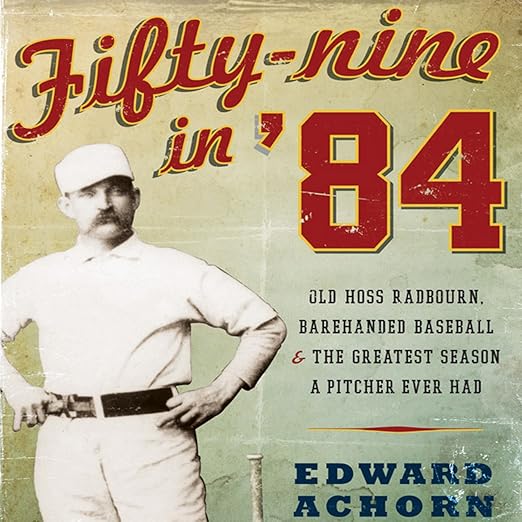
Quick Take
- Narration: Ax Norman reads with an easy authority that suits the storytelling, warm but not sentimental, giving equal weight to the baseball and the broader social history.
- Themes: Athletic obsession and endurance, Gilded Age masculinity, the forgotten origins of professional baseball
- Mood: Richly atmospheric and affectionate, with a genuine sense of discovery
- Verdict: A portrait of a forgotten era that works whether or not you follow baseball, though fans of the sport will find it especially rewarding.
I came to Fifty-Nine in ’84 knowing almost nothing about Charles Radbourn or the 1884 Providence Grays. I had a vague sense that nineteenth-century baseball bore little resemblance to the modern game, but Edward Achorn’s book made that abstraction concrete in ways I was not prepared for. This is a sport played barehanded, by men who thought nothing of cheating or injuring opponents to win, in an era when the profession itself was considered one step above disreputable. The distance between that world and the manicured broadcast spectacle of contemporary Major League Baseball is almost anthropological.
Achorn is a journalist, and it shows in the best possible way. He has done meticulous research, but he knows how to make archival material breathe. The book follows Radbourn through the 1884 season, when he won fifty-nine games, a record that has never been approached since, largely because the Grays were so depleted that he had no choice but to keep pitching. What might have been a straightforward sports biography becomes something richer: a portrait of an era, a city, a woman named Carrie Stanhope, and a man who drove himself past any reasonable limit of physical endurance simply because he refused to be stopped.
Our Take on Fifty-Nine in ’84
The subtitle’s promise, old Hoss Radbourn, the most durable pitcher in history, undersells the book. Achorn is not only interested in the feat itself; he is interested in what it reveals about who these men were and what the game meant to the culture that had just survived the Civil War. The detail about the sport being barehanded is not a footnote but a window into how brutally physical this work was, and how differently physical labor and pain were understood in that decade.
The inclusion of Carrie Stanhope as a genuine character rather than a background figure is one of the book’s most interesting choices. She was the proprietress of a boarding house with, as the synopsis notes, shady overtones, and her relationship with Radbourn is rendered with genuine ambiguity. Achorn does not sanitize her or reduce her to a romantic accessory. Several reviewers flagged that the book is not just a baseball story, and that is the accurate read, the baseball provides the spine, but the book’s real interest is texture.
Why Listen to Fifty-Nine in ’84
Ax Norman’s narration is well-calibrated to Achorn’s prose style. The book has a literary quality that requires a narrator who will honor the sentences rather than race through them, and Norman does exactly that. He brings warmth to the character sections and authority to the historical context without ever sounding like an announcer doing color commentary. At just under twelve hours, the audiobook has room for Achorn’s digressions, the portraits of other players, the glimpses of cities, the asides about how the rules of the game were being invented in real time, and Norman makes those expansions feel welcome rather than indulgent.
One reviewer who knew nothing about pre-1900 baseball said the book put them in the moment completely. That is the right description. Achorn is writing for the general reader as much as the baseball historian, and he earns the attention of both.
What to Watch For in Fifty-Nine in ’84
Listeners who want a straightforward sports statistics biography may find Achorn’s social and romantic detours slow going. He is genuinely interested in the world around the game, not just the game itself, and the sections on Carrie Stanhope in particular require patience from listeners who came primarily for Radbourn’s arm. The trade-off is that the book ends up being more durable and more interesting than a pure sports chronicle would have been.
It is also worth noting that the record count itself is contested, some sources put Radbourn’s win total at sixty rather than fifty-nine, a discrepancy Achorn acknowledges. This is not a flaw in the book but a feature of the era’s incomplete record-keeping, and Achorn handles the ambiguity honestly.
Who Should Listen to Fifty-Nine in ’84
This is an ideal listen for anyone drawn to American social history through individual biography, fans of Erik Larson’s approach to nonfiction will recognize the method. Baseball fans with an appetite for the game’s origins will find it absorbing. Listeners who want pure sports statistics or a modern player biography will likely find it too historically digressive for their purposes.
Frequently Asked Questions
Do I need to follow baseball to enjoy Fifty-Nine in ’84?
No. Several reviewers came to it with little baseball knowledge and found it absorbing as a work of social history. Achorn explains the rules and context as he goes, and the book’s real subject is an era as much as a sport.
Is Carrie Stanhope a major character or a minor subplot?
She is a significant presence throughout the book. Achorn gives her story genuine space and treats her as a character in her own right, not merely as a romantic footnote to Radbourn’s athletic career.
Why does the title say fifty-nine wins if some sources say sixty?
The exact count is disputed due to incomplete nineteenth-century record-keeping. Achorn discusses this ambiguity in the book and settles on fifty-nine as the most defensible figure based on the available evidence.
How does Ax Norman handle the nineteenth-century slang and period-specific language?
Very naturally. Norman does not perform the historical distance or put on vocal affectations, he reads the material as good journalism, which is what it is, and the period detail lands through Achorn’s prose rather than through any theatrical narration choices.